

Nature’s sirens: Flowers’ survival depends on shapely figure
Often when we gaze at a garden, the aspects we admire most are the colors and textures of the plants. But what about the shapes of the flowers themselves?
Shape plays an immensely important role in the design of any outdoor space. If you were planning a monochromatic garden, the clever use of a bevy of flower shapes would certainly enhance the overall outcome. Using only bell-shaped flowers in blue would get a little drab. Sowing a wide assortment of flower shapes will keep the eye moving over the entire garden; and repeating some of those shapes will lend the plot a sense of continuity.
So why are flowers shaped the way they are?
Quite simply, it’s survival of the fittest. Plants are vying for the attention of pollinators using their shapes, colors and scents.
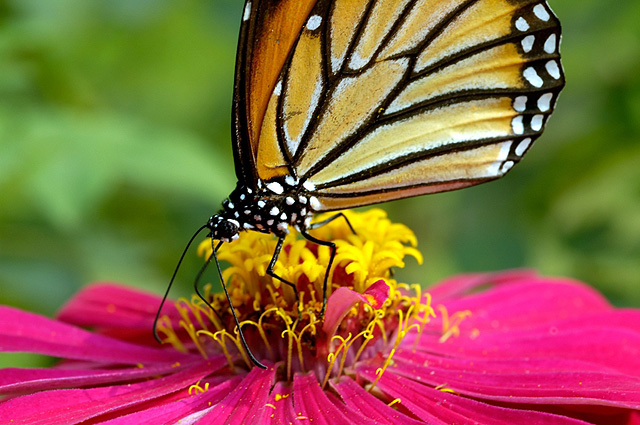
Plants vie for the attention of pollinators using the shape of their flowers. Butterflies are drawn to flat, open surfaces.
Oddly enough, in the beginning, flowers were not much to look at. According to an essay by David Ditcher, a professor at the Florida Museum of Natural History, the fossils of the oldest-known flowers, which were discovered by Chinese researchers, reveal that as of 145 million years ago, petals had not yet made an appearance. These might have been wind-pollinated flowers with no use for a showy look. Or perhaps they were just beginning to lure insects and were still in the process of developing special floral organs to advertise their wares.
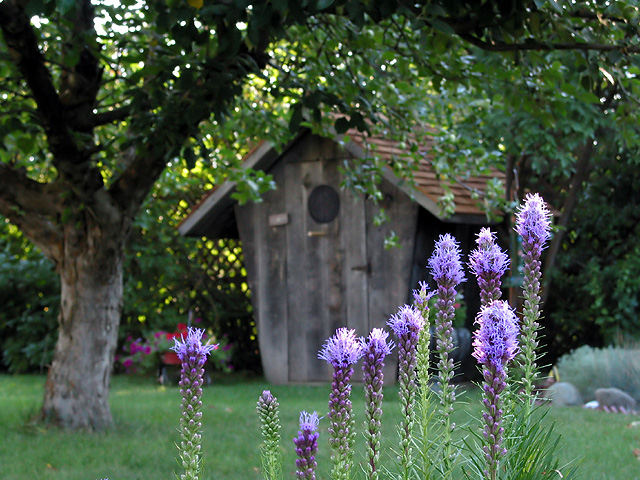
Tubular flowers cater to beaks and insects with long tongues.
A flower is attempting to lure transporters to its sexual organs through the temptation of free food. Ditcher’s essay says showy flowers evolved approximately 125 million years ago. The first petals were arranged spirally and looked similar to spokes on a wheel. Then, about 90 million years ago, bees and other pollinators appeared and the flowers began to evolve beyond the spiral look into new shapes in response to new insects and birds.
These bees, moths, butterflies, birds, ants and other creatures get filled up with sweet, sugar-filled nectar that is rich in protein and vitamins. By happenstance, they touch pollen and fly, crawl or wiggle to the next plant, hence pollinating it. Every physical characteristic of the flower – from its petal design to the time it blooms – is designed for the sake of reproduction.
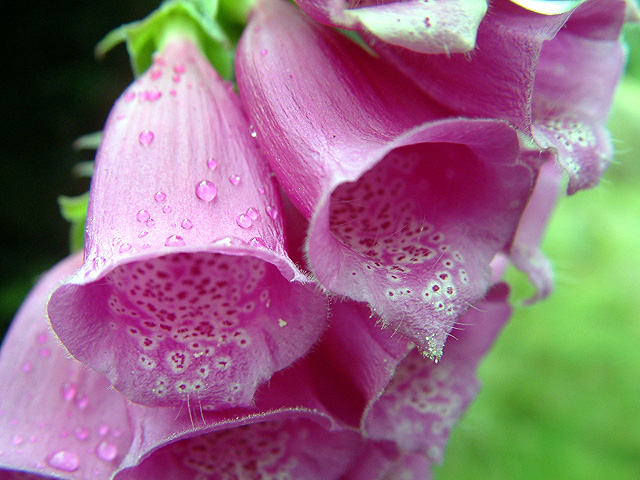
Foxglove has a pattern like airport runway lights, guiding insects to its nectar.
Lena Hileman, assistant professor of ecology and evolutionary biology at Kansas University, says the relationship between flowers and animal pollinators is ancient.
“For the most part, it is the relationship between flowers and pollinators that has driven the evolution of flower shape,” she says. “Often, flowers are highly adapted to a specific type of pollinator. For instance, flowers that are pollinated by hummingbirds tend to be red in color, have a long, tubular-shaped corolla and provide copious amounts of nectar.”
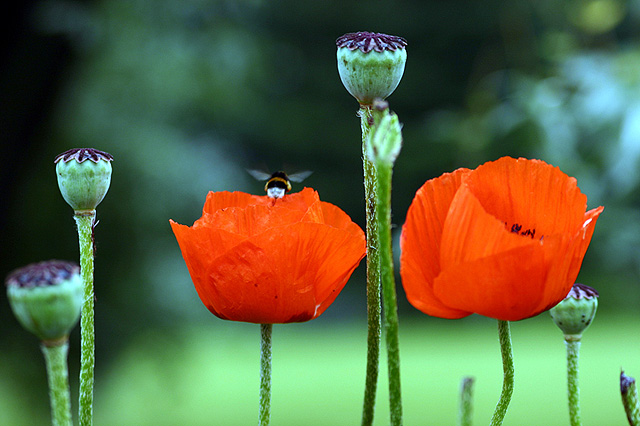
Open, bowl-shaped flowers are accessible to short-tongued pollinators.
Think about it. You’d have to be full of perfume and candy, too, if you were rooted in one spot and the only way to roam and transport your genes was basically through bribery.
The evolution of flowers is endlessly fascinating. Consider the hammer orchid, whose flower evolved to resemble a female wasp to attract its pollinator, the male wasp. Or the foxglove, which has a pattern like the lights on an airport runway, directing the pollinator to its nectar.
Butterflies are attracted to flat, open surfaces like those of zinnias. Certain bees prefer petals to serve as landing platforms, such as those of delphiniums. Open, bowl-shaped flowers like poppies can be seen easily and are accessible to short-tongued pollinators, while tubular flowers cater to beaks and insects with long tongues. Flowers that are bell-shaped provide shelter for bees that can feed while hanging upside down.
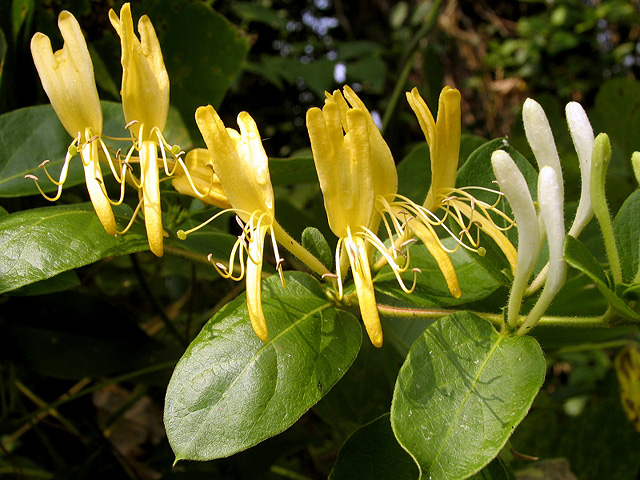
The honeysuckle's unusual shape serves as an excellent accent to a garden.
Hileman says scientists are beginning to understand the genes that are important for shaping flower diversity.
“In my lab, we are interested in understanding how changes in gene expression and gene function establish various flower forms,” she explains. “These are the underlying genetic changes on which selection, often through plant-pollinator interactions, may act.”
So next time you see a honeysuckle, think of it as a tubular-shaped, hummingbird-attracting lure attempting to propagate the sprawl of honeysuckle as far as the eye can see.
Beyond biology
These plant shapes may be scientifically constructed to attract pollinators, but using them in the right combinations also can perk up a garden plan:
¢ Daisies: provide a simple, natural look
¢ Flatheads: horizontal shape gives the eye – and an insect – a place to rest
¢ Clusters: provide weight in a garden design and many opportunities for a sweet snack for visiting pollinators
¢ Spikes: grab attention by adding height to the garden plan.
¢ Plumes: are playful with their fuzzy flowers and make a good transition between spikes and flatheads
¢ Globes: unusual shapes makes them stand out as a great focal point for any garden
¢ Trumpets and cups: trumpets grab attention, while cups add a casual look