

Campaign materials popular to collect
Presidential campaign materials and memorabilia are popular with collectors, especially in November – even when it’s an off-year for national elections. It is an easy hobby to start. Collect the pins, banners, posters and even the cups, scarves and jewelry that represent the candidates. Be sure the material was used in a campaign and is not just a special gift-shop item. The metal or plastic campaign buttons that picture both the presidential and vice presidential candidates are called “jugates.” These seem to gain value faster than buttons decorated with just slogans or the picture of just one candidate. Unusual pieces made for local campaign stops are produced in small numbers, so they also seem to hold their value. Many campaign items are free, and these, too, will have a value in years to come. Commemorative pieces that picture the president during his term or after his death are also of value.
Q: The light-blue glass flask I bought about 35 years ago has an embossed bust of George Washington on one side and Zachary Taylor on the other. There are embossed words in a semicircle above each bust: “The Father of His Country” above Washington, and “Gen. Taylor Never Surrenders” above Taylor. The flask is 6 inches tall and 3 3/4 inches wide. It holds just 8 ounces. The neck and lip are uneven, and there are lots of air bubbles and imperfections in the glass. Can you help?
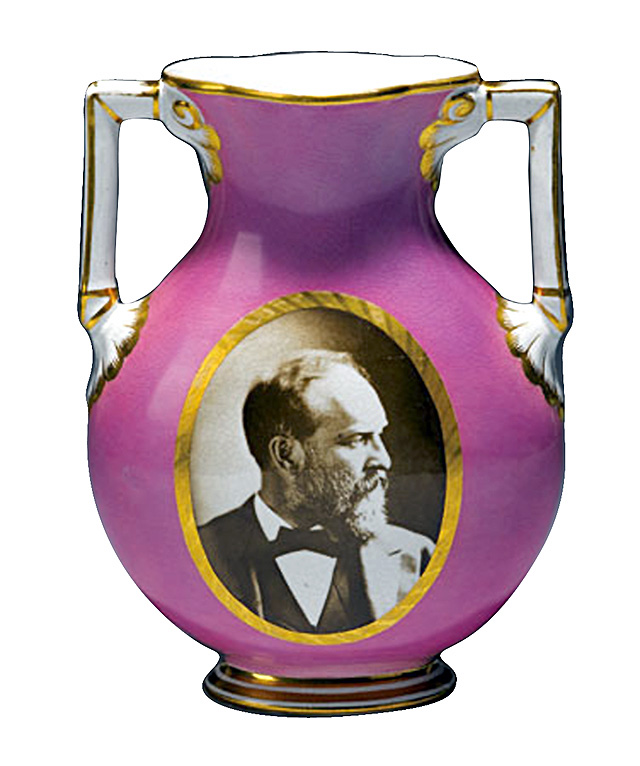
This vase was a memorial for President James A. Garfield after his assassination in 1881. The 9-inch-tall vase with a bright-pink luster glaze and sepia portrait is very rare. The condition plus the rarity led to a price of ,614 at a MastroNet online auction.
A: Your flask dates from the middle of the 19th century. (Taylor became a national hero during the Mexican War, 1846-’48, and was elected president in 1848.) Many flasks with the same or similar designs were manufactured at glassworks in both Philadelphia and New Jersey. Your flask is relatively common. It sells for about $75 to $95.
Q: My half-doll lamp hung on my grandparents’ headboard for as long as I can remember. My mother thinks they bought it about 1919. The doll’s glazed porcelain head has a molded pompadour hairstyle, dark painted eyes and red painted lips. Her arms extend out from her body, then bend at the elbows so her hands nearly meet in front. She is wearing a lacy, layered dress with a big hoop skirt attached to a wire frame that hides the light bulb. Two large hangers extend from the back of the skirt’s top so the lamp can be hung on a headboard. I can’t find any marks. She is 9 1/4 inches long and about 10 inches wide at the bottom of her skirt. I have seen many half-dolls at doll shows, but never a lamp like this one.
A: Your headboard lamp is a half-doll boudoir lamp. Boudoir lamps were popular in the 1910s and ’20s, when electricity was available in homes and frilly lamps dressed up bedroom bureaus and makeup tables. If you peek under the skirt at the doll’s waist, you will probably find marks showing that the doll part was made in Germany. Don’t use the lamp. Many lamps like yours have scorched skirts because the bulb is too close to the fabric.
Q: My mother and I would like to know the value of our matching Hawaiian shirts. Mine is an infant size, and my mother’s is a lady’s Medium. The rayon shirts were purchased the year I was born – 1954 – when my father was stationed in Hawaii. The shirts have a mandarin-style collar, short raglan sleeves and a tailored bodice. On the selvage of the shirt collars are the printed words “‘Original Matson Menu Design’ by Eugene Savage.” The allover design on the fabric shows scenes of Hawaiians dancing and playing music in natural settings.
A: Your shirts are considered treasures by collectors of vintage Hawaiian shirts (they’re also called “Aloha shirts”). The designs on your shirts are based on one of the six Hawaiian murals painted between 1938 and 1940 by American artist Eugene Savage. The murals – which depict Capt. Cook’s discovery of the Hawaiian Islands and a luau with the islands’ first ruler, King Kamehameha – were commissioned by the Matson cruise-ship line. The Matson Line used the designs on menu covers from the late 1940s until at least 1957. The Kamehameha Garment Co., founded in Honolulu in 1936, adapted one of the murals, “Island Feast,” for fabrics used for both men’s and women’s shirts. Your matching woman’s and infant’s shirts, if in excellent condition, could sell for $200 or more.
Current prices
Current prices are recorded from antiques shows, flea markets, sales and auctions throughout the United States. Prices vary in different locations.
l Libbey champagne glass, clear bowl and stem, cranberry egg-shaped knop, Nash, 1931, 5 1/2 inches, $200.
l Bronze mortar, dark patina, cast flower panels alternate with date, 1667, 7 x 5 1/2 inches, $350.
l Moser glass egg cup, Thumbprint pattern, translucent, red, blue, yellow and green leaves on brown and yellow vines, 4 1/2 inches, $375.
l Level with bubble, wood and brass, Stanley Rule & Level Co., 1820 patent, 24 inches, $440.
l Jiminy Cricket doll, wood, jointed, felt hat, blue top hat, Ideal Toy Co., 1940, 8 1/2 inches, $510.
l Robot toy, Moon Explorer, windup, crank-type friction motor, red body, plastic dome on head, Yoshiya, Japan, box, 1950s, 3 x 3 1/2 x 7 1/4 inches, $665.