

Older crowd attracted to auction block
Auctioneer says lookers, buyers at all kinds of sales usually over 50
Garden City ? All eyes were fixated on the fast-talking man in the sharp black cowboy hat as he pointed to a select few people in the crowd holding up white cards in an attempt to buy a set of vintage tools.
After acknowledging the winning bidder, the man in the hat once again started his smooth, fast chant all auctioneers must know like the backs of their hands.
Auctions, whether they are for estates, farm equipment or even livestock, are a way of life for many southwestern Kansans. Some go to auctions to try and find a good deal, some go to socialize and others are looking for one item in particular. For whatever reason, auctions often attract hundreds of eager potential buyers.
On a crisp Saturday morning, about 25 people gathered around and scrutinized the merchandise at an auction that included tools and collectibles. The auction crowd doesn’t differ much in appearance, no matter what the type of auction, said Larry Johnston, owner and auctioneer at Larry Johnston Auction.
The lookers and buyers usually are 50 and older, he said. At this particular auction, all were clad in denim and casual shirts and jackets. The auctioneer’s uniform is simple, with a crisp jacket, cowboy hat and soft leather work gloves.
Kent Scott, of Scott Auction, said that although the cowboy hat is not required, it is a tradition most Midwest auctioneers adhere to. He didn’t wear one when he started out 30 years ago, but the risk of getting sunburned from being outside all day at the auction prompted him to start wearing a hat, he said.
“It’s a symbol,” Scott said.
In order to become an auctioneer, Scott said, he attended an auction school in Billings, Mont. Though the course was only two weeks, as most auction schools are, he said, those two weeks were intensive.
“In school, you learn the basics like the chanting and how to advertise. You learn by doing tongue twisters, then you go home, stand behind the barn and practice. You have to be able to talk, chant and take bids without thinking,” Scott said.
He said the schooling generally costs between $2,500 and $3,000.
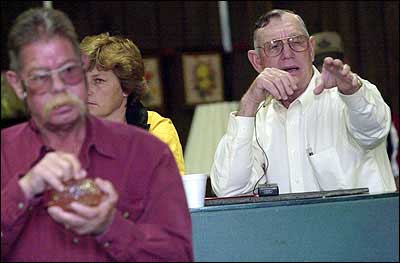
Larry Johnston, right, auctions off an item that Ronnie Plankenhorn, right is holding at an auction April 9, in Garden City. Auctions, whether they are for estates, farm equipment or even livestock, are a way of life for many southwestern Kansans age 50 and older.
Johnston said there isn’t a specific “auction season” and there are buyers year-round. He said some of the top-selling items include farm machinery and antiques and collectibles. He said auctioneers generally are paid a commission off of what is sold, and that depends entirely on what’s for sale and how the auction goes.
He said that although the traditional auction crowd is older than 50, he believes auctions aren’t going anywhere.
“Auctions will stay because it’s a good way to get rid of merchandise and everything is gone that day. It’s a good way to put a value on things and a good way to sell things. They usually don’t sell too cheap,” Johnston said.
He said farm machinery sales have increased because new equipment has gotten so high in price. The demand is high for good, used equipment, Johnston said.
Getting ready for the day of the auction is typically more difficult than the actual auction itself, Johnston said. In order to prepare for the auction, days in advance, they have to make sure all of the merchandise is cleaned and presentable.
Auctions also have become more high-tech, as Johnston prepares for auctions by taking pictures of the merchandise and putting them on his Web site.
“The Web site has helped quite a bit with sales because people can make absentee bids,” he said.