

Negotiators fail to reach deal on judicial filibusters
Washington ? More than a dozen senators trying to head off a showdown over judicial filibusters failed to work out a deal Wednesday to confirm some of President Bush’s controversial judicial appointments while rejecting others.
The Senate’s party leaders, Republican Bill Frist of Tennessee and Democrat Harry Reid of Nevada, opened formal debate on Texas jurist Priscilla Owen — the nominee that will test the Democrats’ ability to continue blocking judges with filibusters.
With a decision on whether to allow filibusters looming early next week, centrist lawmakers met in various offices around the Capitol complex, seeking a compromise that would avert a politically explosive confrontation.
Congressional aides said late Wednesday the negotiators failed to reach agreement but would resume their talks today.
One of the deals being worked on would have the Senate confirming Owen, California Judge Janice Rogers Brown and former Alabama Atty. Gen. William Pryor, with Idaho lawyer William Myers’ nomination scuttled. As part of that deal, two Michigan nominees, David McKeague and Richard Griffin, would be confirmed, while a third nominee — Henry Saad — would be jettisoned.
A fourth Michigan judge, Susan Neilson, also would be confirmed. She has not been filibustered by Democrats in the past. Senators are still negotiating that part of the deal and it is subject to change, aides said.
Under the latest GOP-crafted proposal, both sides would have to operate on “good faith.” Republicans would be bound not to ban judicial filibusters only if Democrats forswear judicial filibusters except for extraordinary situations, aides said.
The Republicans working on that deal are contradicting Frist, who has insisted that all of the White House’s nominees get confirmed. He picked up an additional senator on his side Wednesday, Sen. Gordon Smith, R-Ore.
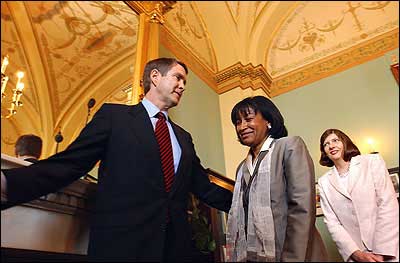
Senate Majority Leader Bill Frist, R-Tenn., ushers judicial nominees Janice Rogers Brown, center, and Priscilla Owen out of the room on Capitol Hill. Owen and Brown are central to the fight in the Senate over judicial filibusters.
Smith said he had decided over the weekend that he would vote to change Senate rules that let members block nominees by threatening to filibuster. “I think to do otherwise has a chilling effect not only on the meaning of elections, but as to the intellectual vigor of the judicial branch of the government,” Smith said.
But Reid said his party would fight to retain what power it still had in a Washington run by a Republican president and GOP houses of Congress.
“If Republicans roll back our rights in this chamber, there will be no check on their power,” said Reid. “The radical right wing will be free to pursue any agenda they want.”