

Nuclear fears focus of conference
United Nations ? In a world of growing nuclear fears and mistrust, U.S. negotiators come to New York today to urge a global nonproliferation conference to take action on Iran and North Korea.
But the Americans and other nuclear powers will face demands themselves. Non-nuclear states last week complained the big powers were moving too slowly toward nuclear disarmament, described as “not an option, but a legal obligation” under the Nuclear Nonproliferation Treaty.
Because of this clash of priorities, treaty members on Sunday still hadn’t completed an agenda for the monthlong conference opening today to review the NPT, whose workings are reassessed every five years.
Hundreds of protesters made their priorities clear on the eve of the opening, as they marched past the United Nations in blustery New York spring weather. “Abolish nuclear weapons now!” and “No more Hiroshimas” read banners carried by a large Japanese contingent in the anti-nuclear march.
“No nation, no group should test and make material for nuclear weapons. Everything should be banned,” said Mayor Tadatoshi Akiba of Hiroshima, the city obliterated by a U.S. atomic bomb in 1945.
After renewed talks with European negotiators made no reported progress, Iran said Saturday it would probably resume disputed operations this week related to uranium enrichment, a potential step toward an atom bomb.
North Korea, meanwhile, denounced President Bush on Saturday as a “hooligan” and said it didn’t expect a solution to the standoff over its nuclear program during his tenure. The escalating rhetoric was followed Sunday by a test-firing of a North Korean short-range missile into the Sea of Japan.
The North Koreans, who declared in 2003 they were withdrawing from the NPT, have since said they have built nuclear weapons.
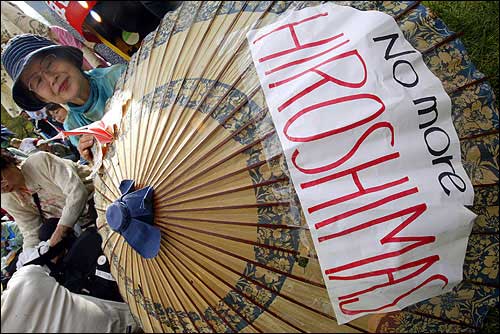
Chieko Neyo, of Osaka, whose brother died during the A-bomb attack on Hiroshima, joins the peace rally in New York's Central Park Sunday.
Under the 35-year-old NPT, North Korea and 183 other states were to have forsworn such arms in exchange for a pledge by five nuclear powers — the United States, Russia, Britain, France and China — to move toward nuclear disarmament. But, under treaty rules, Pyongyang was able to withdraw without penalty.
Conference organizers anticipate a low-key approach toward North Korea, to avoid complicating efforts to draw it back into six-party talks aimed at shutting down its nuclear program. But Bush administration officials say they will work to make treaty noncompliance the focus of the review sessions.