

Kyrgyzstan’s poor cautiously hopeful
Poverty fueled protests that toppled government
Dardoi, Kyrgyzstan ? Jumatai is 8 and looks much younger. He can’t walk. He can’t close his mouth, so he can only eat mashed food. The state should have treated his disability, his grandmother says, but instead it turned its back on ordinary people.
Across Kyrgyzstan, frustrations such as these fused into the street protests that climaxed last week with crowds storming the presidential office building and driving out Askar Akayev.
“The government made such a mess of things,” said Aiymkan Baitasheva, the grandmother. “I wish that just once Akayev would have driven past here. Right now I am feeling so much anger. What can I do?”
The family lives in Dardoi, an impoverished market town just a 15-minute drive from the president’s office. Their unheated home, with no gas or running water, is typical of conditions on the outskirts of Bishkek, the capital, where thousands migrated from the countryside hoping to cash in on post-Soviet capitalism but instead live in slums.
Before 1990, when Kyrgyzstan was still a communist republic, it offered free health care and housing, and even then it was one of the poorest Soviet regions, with 32 percent of its people living in poverty. Today the U.N. Development Program estimates that about 44 percent of Kyrgyzstan’s 5 million people live in poverty.
The poor blame Akayev, who came to power in the Soviet era, for corruption, the collapse of the communist social safety net and the rise of cutthroat capitalism. They have seen Bishkek fill up with cell phones, Mercedes-Benz showrooms and ads for Versace sunglasses, while Baitasheva’s 11-year-old granddaughter isn’t in school because the family can’t afford the $16 enrollment fee or the transport costs.
The grandmother said she tried to get the boy into a home for handicapped children near Bishkek but was told to take him south to her home town, Jalal-Abad, in the poorest part of the country. Months later, Jalal-Abad became a bastion of the protests that brought down Akayev. His replacement, Kurmanbek Bakiyev, is from Jalal-Abad.
Erkin Moldaliyev, who sells used clothes at the Dardoi market, was among the demonstrators who forced Akayev to flee to Russia. Echoing a complaint heard widely across the country, he said Akayev was corrupt.
“He and his family took everything. They kept everything and left nothing for the people,” he said.
He was cautiously hopeful.
“We hope the new government will be different and that everything will be transparent,” he said. “But we don’t know for sure because some of the same people are there and we hope that we have not exchanged one set of bad people for another set of bad people.”
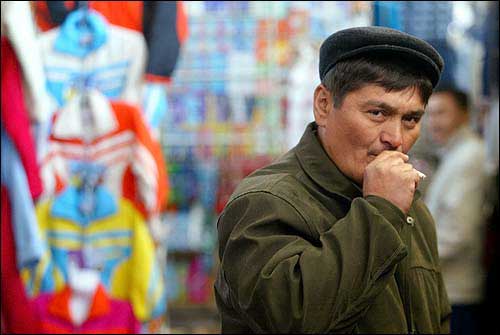
Erkin Moldaliev smokes while he stands next to his trading place at a market in Dardoi, on the outskirts of the Kyrgyz capital of Bishkek. Moldaliyev last Thursday was outside the presidential headquarters for what was to have been a peaceful protest. Demonstrators instead stormed the presidential office building, ousting President Askar Akayev.