

Doctors try to avoid ‘doorknob’ questions
Patients urged not to wait until last minute to air concerns
Chicago ? The four familiar words physicians always dread come when the office visit is ending, doctor’s pen clipped back onto the white coat pocket and hand reaching for the door.
“Oh, by the way,” the patient says.
What comes next could be as innocuous as a harmless freckle — or a bombshell.
“You’re walking out the door and they say ‘Oh, I’ve got this chest pain I meant to tell you about,’ so you have to go back into the room and start over again,” said Dr. John Bonavia, a family doctor at Columbia St. Mary’s-River Glen clinic in Milwaukee.
Doctors call it “the doorknob phenomenon.”
Doctors’ rushed schedules and patients’ natural reluctance to reveal frightening or embarrassing symptoms make those questions at the doorknob almost inevitable, but medical schools increasingly are teaching students how to avoid such situations.
Dr. Rita Charon, who runs the narrative medicine program at Columbia University’s medical school, said the phenomenon might even be one reason that doctors’ visits often don’t start on time — the previous patient may have had a doorknob question requiring another exam.
Part of Charon’s program encourages doctors-in-training to listen and better “read” patients and their greatest concerns.
“You really have no idea of what part of life is going to come up and you really need to signal some desire to hear about it,” Charon said.
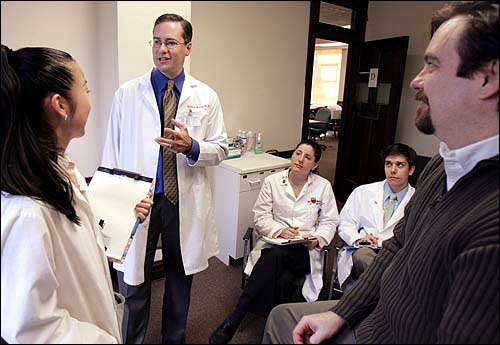
Dr. William Harper talks with Lisa Kang, left, a medical student at the University of Chicago, as fellow students, seated from left, Sarah Cross and Jeremy Nicolarsen, wait their turn to interview mock patient Don Cross, right, at the medical school's clinical performance center. As U.S. medicine edges toward a more patient-centered approach, medical schools increasingly are teaching doctors-in-training to listen and better readpatients and their greatest concerns.
Charon teaches a method she has adopted with her own new patients, whom she tells: “‘I’m going to be your doctor and I need to know a lot about your health and your body and your life’ — and then I stop talking.”
She doesn’t write anything down, or check the computer — she just listens.
“When I did this the first time, the patient started crying, saying ‘No one ever let me do this before,”‘ Charon said.
Nancy Conley, a 48-year-old secretary in Springfield, Mo., says embarrassment led to her own doorknob questions about chronic constipation, along with a belief that nothing could be done for the condition, caused by irritable bowel syndrome.
She sometimes talked herself out of mentioning it at all, trying to downplay it in her mind during the visit “even though I’d go home to my own little hell,” she said.
Conley’s advice to doctors for avoiding such resistance is to “slow down.” A rushed atmosphere can make patients feel uncomfortable about mentioning bothersome issues.
“Often it happens because doctors, including myself, don’t do a good job of getting a sense at the beginning of the medical encounter what the needs are of the patient,” said Dr. William Harper, an internist who teaches communication skills to University of Chicago medical students.
Harper tells students that one remedy is simply asking patients: “Anything else?”
“Just asking that simple question, whether it be at the beginning or end of the encounter, can be enough to prevent the doorknob phenomenon,” he said.
Health
Program that helped people with disabilities scrapped again
Margaret Tomlinson has been recovering from a traumatic brain injury for three years. Nearly a year ago, she moved ...

Excitement builds as LMH Health draws closer to completing Therapy Services renovations
More children’s hospitals turn to furry caregivers to help kids heal
Sometimes ‘baby blues’ is actually something darker
Moments after Jenna Carberg gave birth to her daughter, doctors put the baby on her chest. “I felt a disconnect ...

Moving to music offers all kinds of benefits as you age
Conflicting mamogram advice leads to confusion
WASHINGTON — Deciding when to get routine mammograms is confusing. Some health groups recommend women begin at ...