

Details emerge from shooting
Teen had record of antisocial behavior, investigators say
Red Lake, Minn. ? The 16-year-old shooter in Monday’s bloody rampage at a high school on a northern Minnesota Indian reservation had earlier that day killed his grandfather and stolen his police cruiser, which he drove to the front door of the school before racing inside to begin a spasm of gunfire, authorities said Tuesday.
Jeff Weise, whose record of antisocial behavior had led to his removal from school and placement in a home tutoring program, was wearing his grandfather’s police-issued bulletproof vest and toting three firearms as he strode past a metal detector at Red Lake High School. Yelling taunts at some of his victims, in rapid succession he shot and killed an unarmed security guard who confronted him at the school’s entrance and then did the same to a teacher and five students, according to federal investigators and family members of survivors.
“Jeff is going to kill me; Jeff is going to shoot me,” yelled English teacher Neva Winnecop Rogers before she was struck down, a survivor recounted.
Weise had followed Rogers and the students into a classroom after they fled the bullets ricocheting down a crowded hallway. Though they locked the door, Weise “shot out the window, reached in, and unlocked it,” said Karla Lajeunesse, whose daughter Ashley, 15, was huddled inside the class but lived to describe the ordeal.
After spraying bullets randomly, Weise left to stalk the hallways again, continuing to shoot as he walked. Soon, as police arrived and began firing back at him, the young man returned to the classroom and shot himself, said Michael Tabman, an FBI agent running the investigation.
The episode at the school on the Red Lake Indian Reservation lasted less than 10 minutes, according to a chronology Tabman gave reporters. Weise was accused of killing nine people, including a female companion of his grandfather’s, before his suicide. Five other people remained hospitalized Tuesday, two with critical injuries.
While the sequence and logistics of the killings were becoming more clear, the motivation behind them remained opaque. Most clues came from Weise himself, who had left a trail of rambling Internet postings on a neo-Nazi Web site, in which he described his alienation from school and his surroundings and professed admiration for Adolph Hitler.
As described by law enforcement authorities and reservation residents, the random killings — all at close range — were at once unthinkable and hauntingly familiar. Like many previous school shooting incidents, this incident featured a sullen adolescent male struggling to cope. Many, but not all, such incidents have been in similarly remote settings, where troubled youth often feel they have little escape, said Princeton University sociologist Katherine Newman, whose book “Rampage” is about school shootings.
The Red Lake reservation, where snow and ice covered the landscape of tall pines just sixty miles from the Canadian border, does not fit the classic Minnesota reputation of mild-mannered folk enjoying tranquil and prosperous lives. As described by residents and authorities alike, the social dysfunction of Red Lake bears more resemblance to the movie “Fargo,” set in a bleak and violent Northland, than Garrison Keillor’s Lake Wobegon.
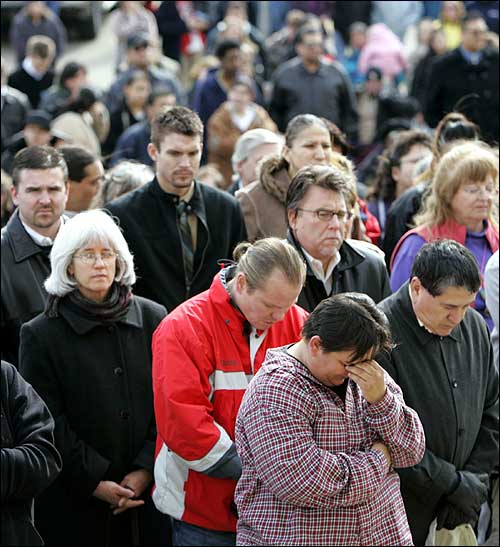
A crowd gathers on the front steps of the State Capitol in St. Paul, Minn., to take part in a traditional American Indian prayer service. The crowd Tuesday mourned those killed and injured in the shooting Monday at Red Lake (Minn.) High School.
The poverty rate on the reservation, which is nearly the size of Rhode Island, is 40 percent. The Drug Enforcement Agency has found high levels of illegal use of cocaine, methamphetamine, and OxyContin, and it has placed an agent at the nearby Bemidji airport to combat drug importation to Red Lake and other reservations, according to spokesman Christopher Hoyt.
It was amid this dreary setting that, sometime before 3 p.m. local time Monday, Weise arrived at his grandfather’s home carrying a .22-caliber handgun. He shot his grandfather, Daryl Lussier, 58, a sergeant on the tribe’s local police force, and also Lussier’s companion, Michelle Sigana, 32.
Weise, who police said did not live at the residence, donned Lussier’s bulletproof police vest and a gun belt loaded with ammunition. The teen also stole two of his grandfather’s police-issued weapons, a 12-gauge shotgun and .40-caliber handgun, and his cruiser.
Once at Red Lake High School, the first person he encountered was the security guard, Derrick Brun, 28, who fell to the floor bleeding from his fatal wounds. Weise walked past the school office and the “cultural room,” down the hallway where he spotted Rogers and other students.
With bullets flying, they took flight into Missy Dodd’s math class, which proved to be no refuge. As Weise barged in, Ashley Lajeunesse was sharpening her pencil, her mother recalled. Classmate Chase Lussier, 15, yelled for Ashley to dive under the desk, then laid in front of her. “Chase got shot and Ashley laid down on him and pretended she was dead,” Karla Lajeunesse said in an interview.
Some of Weise’s movements in the school are captured on videotape, Tabman said, but not any of the shootings. After he left the classroom, he was soon confronted by four police officers and fired upon them. No officer was hurt, but one returned fire. Tabman said he did not know if Weise was hit. In any event, he was soon back in the classroom, where he put the gun in his mouth and pointed upward, Tabman said.
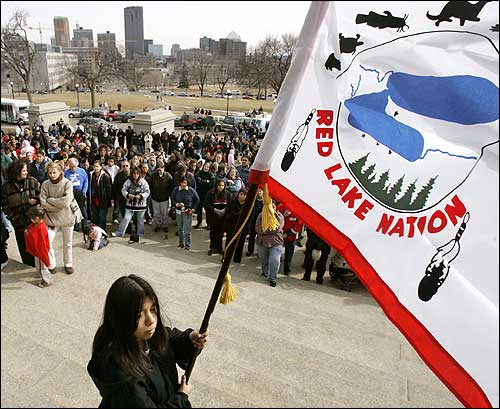
A flag-bearer gathers with several hundred people for a traditional American Indian prayer service on the steps of the State Capitol in St. Paul, Minn. Tuesday's prayer service was in response to the shootings at Red Lake High School on Monday. Jeff Weise killed seven people at the school, including five students, before killing himself.
Inside the classroom, someone announced Weise had shot himself, and the few who remained alive left. “Chase was still alive and told her to get out,” Karla Lajeunesse said, describing the event as her daughter related it to her. The boy later died.
In the immediate vicinity, arrayed in something close to a semicircle, were the bodies of several victims, including Lussier and Alicia Spike, 14, who had been in the Lajeunesse home for a taco lunch a few hours before.
Even after Weise was dead, there remained moments of terror. As Ashley left the classroom, she spotted a man — who actually was a police officer — dressed like Weise in bulletproof vest and feared it was another assassin, her mother said. The girl spun around and ran in the opposite direction, circling the school gymnasium and racing past the dead guard as she escaped out the same door Weise had entered just minutes earlier.
Red Lake school officials have closed all of the campuses for the rest of the week. Grief counselors from the Red Cross and other agencies are providing help to traumatized residents in local community centers, officials said.
Linda Smith was at the Trading Post, a local grocery store, as the shooting unfolded. After seeing several police cars and ambulances rush past the store, Smith said she drove toward the school and saw groups of children running for their lives. That’s when Smith started panicking, she said, as she thought of her daughter and stepdaughter, who are students at the high school, and her other daughter, who attends the middle school.
Smith said her cousin, also a student at the high school, ran to her and said there was shooting inside. Frantic, she ran toward the building, but the police stopped her.
“All I care about are my kids,” she said. “I didn’t worry about myself. I just couldn’t get to my kids.”
Smith said she saw several children trying to pull the security guard to safety, but he was beyond saving. “The kids tried to get the guard up, but he was already gone,” she said. “They were covered in blood.”
In a mid-day news conference, Red Lake Chippewa tribal chairman Floyd Jourdain said the mood on the reservation was one of “utter disbelief and shock.”
“We have never seen anything like this in the history of our tribe,” Jourdain said. “And without doubt this is (among) the darkest days in the history of our people.”
— Special correspondent Kari Petrie in Red Lake contributed to this report.