

CT scans convince Egyptian researchers that King Tutankhamen wasn’t murdered
Refuting some modern conspiracy theories, the death of Egypt’s most well-known ruler, Tutankhamen, was not due to foul play, Egyptian researchers said Tuesday after examining Tut’s mummy with a sophisticated CT scanner for the first time.
The team still does not know precisely how the 19-year-old boy-king died around 1323 B.C. But the most likely explanation is a natural cause, such as a flu infection, or a bacterial infection associated with a broken leg, said Zahi Hawass, Secretary General of the Supreme Council of Antiquities, who organized the project.
The findings come as a blow to a number of Egyptologists, who have suggested elaborate conspiracies against the king.
“There has been so much wild speculation about the cause of death, most of it based on very poor observations,” said Emily Teeter of the Oriental Institute Museum at the University of Chicago. “I’m delighted to find out that those of us who have been very conservative about this have to some extent been vindicated.”
Much of the speculation has been based on previous X-rays of Tut’s skull which showed broken fragments at the back, possibly indicating a skull fracture. Based on that purported fracture, researchers such as Bob Brier of Long Island University have woven theories about murder and intrigue.
In his book, “The Murder of Tutankhamen,” Brier speculated that the foul deed was ordered by Aye, the commoner who ruled Egypt as regent while Tutankhamen grew up.
But the new CT scans clearly show that the skull fracture occurred well after Tut’s death — possibly during the embalming process, but more likely some 3,200 years later when explorer Howard Carter discovered Tut’s tomb and dismantled the body to remove almost 150 jewels, amulets and other artifacts.
Some archeologists had found support for the murder theory in the widely accepted belief that Tut’s embalming had been hurried and careless.
But the team found extensive evidence, including the presence of five different embalming materials, that great time and care had been taken in the mummification of the king.
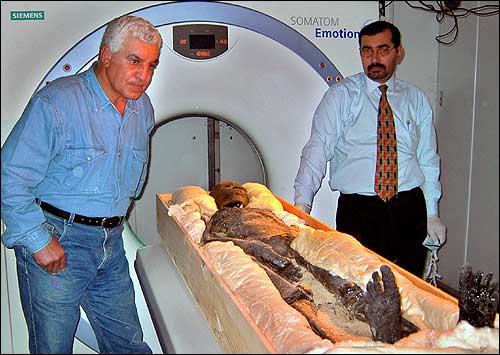
Zahi Hawass, the head of the Egyptian Supreme Council for Antiquities, left, stands alongside the 3,300-year-old mummy of King Tutankhamen in this Jan. 5 file photo. Hawass said Tuesday that the results of the CT scan on King Tut's mummy indicate he was not murdered. The man at right is unidentified.
“Conspiracies are not beyond the realm of possibility, but at least in this case, if there was a murder, it didn’t happen because of a blow to the skull,” said archeologist David Silverman of the University of Pennsylvania Museum.
Brier saluted the findings, saying: “I’m glad they have the data now.” His idea, he noted, was “really only a theory. Nobody should be too invested in their theory.”
The scans unexpectedly revealed a fracture in the left femur (thighbone) of the king’s leg. The break is ragged and has two layers of embalming materials present within the fracture zone. That differs from the sharp bone breaks known to have been produced by Carter’s team in its effort to pry the body out of its inner coffin.
The team is divided on the fracture’s significance. Some members think the break occurred a few days before Tut’s death, which may have resulted from an infection in the wound. Other’s think the break occurred after death and that Carter’s team inadvertently forced the embalming material into the opening.
Silverman noted that an unusually large number of walking sticks were in the tomb, which might support the idea that Tutankhamen fractured his leg. “But the truth of the matter is, the early Egyptians like walking sticks and used them a lot,” he said. “They are a mark of the upper class.”
The scans determined that Tutankhamen was about 5-foot-6 with a slight build. The condition of the bones indicated he was between the ages of 18 and 20 when he died. There were no signs of malnutrition or infectious diseases during childhood, and he appeared to have been well fed and well cared for.
Although the king’s teeth were in relatively good shape, he had a small cleft in his hard palette, the bony roof of the mouth, although it probably did not affect his appearance. His lower teeth were slightly misaligned and he had large front incisors and an overbite — both characteristic of kings from his line.
He also had an impacted wisdom tooth, but it showed no evidence of an infection that could have been fatal.
The team also believes they have found Tut’s penis, which has been missing since Carter’s examination. They think it is in the sand bed in which the mummy has been lying, along with a thumb, other digits and pieces of vertebrae.
Hawass said Tuesday that the mummy has been placed back into its tomb and is unlikely to be disturbed again.
“I believe these results will close the case of Tutankhamen, and the king will not need to be examined again,” he said. “We should now leave him at rest.”