

Better equipment, surveillance needed at Iraq-Syria border
Tanaf, Syria ? On a bleak hill overlooking Iraq, Syrian officials on Monday pointed out enlarged sand berms and other security measures they say they have taken to hinder foreign fighters from crossing the border.
But Western diplomats maintain Syria could do more, saying the guards need better intelligence and better night-vision equipment to keep insurgents from slipping across after dark to join extremist groups like Abu Musab al-Zarqawi’s al-Qaida in Iraq.
Syrian President Bashar Assad is under intense pressure from Washington and Baghdad, which have charged in the past that the Syrians let militants cross the frontier. His government denies that, arguing it is impossible to seal the 360-mile border.
Syrian authorities gave journalists a rare tour of part of the frontier Monday to highlight improvements in security as U.S. Marines and Iraqi troops on the other side waged the latest offensive against insurgents believed to have entered from Syria.
A giant picture of Assad looks out over the desert at Tanaf, a main border crossing where several hundred trucks waited to cross into Iraq.
On a nearby hill, a border officer pointed to the sand barrier that runs along much of the border, saying the government had increased the height of such berms to 12 feet as a measure against infiltrators and smugglers.
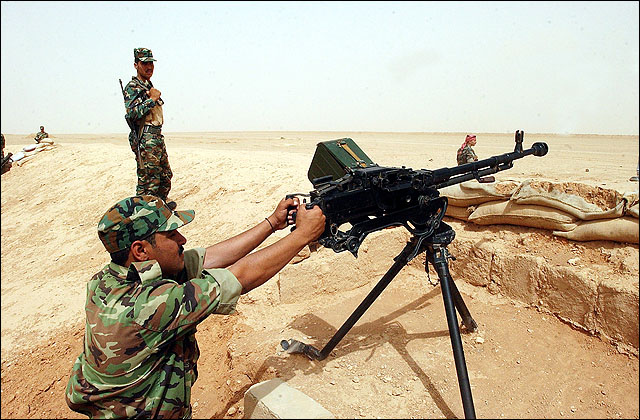
A Syrian soldier hangs onto a machinegun Monday along the border with Iraq as other soldiers look on.
The officer, who would not give his name because of the sensitivity of the border issue, said the Syrian government has deployed 7,000 soldiers along the border.
Journalists who were driven for 120 miles along the berm north from Tanaf saw small outposts spaced along the way, each manned by about a half-dozen guards who snapped to attention and saluted as the trucks drove by.
The officer said there are about 540 posts on the frontier. They are spaced about 430 yards apart in some areas and 1 3/4 miles apart in others, depending on the nature of the terrain and how sensitive the area is, he said.
The government also has filled up wadis – gullies gouged by rainstorms – with cement blocks and barbed wire to block infiltrators as well as smugglers, the officer said. During the day, border guards go out on patrols and at night they set up ambushes for infiltrators, he said.
A British military attache who went on the tour said the region shown to journalists is not the most vulnerable to insurgent crossings.
More fighters infiltrate farther to the northwest, at the frontier town of Abu Kamal, across from the Iraqi town of Qaim, said Col. Julian Lyne-Pirkis, who has surveyed the entire length of the border.
Lyne-Pirkis said the Syrians began bolstering security along the border nine months ago, but it still remains “very difficult” to control, especially at night.
“They are making progress, but they can still do more on the border to improve it,” he said.
He called security measures “fairly basic,” relying on Syrian troops who have “mostly just their eyes to survey the border, and that is not enough.”
The Syrians have asked Britain to donate expensive night-vision equipment, and British officials have promised 700 pieces, Lyne-Perkis said. But he said the deal awaited approval at a higher government level. There are restrictions on the types of military equipment Western nations provide to Syria.
Lyne-Perkis said the Syrians also need to improve their patrolling and get better intelligence to understand how the insurgents operate.