

Reform at stake in Iran vote
Tehran, Iran ? Iranians voted Friday in a presidential election that could determine the pace of reform and the prospects for rebuilding relations with the United States, issues at the center of the most competitive campaign since Iran’s 1979 Islamic revolution.
Though results and turnout figures weren’t expected until today, the race is likely to go to a runoff – the first since the revolution – because no candidate appeared poised to win a majority of votes.
Millions turned out to choose from seven candidates, including hard-line Muslim fundamentalists reluctant to seek ties with the United States and reformists who call for warmer relations.
Which side prevails could shape Iran’s path in the years ahead, including key decisions over the development of nuclear technology, which the U.S. and European nations suspect is for military use.
“The issues people care about are unemployment, welfare and housing. Those are the reasons why people know voting is important,” said 45-year-old oil-company clerk Mortazar Najafi. Like many, he said he voted for Ali Akbar Hashmi Rafsanjani, a 70-year-old cleric and two-term former president who has led the pack in opinion polls, with a blend of a reformist’s calls for change with a conservative’s religious credentials.
Across the street from the mosque where Najafi voted in southern Tehran’s Amivieh neighborhood, 34-year-old restaurant cashier Abazar Hodari said voting is a useless exercise that would lend credibility to a regime he believes has failed him.
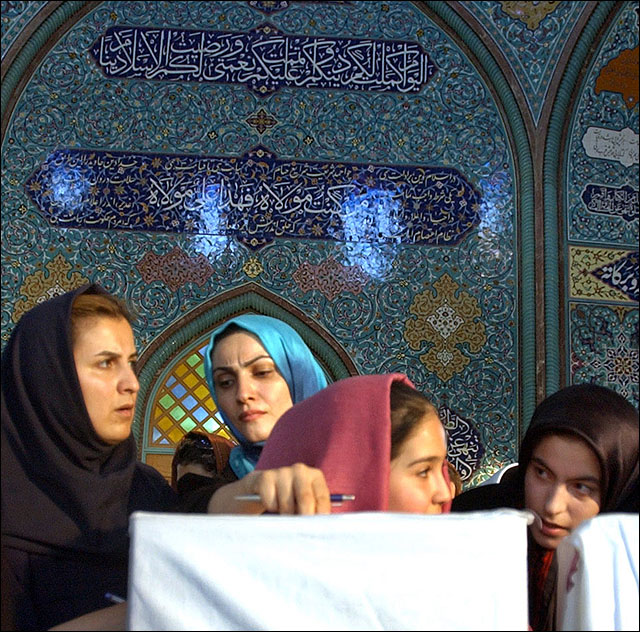
Iranian women stand in line to cast their vote at the Hoseynieh Ershad polling station in Tehran, Friday. The election could be the closest presidential race since the 1979 Islamic Revolution.
“This government can’t do anything for us. As a young person, I have no money, I have to work here from 8 a.m. to 2 a.m. This is not a life,” he said
Rafsanjani’s strongest challenger is 54-year-old reformist Mustafa Moin, who has positioned himself as the heir to Mohammad Khatami, the outgoing term-limited president who has served since 1997. Another contender is conservative former police chief Muhammad Baqaer Qalibaf, who employed a vast billboard and poster campaign to repackage himself as a youth-oriented jetsetter.
The Bush administration has called the election illegitimate because senior clerics barred many reform candidates and all women from running. Iranian exiles in Los Angeles and elsewhere in the United States are using satellite television and the Internet to urge would-be voters to boycott. Some Iran observers had predicted a turnout as low as 40 percent, but anecdotal evidence Friday suggested that was unlikely.