

N. Korea, Iran warned over nuclear efforts
Vienna, Austria ? The United States continued its drumbeat of criticism of Tehran’s efforts to enhance nuclear capability Thursday, saying it would not tolerate an Iran with nuclear bombs.
Separately, Washington warned North Korea that the United States would look at “other options” unless Pyongyang returned to six-party talks that had been attempting to find a peaceful resolution of the communist regime’s nuclear activities.
In a statement at the quarterly meeting of the International Atomic Energy Agency’s governing board, U.S. Ambassador Jackie Sanders warned that Iran could face military action unless it complied with demands to cease its quest for nuclear capability.
“The choice is now up to Iran to take the necessary steps to secure an acceptable, peaceful solution. : We will not accept a nuclear-weapons-capable Iran,” her statement said.
Sanders accused Tehran of deceiving the IAEA about its nuclear ambitions.
While Iran insists that its nuclear plants are solely for peaceful purposes, inconsistencies in its answers to questions from the nuclear agency and reluctance to address some queries have left serious doubts.
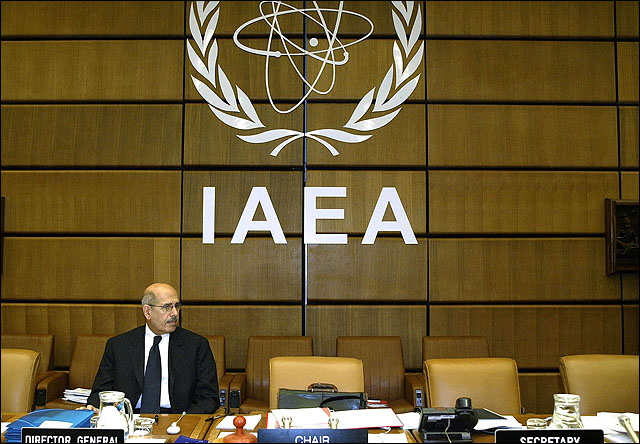
International Atomic Energy Agency Director General Mohamed ElBaradei waits for the start of a meeting of the IAEA's 35-nation board of governors on Thursday at Vienna's International Center.
Over the past two years, the IAEA investigation of Iran’s attempts to build facilities related to the nuclear fuel cycle, including the conversion and enrichment of uranium, has raised disturbing questions about the country’s intentions.
In a statement to the board Thursday, IAEA Deputy Director General Pierre Goldschmidt said Iran had recently revised its statements about when it had last processed plutonium, a substance that, like uranium, can be used to make nuclear bombs.
IAEA tests of samples of Iran’s plutonium showed it had been experimented with more recently, and Tehran now says it worked with plutonium for an additional five years, until 1998.
In Iran’s response to Goldschmidt’s presentation, its IAEA representative, Mohammed Mehdi Akhondzadeh, said the country has worked hard to meet the demands of agency officials.
Despite the United States’ tough talk aimed at Iran and North Korea, its options are limited if it wants international support. Washington could ask the U.N. Security Council to take action, but council authorization of military action would be highly unlikely, and limited economic sanctions could backfire, possibly garnering even more support for the current governments’ nuclear policies.