

Unrest prevents Bolivia’s Congress from addressing leader’s resignation
La Paz, Bolivia ? Riot police launched round after round of tear gas Tuesday to repel thousands of dynamite-wielding marchers in downtown La Paz. The chaotic scene prevented Congress from meeting to consider President Carlos Mesa’s resignation, offered the night before.
Senate President Hormando Vaca Diez said that Congress would attempt to meet again this afternoon. But if the situation remains unstable, Vaca Diez said, Congress could leave La Paz to meet in the old capital of Sucre.
Adding to the climate of uncertainty, La Paz is beginning to suffer food and gasoline shortages, and protesters have shut off water to some neighborhoods over the past two days.
The growing unrest led the U.S. State Department on Tuesday to issue a travel warning for the country and to begin an “authorized departure” of non-essential U.S. Embassy staff here.
Farmers who earn less than $5 a day have dominated the crowds of marchers in recent days.
On Tuesday, it was miners who predominated, tossing their tools of trade, dynamite, at constant intervals while marching down the highway from El Alto and on the hilly cobblestone streets of colonial La Paz. They were making a vain attempt to reach the Plaza Murillo, which houses both the presidential palace and Congress.
Police reported at least 10 arrests Tuesday, with a dozen injured.
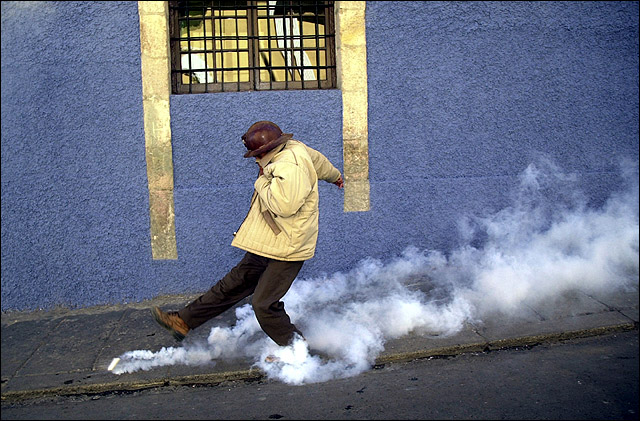
A miner kicks a can of tear gas shot by riot police during clashes Tuesday in La Paz, Bolivia. Riot police fired tear gas and clashed with protesters, who demanded more power for Bolivia's impoverished Indian majority. An offer by President Carlos Mesa to resign failed to halt a crippling blockade in the Bolivian capital.
The marchers have two demands. They want the government to nationalize the huge natural gas reserves held by foreign companies, although they have yet to explain how Bolivia could compensate the companies.
The marchers also want the Congress to call a special assembly to rewrite the country’s constitution, with Indians having an extra set of delegates to ensure that the new constitution is written to their demands.
Exactly who would replace Mesa remains up in the air.
Vaca Diez stands next in line. But he has participated in church-led talks over the past three days where the president of the Supreme Court, Eduardo Rodriguez, would replace Mesa and serve as interim president until early elections could be held in August or December. This plan would require Congress’ approval.
It remains unclear whether the next president – whoever he is – could pacify the marchers who have descended on La Paz with increasing strength over the past two weeks with anti-free trade and anti-foreign investment demands and in the process put civil authority on the verge of collapse.
“It’s hard to see the solution,” said Carlos Toranzo, a political analyst. “We are very near having a situation with violence and deaths.”