

Swiss vote to scrap passport checks at border in vote of confidence for EU
Geneva ? Independent-minded Swiss voters gave the shaken European Union a vote of confidence Sunday, approving participation in an EU passport-free zone even though Switzerland has never joined the 25-nation bloc.
Same-sex couples also were granted more rights in the two-issue referendum, marking the first time the issue has been put to a national vote in Europe.
Signaling Swiss desire for closer integration with the EU, about 55 percent of voters, or 1.47 million people, supported joining Europe’s passport-free “Schengen” zone by 2007.
Swiss President Samuel Schmid hailed the result as backing for the coalition government’s policy of developing closer links with the rest of Europe, but he said the government would not ignore the majority that voted against Schengen membership.
“The government sees the people’s ‘yes’ to Schengen as a confirmation of a bilateral approach to Europe,” Schmid told reporters in Switzerland’s capital, Bern.
The result goes against the prevailing mood in the EU, reeling from recent rejections by French and Dutch voters of a proposed constitution for the bloc.
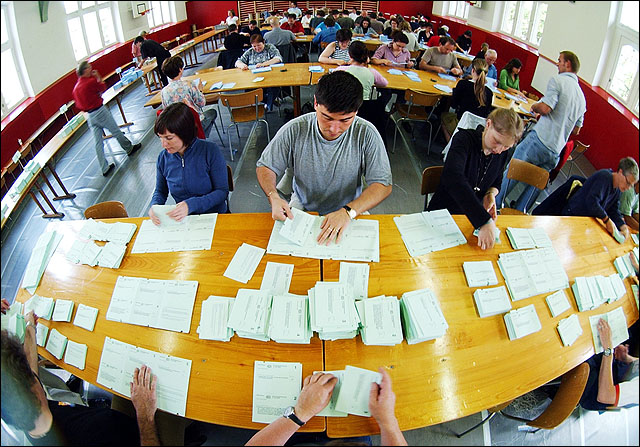
Polling officials count the ballots of the nationwide poll on more rights to same-sex couples and passport checks on the country's borders in a school in Buehl, near Zurich, Switzerland. Initial projections in Switzerland's two-issue referendum Sunday indicated that 55 percent of voters were in favor of joining the European Union's passport-free area, known as the Schengen zone, by 2007, while 58 percent voted in favor of granting more rights to same-sex couples.
In Brussels, Belgium, EU Foreign Affairs Commissioner Benita Ferrero-Waldner and Justice Commissioner Franco Frattini welcomed the vote on behalf the European Commission.
“The ratification of these association agreements is an important step in the relations between Switzerland and the European Union,” Ferrero-Waldner and Frattini said in a joint statement. “On the one hand, freedom of movement will obviously be facilitated; on the other hand, the cooperation on internal security can be strengthened.”
The vote is “an important positive signal for Europe at a time when Euro-skepticism – hopefully only temporarily – is gaining the upper hand,” German Interior Minister Otto Schily said.
The Schengen zone allows travel through all participating countries without border checks. The 15 current members are Austria, Belgium, Denmark, Finland, France, Germany, Greece, Iceland, Italy, Luxembourg, Netherlands, Norway, Portugal, Spain and Sweden.
Under Switzerland’s system of direct democracy, the people’s consent is required on any major issue, including closer integration with the rest of Europe.
Before Sunday’s vote, experts predicted that French and Dutch rejection of the EU constitution during the past week would encourage Schengen opponents, and opinion polls showed a rapid narrowing of the majority in favor of joining the zone.
The government has been in favor of joining the EU and its passport-free area, but many of Switzerland’s German speakers – who make up about two-thirds of the population – had opposed greater integration with the rest of the continent.
Participating nations
The 15 current members of the European “Schengen” passport-free zone, which Switzerland voted to join in a referendum Sunday: Austria, Belgium, Denmark, Finland, France, Germany, Greece, Iceland, Italy, Luxembourg, Netherlands, Norway, Portugal, Spain and Sweden.
When Switzerland joins Schengen in 2007, customs controls will remain in place since the country remains outside the EU.
In the referendum’s other issue, a larger majority – 1.56 million people or 58 percent – were in favor of granting more rights to same-sex couples.
The vote means that starting in 2007, registered same-sex couples will be receive the same tax and pension status as married couples, but they will not be allowed to adopt children or undergo fertility treatment.
It is the first national vote in Europe on such an issue, although other countries, such as Germany, have passed laws allowing registration of same-sex couples.
The two topics sparked a larger turnout than usual in Switzerland’s referendums, which are held three or four times a year. Some 55.9 percent of the 4.82 million eligible voters participated.