

Women inmates gain confidence with help from prison mission
Last August, Kristy Wilson apprehensively stepped out of prison for the first time in nine years.
She was soon able to shake off her nerves by playing the lighthearted character Ima N. Mate in a skit written, costumed and performed by inmates.
“That was in Pomona – the women there were kind of standoff-ish at first,” she said.
She was there with six other inmates from the Topeka Women’s Correctional Facility to perform an informative skit for one of their many audiences in the area.
“Was that the place with the teapots?” asked Jolene Garrison, an inmate of three years, trying to remember.
It was.
“That was my first ‘outside’ experience,” Wilson said. “Driving in a vehicle, checking out new cars – it’s the little things.”
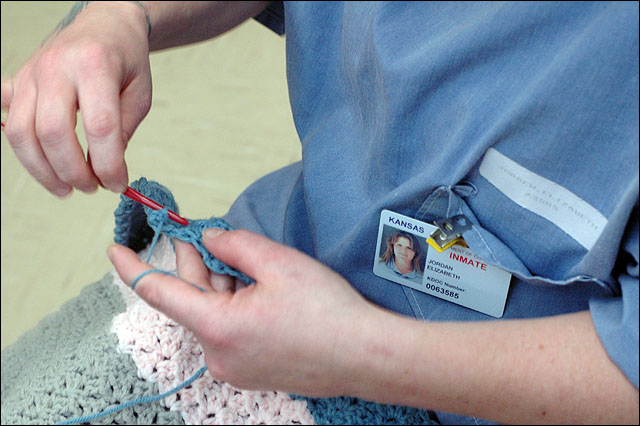
Topeka Women's Correctional Facility inmate Elizabeth Jordan works on a crochet project during a crafts session as part of the United Methodist Women of Kansas rehabilitation program at the facility.
After the performance – a mock debate arguing for restorative justice over retributive justice – everyone eased up.
“I wear the Ima costume, with breasts this big,” Wilson said, motioning a foot out from her chest. “I’m more confident in costumes. There’s a reason to be silly, and be myself.”
Wilson and Garrison are regular actresses in the group’s skits, arranged by United Methodist Women of Kansas. The organization is responsible for some of the prison’s largest programs.
“Being in UMW has brought me out of my shell,” Garrison said. “I never would have dreamt of doing all this.”
United women
Wilson, Garrison and about 50 other women at the prison are members of Women Helping Women Inside, a mission-oriented group of inmates started by United Methodist Women of Topeka. Its goal is to help others through missions, by making crafts, earning money to donate and performing educational skits.

UMW is a worldwide organization, but its involvement with the Topeka prison is unique: There are just two other programs similar to it in the country, though it has been successful since 1987.
Casey Woodward is coordinator of Inmate Family Reintegration Services, which houses the Women’s Activity Learning Center, a unit of the prison started by UMW and built with grant funding that helps women become better mothers. It includes a children’s visiting area, where mothers can interact with their families inside the prison.
“Out of 659 inmates, roughly 80 percent are affected by these programs and also by UMW and their amazing volunteer support to the families of incarcerated and women incarcerated,” Woodward said. “Their support is astonishing.”
Woodward is the staff organizer for the UMW volunteer mentors, and she has her hand in just about everything the Women Helping Women inmates do.
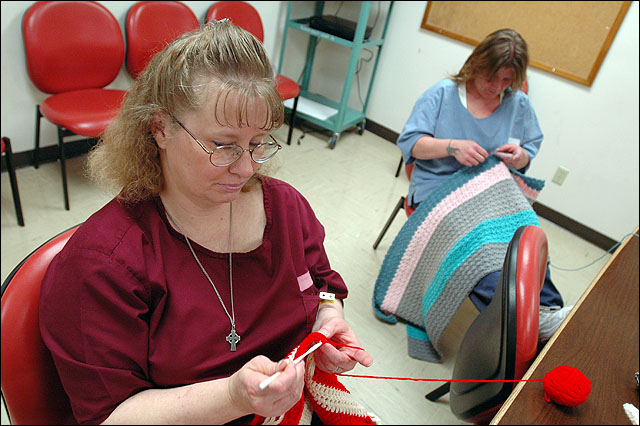
Jolene Garrison, left, and Elizabeth Jordan crochet projects at the Topeka Women's Correctional Facility. The two inmates are members of the United Methodist Women of Kansas. The group has crafts nights and parenting classes and offers inmates the ability to earn yearly parenting retreats with their children.
“We are able to assist the inmate families to be closer and better equipped for their release to succeed and be a thriving family,” she said.
UMW’s six current volunteer mentors, all from Topeka, work with inmate members of Women Helping Women. The volunteers attend meetings at the prison, including board meetings, craft nights and parenting classes. Through the parenting classes, inmates can earn their way to yearly parenting retreats, where they spend three days with their children at Camp Chippewa in Ottawa.
Craft nights are the members’ most frequent activities. Friday nights they work on projects chosen by Women Helping Women board members, who are all inmates. Last month the inmates stuffed 250 hand-sewn casings of teddy bears for American soldiers to hand out to children in Iraq. They regularly make “church purses” for little girls, which they sell. With their profits, they recently bought a cow for Youthville, a purchase they were especially proud of. They also earned $2,000 in a walk-a-thon to buy shoes for children in need.
Barb Scott helped found the Topeka unit in the prison 18 years ago and has been involved ever since.
“When we went in, we had no idea the effect it would have on the women – or the effect on us,” she said. “Most of the world doesn’t want to go into the prison, but there are a lot of remarkable women in there, no matter what they’ve done.”
Scott said the UMW group doesn’t go to the prison to evangelize; it goes to serve practical needs and offer unconditional love.
“They need much more than evangelizing,” she said. “If you don’t offer something else, it’s pretty hard to hang on to that.”
An afternoon in the life
Garrison comfortably sat around a table several months ago in a homey room of the prison’s Women’s Activity and Learning Center, surrounded by five friends and piles of craft supplies.
She and Wilson crocheted, as did Elizabeth Jordan, an inmate for more than two years. Billie Gibson, who’s been behind bars for three years, traced lines of around pictures of food items available in Mexico to be cut out for nutrition kits to teach Mexican children about health. Gayle Culberth, a UMW volunteer, just talked and laughed along.
“These ladies amaze me – they’ve tried to teach me to crochet,” Culberth said, laughing.
Culberth said that not everyone she talks to understands her involvement at the prison.
“The funniest question I’ve gotten is, ‘Are you safe in there?'” she said. “I tell them I’m more safe in here than out there.”
The women talked about the misconceptions that most people have about prisons.
“Most of us are mothers, and we’re in here because we messed up,” Jordan said. “Most of us are trying to go home, and that’s it.” Her attitude on being incarcerated has changed with time. “I’m no longer ashamed,” she said. “I consider myself blessed – I make an effort to change myself, and become a better mother, daughter, sister.”
Garrison said the skits gave the women a chance to educate the outside world and advocate for other women in prison.
“Before I came to prison I had misconceptions about prisons and inmates,” she said. “We’re people just like everyone else – we’ve just made mistakes.”
Lasting impressions
For Jordan, the UMW’s parenting classes have made the most impact.
“A lot of mothers hold a lot of shame and resentment for what they’ve done, and a lot of what they hold inside keeps them from being a good parent,” she said. “The parenting class teaches how to get that out.”
Jordan has three children, and although she is serving a shorter sentence than the other inmates around the table, her wait to get out won’t be short enough.
“I’ve missed entirely too much of their lives. I’m a better mother now than when I came in,” she said.
The parenting classes, held three times a year, are video courses administered by incarcerated volunteers who have gone through the class twice. Jordan said the message of the class is effective beyond its purpose.
“It goes beyond parenting. It teaches you how to be a better person, to keep from coming back here,” she said.
The four inmates said that being incarcerated and involved with UMW had significantly improved their attitudes.
“It’s changed my perspective in all aspects,” said Garrison, who has four years left on her sentence. “I definitely will volunteer with this group and others as soon as I’m able.”
The four inmates said they were drawn to UMW through other inmates’ good experiences with it.
“You can tell when someone is doing well and has found peace,” Wilson said. “You want that.”
Barb Scott would agree. She said a UMW group from Virginia had recently visited the Topeka prison in hopes of starting a similar UMW unit of their own.
“It can be a really good snowbally thing, changing the way people think about prisons,” she said. “There are some women who are really trying to turn their lives around.”