

London attacks show terror’s global reach
London ? When the bomb he tried to detonate aboard a London Tube train failed to explode, police say Osman Hussain jumped out a carriage window, ran along the track, then hopped through back yards before melting into the city’s bustle.
After going underground for five days, Hussain boarded a train at Waterloo station – possibly walking past his picture and those of three other suspected July 21 attackers on posters that blanketed the city. Then he slipped away, traveling from London through France to Rome.
His ability to escape a massive British dragnet, coupled with the arrest of another suspect in Zambia with al-Qaida ties, raised fears about the global reach of today’s terrorists and the depth of their networks.
“The way people fanned out after the bombings, it’s brought it home to people … that it is part of a kind of a network, interconnected – all the fingerprints are there,” said Michael Cox, a professor at London’s Royal Institute of International Affairs specializing in the post-Sept. 11 terrorism threat.
“They’d have to have a much wider support base than just those who are active suicide bombers.”
Hussain, an Ethiopian-born Briton, was captured Friday at his brother Remzi Isaac’s house in Rome, where police traced him through his use of a relative’s cell phone. Italian newspapers said investigators suspected Hussain’s real name was Hamdi Isaac.
He admitted to a role in the attack but said it was only intended to be an attention-grabbing strike, not a deadly one, a legal expert familiar with the investigation told The Associated Press in Rome.
Hussain told interrogators he wasn’t carrying enough explosives even to “harm people nearby,” the expert said, speaking on condition of anonymity, citing the ongoing investigation, which under Italian law must remain secret.
He also told investigators the bombers were motivated by anger over the U.S.-led war in Iraq, but said his cell was not linked to either al-Qaida or the cell that carried out the deadly July 7 suicide bombings, Italian media reported.
The arrest sparked more than a dozen follow-up raids across the country, as Italian authorities tried to determine if any attacks on Italy were being plotted.
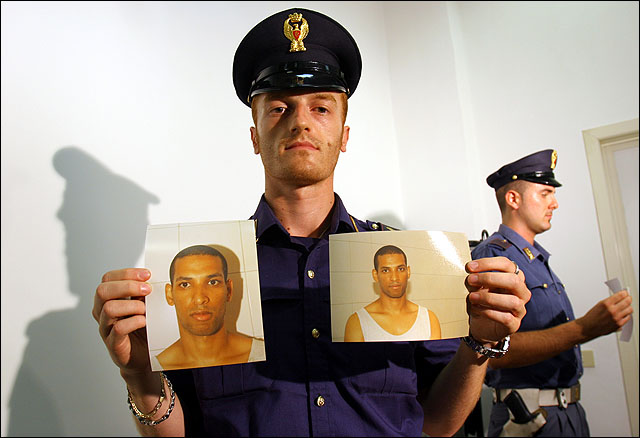
Italian police officers hold up photos of a man identified as Somali-born Osman Hussain, a naturalized British citizen arrested in the July 21 bombing attempts in London. Hussain was able to flee Britain and make his way to his brother's house in Rome before authorities caught up with him.
In addition to Hussain, at least two of the other July 21 suspects were of East African origin, and Italian Interior Minister Giuseppe Pisanu said the country was watching the area closely.
“We are following the evolution of the overall situation in the Horn of Africa where, in stateless lands, al-Qaida has arrived, has settled, and from where it tends, in various ways, to dispatch its followers into Europe and the rest of the world,” Pisanu said.
If it turns out both events had a single mastermind and a common bombmaker, experience shows they probably would have fled Britain before the attacks, said Alex Standish, editor of Jane’s Intelligence Digest. A likely hiding place would be in western Europe, where they could flee without having to undergo tough border security checks.
“They’ll go to ground in areas that they will not be conspicuous,” Standish said. “Most European Union countries have a significant Muslim population where these guys can just sit there and fade into the background.”
If the attacks of July 7 and July 21 are linked, they show a worrying degree of preparation by a person or people making use of homegrown radicals from two distinct ethnic groups – with three of the four July 7 bombers of Pakistani origin, and at least three of the July 21 suspects with East African roots, Standish said.
That ensured that when police focus was on the Pakistani community after the July 7 attacks, the East African group could still move freely.
“It seems a very sophisticated level of planning went into it,” Standish said. “What will the next one be – from Kashmir? From Nigeria? From Southeast Asia? From Saudi? – We just don’t know.”