

Senate approves historic designation
A Lawrence-led coalition of Northeast Kansas counties is one big step closer to receiving federal dollars to help preserve and market its pre-Civil War history.
The U.S. Senate late Tuesday approved legislation that would create the Bleeding Kansas and the Enduring Struggle for Freedom National Heritage Area.
The designation, if approved by the House and signed by President Bush, would pump $10 million over the next 15 years to projects such as markers, signs, brochures and museums dedicated to Kansas history, which many scholars say helped spark the Civil War.
“I’m so excited,” said Deanell Tacha, chief judge of the 10th U.S. Circuit Court of Appeals. “This is very important progress.”
The bill includes 26 Kansas counties in the historic designation.
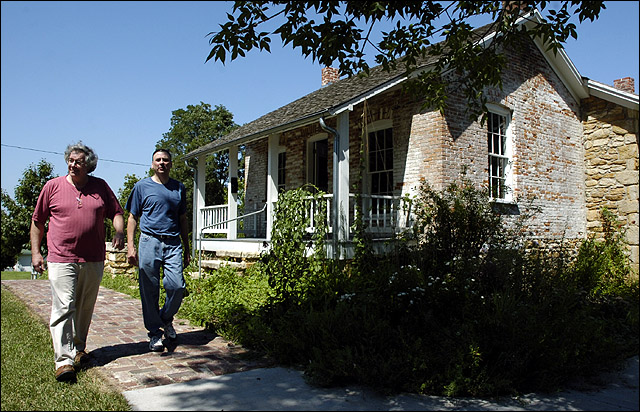
The Murphy-Bromelsick house in Hobbs Park, 10th and Delaware streets, is one of many Bleeding Kansas-era sites in the county. Mark Kaplan, who has directed conservation efforts of the Hobbs Park Memorial, left, and Dave Evans, a volunteer researcher, right, were pictured outside the house recently. The U.S. Senate on Tuesday approved legislation that includes 26 Kansas counties in a National Heritage Area designation.
And in a twist of historical irony, the bill also includes the option of adding 12 counties in Missouri – Kansas’ old “Border War” foe during the Civil War era – if the counties want the designation and a commission created by the legislation agrees. That provision helped draw the support of a key Missouri lawmaker to get the bill passed.
The Bleeding Kansas area was one of nine heritage areas across the country included in the bill. There already are 27 in existence.
Joint effort
A group of Lawrence residents has worked for three years to get the designation approved. This is the second year in a row the legislation for the heritage area has been introduced in both the House and the Senate. Last year’s bills did not reach a vote.
“This project has joined communities throughout eastern Kansas in an effort to document, preserve and celebrate Kansas’ significant role in the political struggle that led to the Civil War and in other historic struggles for equality that took place in our state,” said Sen. Pat Roberts, who worked on the project along with Sen. Sam Brownback, a fellow Republican from Kansas.
Judy Billings, director of the Lawrence Convention and Visitors Bureau, said the attention now would turn to passage in the House.
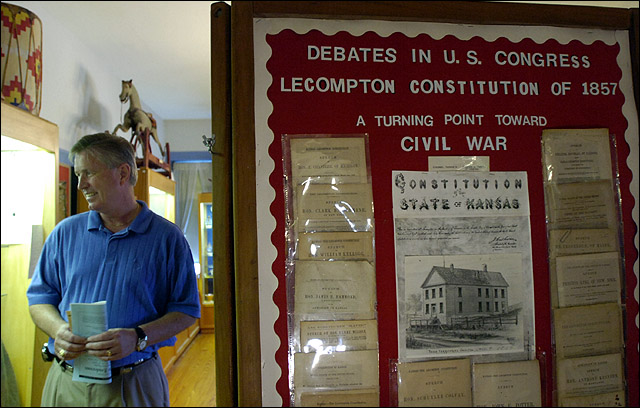
The Bleeding Kansas Heritage Area bill passed the Senate on Tuesday, putting Lawrence and northeast Kansas a step closer to becoming a Civil War tourist destination. Wednesday at the Territorial Capital Museum in Lecompton, Dennis Wollnik, of Kansas City, Mo., toured the exhibits.
“This is a huge step in the right direction,” she said. “After working on this for three years, that really feels good.”
The National Park Service has urged lawmakers to defer legislation on heritage areas until Congress establishes a uniform system of guidelines for deciding what areas are nationally significant.
Nick Reid, a spokesman for heritage area supporter Rep. Jim Ryun, R-Lawrence, said he didn’t expect any action in the House on the historical designation before the end of the week, when Congress is scheduled to adjourn.
Action is more likely to occur when Congress reconvenes in September, though Reid said he didn’t know if the House would work on its own version of the bill or simply debate the Senate version.
“We’re just going to keep pushing,” Reid said.
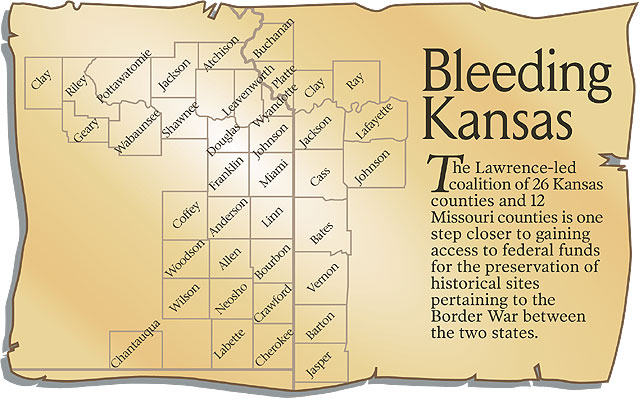
Missouri help
One difference between the House and Senate bills is that the Senate bill was amended to include the Missouri counties at the request of Sen. Jim Talent, R-Mo. Talent’s spokesman did not return phone calls Wednesday, but Tacha said she supported the inclusion of Missouri.
“We just wanted to make sure the story is told accurately from a historical perspective,” she said. “Some of these Missouri counties were obviously important in this. When you want to tell a story with historical accuracy, you have to get all the players.”

Billings said if the heritage area was approved, work would begin immediately to draw up a master plan for promoting Bleeding Kansas sites. Locally, that could mean developing the Black Jack battlefield site near Baldwin, exhibits at the Watkins Community Museum of History, trails connecting historic sites and signs talking about Bleeding Kansas.
“The concept (of heritage areas) is kind of exploding right now,” she said. “We’re excited to be in at this point in time.”