

British government criticized for not keeping tabs on suspect
London ? Criticism of the British government grew Monday over the revelation that the vaunted domestic intelligence service did not detain one of the London attackers last year after linking him to a suspect in an alleged plot by other Britons of Pakistani descent to explode a truck bomb in the capital.
The MI5 found itself under fire as new information emerged Monday about the bombers’ connection with Pakistan: Two of the suspects traveled together to the southern city of Karachi last November and returned to London in February. A third bomber went to the same city last July.
The British intelligence service reportedly did not find Mohammad Sidique Khan – who was checked out in connection with the alleged bomb plot last year – to be a threat to national security and failed to put him under surveillance.
The Home Office, which speaks for MI5, declined to comment on the suggestion that agents had dropped a crucial lead, or on reports that a Briton of Pakistani origin suspected of links to al-Qaida had entered the country two to three weeks before the attack and flown out the day before.
If true, “this would indeed be evidence of an enormous failure,” said Charles Shoebridge, a security analyst and former counterterrorism intelligence officer.
Despite criticism of British intelligence, the government has not launched any investigations into why the security services did not pick up the London bombers before July 7, when the attackers blew up three London subways and a double-decker bus, killing 56 people.
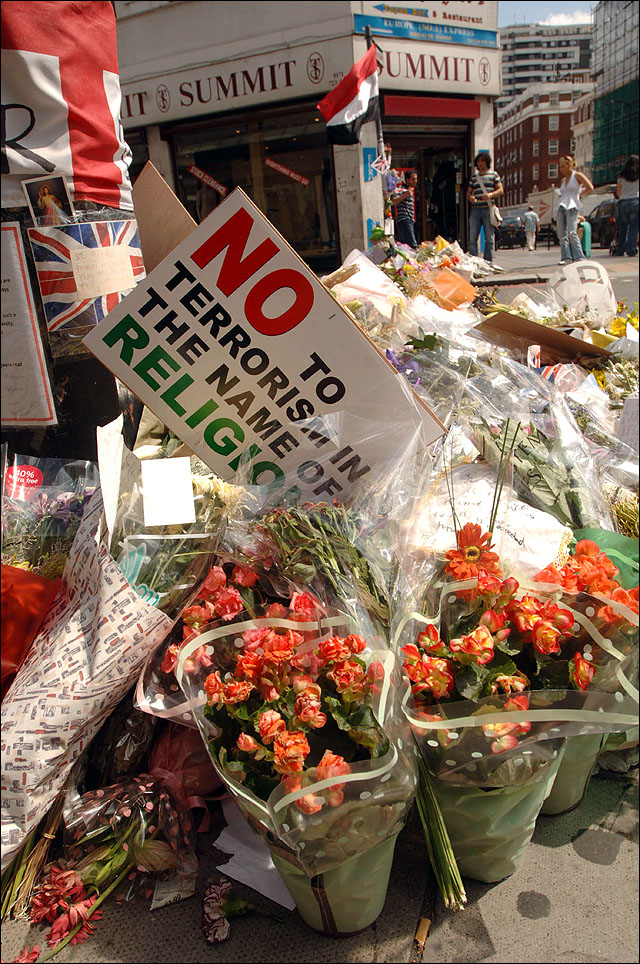
The Metropolitan Police investigation continues at Edgware Road in London, where a spontaneous memorial remembers those killed by a bomb on an Underground train on July 7. Forensic teams investigating the terrorist bombings in London continued their search for clues Monday, while authorities in Pakistan said they were trying to trace the movements of three of the suspected suicide bombers in that country.
Charles Falconer, the lord chancellor, said a primary focus should first be “getting to the root of that evil ideology that is driving this terrorism.”
“Now is not the time for any form of inquiry,” he told the BBC.
According to The Independent and other British newspapers, British intelligence reportedly found that Khan, 30, had visited the home of a man linked to an alleged plot to blow up a London target, possibly a Soho nightclub, with a fertilizer bomb.
In that investigation, detectives arrested eight suspects across southern England in March 2004 and seized a half ton of ammonium nitrate, a chemical fertilizer used in many bomb attacks.
John Carnt, a former Scotland Yard detective superintendent with expertise in counterterrorism and covert surveillance, said intelligence agencies are so bombarded with information it can be hard to home in on an individual.
Khan’s “might have been one name amidst many other names, and there may have been nothing else that added weight to it,” said Carnt, now managing director of Vance International Ltd., a London-based security and intelligence company.
Khan traveled to Karachi in November with fellow bomber Shahzad Tanweer, 22. Hasib Hussain, the 18-year-old bus bomber, went to the same city in July. The purpose of their visits was unclear.