

Massacre victims laid to rest
Srebrenica, Bosnia-Herzegovina ? Women wept Monday as they finally buried husbands and sons 10 years after Europe’s worst massacre since World War II – funerals made possible by the excavation of mass graves of victims killed by Bosnian Serb forces.
An extraordinary gathering of 30,000 people – including the Serb president – came to Srebrenica to mark the anniversary and honor the dead.
To the sound of Muslim prayers echoing across a sprawling green valley, family members wandered among 610 caskets of the most recently identified victims of the July 11, 1995, massacre, in which some 8,000 Muslim men and boys were killed.
After a religious service, the caskets were passed from hand to hand toward the graves and buried. The sound of dirt striking the coffins and the weeping of women competed with a voice reading the names of victims.
They were buried beside 1,330 existing graves at a memorial cemetery across from an abandoned car battery factory that was the wartime base for Dutch U.N. soldiers.
The Dutch were supposed to protect Srebrenica – a designated U.N. safe zone- from Serb attacks during the 1992-95 Bosnian war. But outmanned and outgunned, the Dutch mission watched as Srebrenica’s men and boys were separated from the women and led away, to be slain and dumped into shallow graves that are still being discovered a decade later.
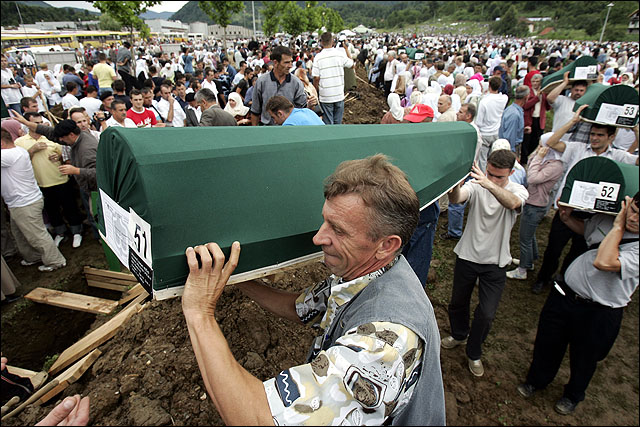
People carry coffins during a funeral of 610 Bosnian muslims killed by advancing Bosnian Serb forces in Potocari, outside Srebrenica, on the 10th anniversary of the Srebrenica massacre Monday. After a religious service, the 610 caskets containing the remains of the most recently identified victims were passed in a long line from hand to hand toward the grave pits and buried.
World leaders offered apologies Monday and called for the arrest of top war crimes fugitives, Bosnian Serb leader Radovan Karadzic and military commander Ratko Mladic, and their extradition to the U.N. war crimes tribunal in The Hague, Netherlands.
“It is the shame of the international community that this evil took place under our noses,” British Foreign Secretary Jack Straw said. “I bitterly regret this and I’m deeply sorry for it.”
The ceremony opened with the Bosnian anthem and the raising of the Bosnian flag followed by a choral performance of “Srebrenica Inferno,” a song written for the anniversary that tells of a dead boy speaking to survivors.
“The crimes that were committed here were not simply murders,” said Theodor Meron, president of the U.N. war crimes court. “They were targeted at a particular human group with the intent to destroy it. They were so heinous that they warrant the gravest of labels: Genocide.”
There was no visible presence of Bosnian Serbs at Monday’s service, although Bosnian television aired it live.
It was also carried live in Serbia, which confronted the horrors of Srebrenica for the first time only recently when a videotape showing the slaying of six men and boys in Srebrenica shocked residents, who had been largely uninformed about atrocities committed by Serb troops in Bosnia.
Serbia’s President Boris Tadic attended the service – a significant gesture given Serbia’s political and military backing of the Bosnian Serbs during the war. He did not speak, but said earlier that his gesture should be considered an act of remorse to Srebrenica’s Muslims. He has also pledged to seek Mladic’s arrest.
Some 250,000 people were killed in the war between Bosnian Muslims, Catholic Croats and Orthodox Serbs. About 16,500 bodies have been exhumed from more than 300 mass graves throughout the country, but the Srebrenica massacre became the symbol of the war’s brutality.