

Lactation experts provide comfort for new mothers
Consultants promote breast-feeding
Mammals have been nursing their young as long as there have been mammals, but human mothers often find breast-feeding to be a real beast. Baby wants to sleep. Baby won’t latch on. Baby nurses, but is baby getting enough nourishment? It’s enough to try the patience of the most eager new mother.
For new mom Loremi L. Mendoza, the issue was more challenging because her son had a growth on his liver and had to be hospitalized. When Mendoza, 22, traveled to Driscoll Children’s Hospital in Corpus Christi, Texas, lactation consultant Laurie Beck was on hand to answer her questions about breast-feeding.
“I had always wanted to breast-feed,” Mendoza said. “I know it’s healthier for the baby and I had read that you lose weight faster.”
Mendoza’s son, Alberto Mendoza IV, quickly learned to nurse when he was born Nov. 10.
At Driscoll, Beck loaned Mendoza an electric pump, which helped her pump milk for her son quickly and get back to his bedside. Knowing a consultant is just a phone call or e-mail away, Mendoza said she hoped to breast-feed her son for a year.
Beck said consultants support and promote breast-feeding. She helps patients’ mothers get the hang of using a breast pump and maintaining their milk supply while the baby is hospitalized. Breast-feeding, she acknowledged, can have a considerable learning curve.
“Most of the moms quit that first week because it’s a mess,” Beck said.
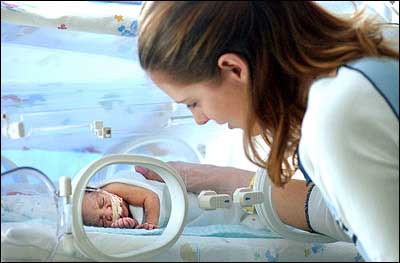
Kaleigh Bowen touches her son, John William, who is 40 days old. Bowen previously pumped her milk and stored it to feed her baby by tube into the incubator. Bowen has found the lactation consultants at Driscoll Children's Hospital in Corpus Christi, Texas, useful in learning about breast-feeding.
Beck said consultants could keep in touch with moms throughout the breast-feeding experience. Moms often call with questions about managing breast-feeding after maternity leave, about combining breast-feeding with introducing solid food, about feeding during flu season and so forth, all the way through weaning.
When it comes to breast-feeding challenges, Beck said, two or more heads are often better than one.
She often trades ideas with other consultants as well as networking with members of La Leche League, a group of mothers who help other mothers with breast-feeding.
| La Leche League of Lawrence has support sessions that provide sharing and learning opportunities for pregnant women, nursing mothers and babies. The sessions offer networking and the latest information and research on breast-feeding.The next meeting will be at 7 p.m. Feb. 8 at Lawrence Memorial Hospital, 325 Maine. The topic will be “Breast-feeding — When Baby Arrives.”For more information, call 691-0204 or click on www.lalecheleague.org. The club also provides free telephone support. For help, call Chris at 218-9124, Jane at 865-5919 or Julie at 842-9672. |
“We all kind of work together,” she said. “If one hits a snag, we can talk. It’s everybody pulling together.”
Luckily, lactation consultants often have answers handy, and the Corpus Christi just got two more board-certified consultants. Registered nurses Lynda Wood and Cheryl Mills were certified Oct. 15, and will help new moms in the military community through the visiting nurse program of Navy-Marine Corps Relief Society
“In this community 99 percent of our (clients) are pregnant or postpartum,” Mills said. “They have newborn baby care educational needs and breast-feeding needs.”
With so many requests for help from new mothers, Wood and Mills decided to go through the certification process together. Just as they support new mothers, they supported each other through the grueling path to completion.
“You need to have 2,500 to 4,000 hours directly involved with breast-feeding education,” Mills said. “This is either provided in classroom instruction or counseling with mothers involving problems or visiting them postpartum.”
Mills also is encouraged by the growing numbers of fathers willing to get involved with their babies.
“Those fathers,” Mills said. “They can tell me the color, consistency and how many times — anything — about the baby’s poop.”
| According to the American Academy of Pediatrics, the benefits for children are:¢ Fewer ear infections¢ Fewer allergies¢ Less vomiting¢ Less diarrhea¢ Less pneumonia, wheezing and respiratory infection¢ Less meningitisThe benefits for moms:¢ Reduces the risk of ovarian cancer and, in pre-menopausal women, breast cancer.¢ Delays the return of your menstrual cycle, which may help extend the time between pregnancies.¢ Builds bone strength to protect against bone fractures in older age.¢ Burns more calories and helps you get back to your pre-pregnancy weight more quickly.¢ Helps the uterus return to its regular size more quickly.¢ Breast milk saves time during those 2 a.m. feedings.¢ It does not need to be prepared.¢ Breast milk costs nothing to make and is always in supply. |
Health
Program that helped people with disabilities scrapped again
Margaret Tomlinson has been recovering from a traumatic brain injury for three years. Nearly a year ago, she moved ...

Excitement builds as LMH Health draws closer to completing Therapy Services renovations
More children’s hospitals turn to furry caregivers to help kids heal
Sometimes ‘baby blues’ is actually something darker
Moments after Jenna Carberg gave birth to her daughter, doctors put the baby on her chest. “I felt a disconnect ...
Moving to music offers all kinds of benefits as you age
Conflicting mamogram advice leads to confusion
WASHINGTON — Deciding when to get routine mammograms is confusing. Some health groups recommend women begin at ...