

What, me worry? Absolutely!
Learning to live with neurotic behaviors is a good thing
If you worry about being neurotic, you are.
Worry is the very essence of neurosis, that insidious chronic anxiety that has nothing to do with anybody’s reality but your own.
“You worry about anything and everything,” says psychologist Frank Bruno. “You make psychological molehills into psychological mountains.”
But Bruno wants to reassure the 20 million really anxious among us that it’s not only OK to be neurotic, but it can be a good thing. That, in fact, is the name of his comforting new book, “It’s OK To Be Neurotic: Using Your Neuroses to Your Advantage.”
Bruno readily admits he’s his own poster child. This former 245-pound, two-pack-a-day smoker changed his neurotic behavior in ways that enabled him to quit smoking and lose weight. Then he wrote a book about it — “Think Yourself Thin” — and became a best-selling author.
“If I had not had those self-defeating tendencies, I would never have been able to write that book and have all that success,” says Bruno, who has written 19 more psychology books since. “You can turn problems into terrific things sometimes. But most neurotic people let it sink them.”
What most people would call a “neurosis” is really an anxiety disorder that can take different forms, Bruno says.
Free-floating anxiety involves worry about anything and everything. My son has a certain amount of this — he’s a structure-loving, change-resistant kid who has wallowed in buckets of borrowed trouble since he was a mere tad.
“How will I find my classroom?” he asked on the first day of preschool. “Once I find my classroom, how will I find the bathroom? Once I find the bathroom, how will I find my classroom again? If I get lost somewhere between the bathroom and my classroom, how will anybody find me? What if they don’t find me and I need to go to the bathroom again?”
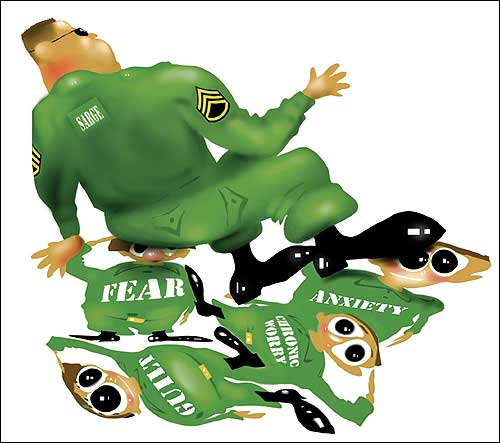
Free-floating anxiety is different from phobias, which are irrational fears of specific things like needles (aichmophobia), snakes (ophidiophobia), ventriloquist’s dummies (automatonophobia) or gaining weight (obesophobia or pocrescophobia). George Orwell gives a nod to neurosis in “1984,” where the worst thing in the world awaited people in Room 101.
“The worst thing in the world varies from individual to individual,” he writes. “It may be burial alive, or death by fire, or by drowning, or by impalement, or 50 other deaths. There are cases where it is some quite trivial thing, not even fatal.”
One person’s triviality is another person’s furry little nightmare: rats terrified Orwell’s neurotic hero, Winston.
Post-traumatic stress disorder describes anxiety associated with surviving a painful or dangerous event, such as a war or an earthquake or being lowered into a pit of snakes. Perhaps you feel anxiety at the prospect of trying to morph your neurosis into an advantage because you know that failure is inevitable in this, as in all things.
Perhaps you feel that turning neurosis into a good thing is much like spinning straw into gold, and that only really smart, talented, lucky people who have little magic men with ridiculous names to help them could ever do it. Perhaps you believe that anything dropped in the bathroom will fall in the toilet. If so, this might work for you.
“You don’t have to cure yourself of your neurosis,” Bruno says. “You just have to get intelligent about it and learn to live with it.” Neurotics generally live their lives by Murphy’s Law: “If anything can go wrong, it will.”
At the worst possible time. The master strategy for making your neurosis work for you begins with recognizing that neurosis is an inherited trait rather than an affliction. It’s like being tall or having curly hair, except a lot more annoying for everybody around you. OK, so I know my son got his bone structure and love of Looney Tunes from me, and his freckle-free skin and ability to save money rather than immediately blow it on clothes from his father. But where did his incessant trouble-borrowing come from? This worries me.
“It begins with something that is simply not in your control,” Bruno says. “Having said that, all is not hopeless. Instead of fighting it, you relax and say, ‘I accept the fact that I have a neurotic disposition.’ Now, instead of trying to suppress it or deny it or run away from it or cure it, realize that it’s something you can live with and have a constructive, rewarding life.”
Health
Program that helped people with disabilities scrapped again
Margaret Tomlinson has been recovering from a traumatic brain injury for three years. Nearly a year ago, she moved ...

Excitement builds as LMH Health draws closer to completing Therapy Services renovations

More children’s hospitals turn to furry caregivers to help kids heal
Sometimes ‘baby blues’ is actually something darker
Moments after Jenna Carberg gave birth to her daughter, doctors put the baby on her chest. “I felt a disconnect ...

Moving to music offers all kinds of benefits as you age
Conflicting mamogram advice leads to confusion
WASHINGTON — Deciding when to get routine mammograms is confusing. Some health groups recommend women begin at ...