

Berkeley city officials take university to court
Battle centers on development near campus
Berkeley, Calif. ? The University of California at Berkeley, once famous for being a hotbed of anti-establishment protest, finds itself in an uncomfortable role these days: the object of protest.
City leaders have taken their university to court in hopes of blocking construction on its 15-year growth plan, arguing that campus administrators didn’t adequately evaluate the consequences to the city.
The flap is the latest in a series of town-gown spats across the country as modern-day budget constraints intensify age-old friction between schools and their surrounding communities.
A number of other University of California campuses are embroiled in disagreements with their cities, including Santa Cruz, where officials are wary of that campus’ expansion plan.
One twist in the Berkeley vs. Berkeley face-off is that it is being led by Mayor Tom Bates, a graduate of the same campus he is now suing and a starting member of the 1959 Rose Bowl team.
“As a proud alumnus of the University of California, I’m disappointed that we’re here today to file the lawsuit, but we want a fair and lasting partnership with the university,” Bates said.
No ‘blank check’
The suit, filed Wednesday, alleges that a campus environmental impact report, approved last month by the university’s governing board of regents, doesn’t adequately evaluate the consequences of adding up to 2.2 million square feet of space and about 2,000 parking spaces.
“The university has, in essence, asked us to sign the equivalent of a blank check that will allow them to build wherever, whenever and however it would like,” Bates said. “This lawsuit firmly states that we are not willing to sign anything until we know what we’re buying.”
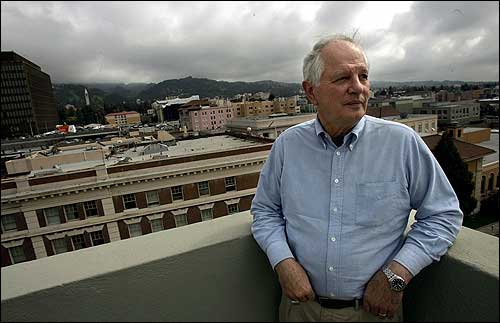
Long-simmering tensions between the city of Berkeley, Calif., and its famous university erupted this week as the city sued to block campus expansion plans. The suit alleges a campus environmental impact report doesn't adequately evaluate the consequences of the expansion. Berkeley Mayor Tom Bates is leading the charge against his alma mater.
Bates also announced the city plans to start billing UC Berkeley for sewage service and parking taxes and is prepared to sue if the campus balks at paying.
Campus officials counter that they are tax-exempt as a public agency. They defended their environmental report as meeting all legal requirements.
Berkeley administrators said they sympathized with the city’s tight financial situation but, “it is in no one’s interest for one public agency to sue another to address a budget shortfall.”
Town-gown tensions
The controversy is ironic in what many jokingly call the People’s Republic of Berkeley, where the campus became a hotbed of leftist politics and student unrest during the Vietnam War.
While town-gown tensions have often flared over alcohol abuse and noise, the recent focus has been on money, said Sheldon Steinbach, general counsel for the American Council on Education in Washington, D.C.
| Kansas University and the Lawrence City Commission are working on a draft of a pact that for the first time would significantly regulate how KU builds on parts of its campus near neighborhoods. |
“Over the last almost 40 years the principal point of friction has been over monetary issues as localities and states have become increasingly strapped for funds,” he said.
One of the more prominent disputes nationally was between officials at Northwestern University and Evanston, Ill., who fought over taxes for years before settling a lawsuit in 2004.
The university had sued Evanston, accusing the city of including dozens of its buildings in a historic district in retaliation for Northwestern’s refusal to make voluntary payments in lieu of property taxes. The designation prevented the school from making changes to the buildings without city approval.
Give and take
UC Berkeley now pays more than $500,000 a year to the city, mostly for sewage service, a campus spokeswoman said. The campus has offered to increase the amount to $1.2 million. However, city officials say a fair figure would be more than $2 million.
Campus officials say they contribute more than they take, spending about $70 million a year on goods and services purchased locally. Meanwhile, students, faculty, staff and others generate millions more in sales tax revenues for the city, according to campus studies.
The sense that “we’re giving more than we’re getting” is a typical theme of these kind of disputes, said Joan Girgus, a psychology professor at Princeton University who has worked with universities around the country on issues including turmoil with surrounding towns.
Girgus’ work has focused on creating partnerships, rather than trying to determine which way the financial scales tilt.
“That’s a long debate,” she said. “In a sense, it’s not about accounting, it’s really about how can we create a community in which everyone can flourish.”