

Israel begins charting final borders
Cabinet agrees to withdraw from Gaza, reroute barrier wall
Jerusalem ? Prime Minister Ariel Sharon’s Cabinet began charting Israel’s future borders in a historic session Sunday, giving final approval to a withdrawal from the Gaza Strip and a revised route for the West Bank separation barrier that would move Israel’s border closer to that of its original frontier.
With the vote, an Israeli government agreed for the first time since capturing the West Bank and Gaza in the 1967 Mideast war to dismantle some of the dozens of Jewish settlements it has built there. However, approving the route of the barrier, Israel acted unilaterally on what was to be a key issue in peace talks with the Palestinians, and signaled it will keep a chunk of prime West Bank land close to Jerusalem, including two large Jewish settlement blocs.
While the Palestinians have balked at Israel’s go-it-alone approach, they avoid declaring the moves a deal-breaker in a reinvigorated peace process.
“Israel is creating facts on the ground in the West Bank,” Palestinian legislator Hanan Ashrawi said. “Sharon wants payback in the West Bank for the disengagement from Gaza, particularly Jerusalem.”
The Gaza withdrawal won approval from 17 Cabinet ministers, including eight from the moderate Labor Party, while five ministers from Sharon’s ruling Likud Party voted against it.
Sharon, a former settler patron, said the dismantling of 21 settlements in Gaza and four in the West Bank was vital for Israel’s security. He later signed an order requiring some 9,000 settlers to leave their homes in these areas by July 20 or face removal by force.
“Israel has taken a step that will be decisive for its future … the right one to ensure Israel’s future as a Jewish and democratic state,” he told American Jewish leaders in Jerusalem. He said the vote proved Israel’s readiness to take “painful steps … to make peace.”
The easy endorsement appeared to be the final political defeat for withdrawal opponents, including the powerful Jewish settler lobby. The pullout could still be derailed if Sharon fails to get his 2005 budget passed by parliament by the end of March.
Pinchas Wallerstein, a leader of the council of Jewish settlements, called on supporters to begin “an aggressive and strong struggle,” but to avoid violent confrontations with Israeli troops.
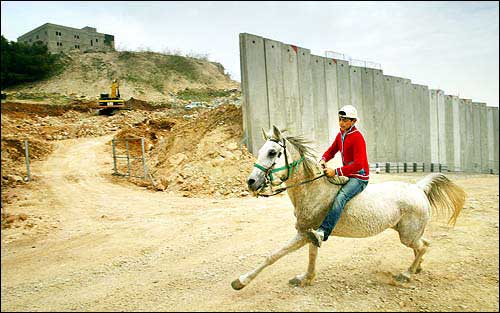
A boy rides a horse past a break in the wall of the Israeli security barrier, which is still under construction, between the West Bank village of Abu Dis and Jerusalem. On Sunday, the Israeli Cabinet met to vote on a new route of the barrier, which was redrawn after Israel's Supreme Court ruled that the previous route was needlessly disruptive to Palestinians' lives.
The militant Hamas group, meanwhile, claimed victory. Musher al-Masri, a Hamas spokesman in Gaza, called the Israeli pullout “a result of the heroic resistance of our people.”
Construction of the West Bank barrier began in 2002 and is one-third complete. Israel said it needed a shield against Palestinian suicide bombers and gunmen. The Palestinians denounced the barrier as a land grab, saying Israel could have built it on its land. Last year, the world court said in a nonbinding opinion that the construction of the barrier is illegal and should stop.
Palestinian leader Mahmoud Abbas told the German news magazine Der Spiegel that Israel must dismantle all settlements and halt construction of the barrier. “What right does Israel have to build settlements on our land?” Abbas said.
Sharon has said he has U.S. blessing for holding on to large West Bank settlement blocs in a future peace deal. Last year, President Bush affirmed to Sharon in a letter that “new realities” in the West Bank, meaning concentrations of Israeli settlers, could not be overlooked in drawing future borders.
“The American letter to Sharon is unacceptable because it pre-empts solutions for a final phase we haven’t reached yet,” Abbas told Der Spiegel, saying Bush cannot determine the Palestinians’ fate.