

KU adds youthful, cultural and national flavor to Lawrence
City offers rich mix of cultural, educational opportunities
First take a history-rich midwestern city in the heart of the country.
Then add the Kansas University ingredients:
- Pour in a liberal helping of college students and faculty from all over the world.
- Season with a growing core of biosciences researchers, artists and professional musicians who work and study at the university.
- Zest the mix with live music, art galleries, poetry readings, nationally known musicians, dancers, actors and singers.
- Then stir it all up with the excitement of a nationally ranked basketball team.
What you get is a livelier, younger, educated, more diverse and worldly city — a city that just doesn’t quite taste like the rest of Kansas.
The Jayhawk identity
The main way KU enriches the city is by helping it establish an identity, says Paul Carttar, KU’s executive vice chancellor for external affairs.
“As a person who grew up in Lawrence and then spent most of my professional life not only outside of Lawrence, but of Kansas, on both coasts of the U.S. and Europe, the thing that always was profoundly impressive to me, thinking back on growing up here, was the strength of the identity that you have as someone who grows up in this town,” Carttar said. “And it’s summarized by being a Jayhawk.”
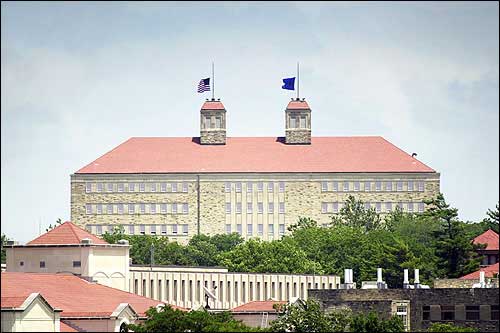
Flags fly at half-staff at Fraser Hall on the Kansas University campus.
He said a lot of people refer to themselves as being Jayhawks.
“But there are Jayhawks, and then there are Jayhawks. What KU provides to Lawrence, in its most powerful form, as someone who actually lives here, especially as a kid living here, is an identity. You know who you are. You know where you grew up. You know where you’re from.”
He said KU men’s basketball, which is perennial national powerhouse, is a fundamental piece of that identity.
“The basketball team brings a broad and positive awareness to the university and through the university to the town,” he said.
Lofty site
While Lawrence’s original settlers put the heart of the city in a valley between two rivers, the Kansas River and the Wakarusa River, they sought a loftier perch for the state university.
KU is located on the highest point in Lawrence, on 940 acres around a hill named Mt. Oread by the city’s earliest settlers.
Today, the waving flags atop of KU’s Fraser Hall can be seen from almost everywhere in Lawrence, reminding its citizens the central role the university plays in the city’s economy, its education and in its future.
Bringing vibrancy
When close to 27,000 students arrive in Lawrence each fall to attend classes, they bring a boost of enthusiasm and youth to the city.
“I think what students bring is vibrancy in its truest form,” Carttar said. “They also bring a lot of cultural offerings that exist just for the students. … I think that the faculty brings, to the average Lawrencian, is a breadth of experience, world view and intellectual and cultural interest that a city of this size, in the absence of a university, simply wouldn’t have.”
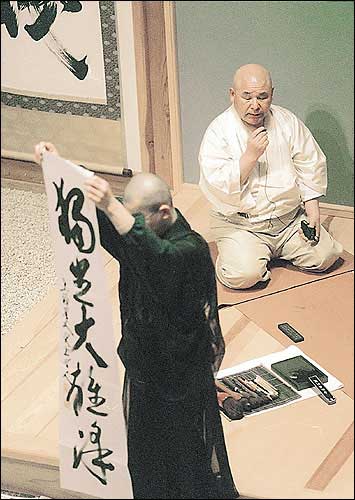
Fukushima Keido Roshi, head abbot of the Tofuku Temple in Kyoto, Japan, and leader of that sect of Rinzai Zen describes what he has written during a past calligraphy demonstration at the Spencer Museum of Art.
The influx of students keeps Lawrence’s median population relatively youthful. While the median age for the rest of Kansas is about 35, the influx of KU students each year creates a median age of 25 for Lawrence, according to federal census data.
Students and faculty also bring a cultural diversity to the city, Carttar said.
“I’ve got a 12-year-old son who goes to Hillcrest School. Hillcrest School has children from over 40 countries, right here in Lawrence, Kansas,” he said. ” I mean, it’s phenomenal the cultural and ethnic diversity that the faculty brings to Lawrence.”
Major employer
KU already has long been a major force in Lawrence’s economy, said Sheila Stogsdill, assistant director of the Lawrence-Douglas County Planning Commission.
“It’s one of the major employers for the community,” Stogsdill said. KU has 9,555 faculty and staff members on its payroll.
Stogsdill said KU has also had a strong economic development impact, in terms of trying to tie the research and technology industry sector into a growth sector for the community.
“We got started back, at least in the ’80s — it may have started before that — with the Oread West Research Park that was sort of an offshoot from the university research,” she said.
Rich cultural mix
Carttar said the growing number of professional artists drawn to the university brings a cultural vibrancy to the city.
“Really in its richest form, it’s not only in the different types of art and cultural experiences that you can have, but the different types of individuals that make up the community,” he said.
KU has had a positive effect on bringing in cultural events.
“A community with a population of 80,000 people would not always get Broadway shows and music performance opportunities that come because of the university,” Stogsdill said. “There’s probably also an increase in the night life entertainment market, due to having that population.”
Biosciences research
A core group of bioscience researchers among KU’s faculty and graduate students brings economic promise to the city, Carttar said.
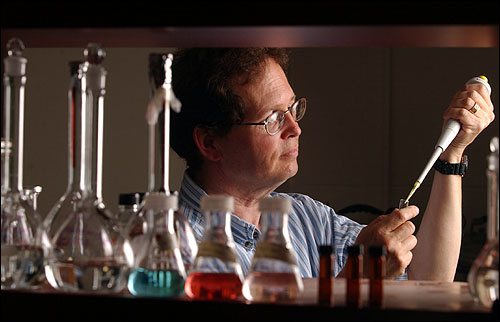
Val Smith, a professor of Ecology and Evolutionary Biology, is part of a research team that is studying how nutrients affect the development of diseases. He's pictured above at his laboratory at Haworth Hall.
The research they produce can eventually spin off new products and services in the growing biosciences industry, he said.
“As KU is better able to establish a critical mass of researchers in the biosciences area, that has very positive implications for the likelihood that discoveries made by those scientists will, over time, be transformed into vibrant, productive businesses and commercial enterprises,” Carttar said.
Outside dollars
“Obviously the university is a big draw in terms of bringing in outside dollars,” Stogsdill said.
For example, KU fans, alumni and students’ family members from outside of the city come to Lawrence on game days to watch football, basketball, soccer or other sports.
While in Lawrence, they spend money in restaurants, motels, grocery stores and gasoline stations.
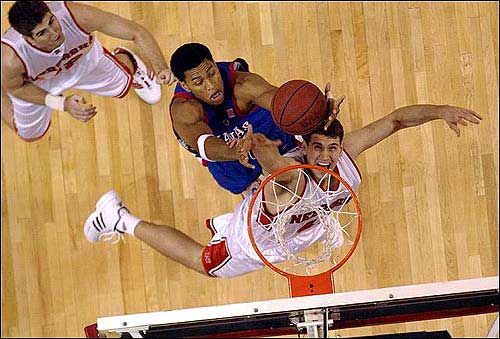
Kansas University's Wayne Simien, center, goes up for a rebound against Nebraska's John Turek, front, and Jake Muhleisen.
The university also attracts research dollars. KU Chancellor Robert Hemenway recently reported to the Kansas Legislature that total research funding is at an all-time high — $258 million from all sources during the 2003 fiscal year.
Those were largely federal grants, enabling KU to undertake productive work in a broad range of fields, such as medicine, engineering and the life sciences, Hemenway said.
KU-city clashes
Stogsdill has worked for 15-years dealing with planning and growth issues affecting Lawrence and the impact KU has had on that growth.
“In the time that I’ve been here, I’ve seen growth in that cooperative arrangement,” Stogsdill said.
As KU and the city both grew, it created some logistics problems.
For example, traffic flow throughout the city is hindered by the campus’ central location. KU closes off the campus to most through traffic during days classes are in session.
In recent years, there have been clashes between the city and the university concerning the housing property surrounding the university’s main campus.
Some who live in neighborhoods near the campus are worried about KU buying up too much of the housing stock in those neighborhoods and changing the character of their neighborhoods.
But over the years, constraints have had to be made to deal with potential negative impacts on surrounding neighborhoods, including stormwater runoff, Stogsdill said.
And KU has been more willing to take up community concerns, she said.
“There’s a lot more effort on the university’s part to include community in the planning stages when they’re doing new projects and trying to mitigate the potential negative impacts when they do construction projects,” she said.
Obviously, she said, there are positive aspects of KU construction projects, in terms of improving the local economy and the construction industry.
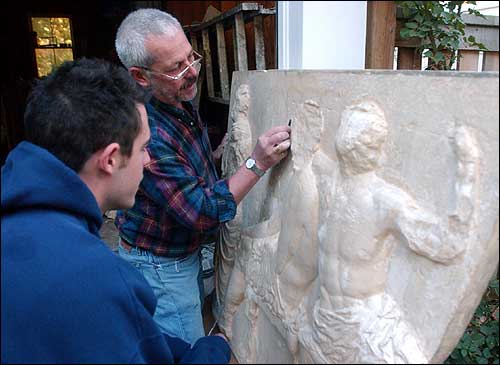
Kansas University junior John Senn, left, of St. Louis, and classics professor John Younger clean a plaster cast panel that is part of the Wilcox Classical Museum collection.
“But there seems like there’s been an increased effort to really try to play by the local regulation to the extent that they can, as opposed to working in a vaccuum,” Stogsdill said.
Effects on housing
The ebb and flow of students into Lawrence each academic year has created a need throughout the city for temporary housing.
KU does offer on-campus living for students, including a few new scholarshp halls and some newly remodeled residence halls.
“The fact that KU does not build new dormitory space, definitely is a factor in the growth of the apartment complex market, especially the market that is geared toward the college student environment,” Stogsdill said. “In the ’90s we saw several new larger complexes that were specifically marketed to that population. And part of the result of that is that the university has been in the process of upgrading the halls on Daisy Hills to be more attractive and competitive to retain some of those students in the dorms. They’ve had this multi-year improvement project where they take one (dormitory) off line and update it and create suites … It’s affected the apartment marketplace and the growing apartment marketplace has obviously affected those housing decisions.”
There has also been an impact on rental rates in the city, she said.
“We have heard that the student population may make the apartment market rental rates higher, maybe, compared to Kansas City rental rates, because of that population being here,” she said.
Returning to roost
While bringing in the regular new crop of 18- to 20-somethings each year, KU has also been luring in an older, more seasoned population group to Lawrence.
“We have found, over the last 10 to 15 years that we have become an attractive retirement market,” Stogsdill said.
“And oftentimes, what we’ve heard, is there are folks who had an earlier tie with KU who have decided to come back to Lawrence to retire, partially because of the university ties of cultural events and that sort of thing.”