

Haskell not alone with budget shortfall frustrations
Tribal colleges struggle with chronic underfunding
Tom Dixon walks through the halls of the science department at Haskell Indian Nations University, where he has been a physics teacher for more than 30 years.
He points out peeling paint and the new heating and cooling system, which he says takes up too much space, costs too much to run and still doesn’t work right. He shows how one classroom also triples as an office and a lab.
Then there’s Dennis O’Malley’s office, which doesn’t have electricity. O’Malley, a chemistry professor at Haskell, makes do by snaking an extension cord from an adjoining classroom.
“We all make do,” Dixon said. “We all have more than one job, and we all work long days. That’s just the way it is.”
Haskell and the nation’s other 34 tribal colleges serve about 30,000 students. The tribal college system was founded in the 1960s to educate the nation’s American Indians, who now number about 2.4 million and consistently rank on the lower rungs of most socio-economic scales. Unlike Haskell, most of the tribal colleges are two-year programs and are located on reservations.
Most also are largely funded by Congress and controlled by their particular tribe. Haskell, the Southwestern Indian Polytechnic Institute in Albuquerque and the Institute of American Indian Arts in Santa Fe are controlled and funded by the federal government.
Last year President Bush asked Congress to allocate $43.4 million for the colleges, a $5.5 million cut from the previous year. Congress gave $52.8 million, but full funding would have been about $67 million, said Meg Goetz, congressional liaison for the American Indian Higher Education Consortium.
“It’s definitely chronic underfunding,” Goetz said. “And another big problem is the fact that the schools aren’t forward-funded. So this year it took until December (for funding to be approved), and in those gap times the tribal colleges have to come up with money. It’s year by year, and they can’t plan.”
Goetz said the tribal colleges get money on a per student basis and were losing money at current levels.
“If they were funded at the authorized level of $6,000 per student and you factored in inflation, they would be breaking even,” Goetz said. “But they’re not funded at the authorized level. This year they’re getting $4,447 per student.
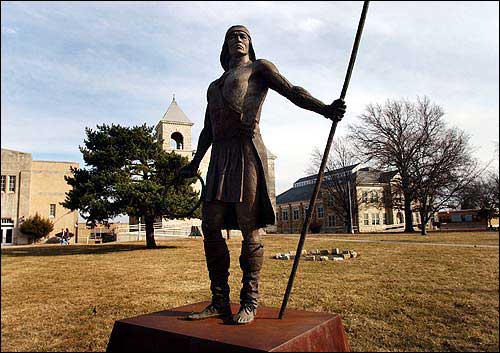
A sculpture at Haskell Indian Nations University is shown Wednesday in Lawrence. The school is among tribal colleges struggling with a lack of funding by the federal government.
“So it’s been 24 years, and they’re just hitting three quarters of their authorized funding,” she said. “After 24 years, you’d kind of figure they could have found it.”
AIHEC recently studied the campus needs for the tribal colleges, many of which were still operating out of abandoned Bureau of Indian Affairs buildings or trailers.
“Some are still in trailers,” Goetz said. “One school moved into a fish-processing plant, up in Michigan’s upper peninsula. And they love it. It’s freezing in there, but they said it’s a big improvement.
“Other schools said they had all the computers they needed, but that they couldn’t use them because the wiring wasn’t up to code.”
Innovative funding
Some of the tribal colleges have come up with new ways to make ends meet. Sitting Bull College in North Dakota has its own construction company and just recently started a technical support company.
“We do not operate at all with loans,” said Coreen Ressler, dean of academic affairs at Sitting Bull. “We always do a balanced budget, which is why we’ve kind of gone to some innovative types of funding.”
She said the college, which is located on the Standing Rock Indian Reservation in Fort Yates, N.D., has constant struggles with old buildings.

 Brownback, Moore tour Haskell science labs (1-19-05)
 6News video: Lawmakers tour Haskell science facilities (1-18-05)
“We have one hall we call the Hall of Many Buckets, because we have buckets all over the place so they can catch the rain when the roof leaks. And we have to put up walls to make offices, we lack classroom space,” she said. “Right now our science facility is a two-room trailer.”
But Sitting Bull College, which enrolls about 400 students, is building a new science center thanks to a combination of money from the tribe, private donations and competitive federal grants, Ressler said.
Schooling isn’t free
Nicole Adams of the American Indian College Fund said common misconceptions were that American Indians get free education or that Indian casinos foot the bill for the schools. But less than one-third of the federally recognized tribes in the nation have gaming operations.
“It’s a tiny percentage of all Indian communities that get any benefits from gaming,” Adams said. Plus, she said, if one tribe makes a lot of money from gambling, that doesn’t mean other tribes will benefit.
“There’s this good analogy: People don’t expect the city of Las Vegas to share the wealth with the city of New York or Long Island,” Adams said. “Why should they expect the tribes who make money with casinos to pay for other tribes’ education?”
The American Indian College Fund gives out about $3.4 million in scholarship money annually to American Indian students attending tribal colleges. That amount reaches about 15 percent of the need, Adams said.
“The scale of how far the dollar will go with these students is amazing. They will say ‘I got a $500 scholarship, and it made all the difference. It’s what got me through,”‘ she said.
Safe environment
Karen Swisher, president of Haskell, said Haskell and the tribal colleges provide American Indians with more than degrees. In order to enroll at Haskell for BIA benefits a student has to be a member of a recognized tribe. The fee for a semester is $105 for on-campus students, and $70 a semester for off-campus.
“The environment that we provide is one that many of our students have never experienced before. It’s a safe environment,” Swisher said. “Safe meaning they can be who they are.”