

Pop the top this New Year’s Eve
Filmmaker Francis Ford Coppola, a California vintner by avocation, is making Americans an offer he hopes they won’t refuse: He’s asking them to drink his champagne out of cans.
The new bubbly – named Sofia, after Coppola’s moviemaking daughter – comes in individual servings of about 6 ounces. It’s offered in a demure raspberry, plastic-lined can with a straw attached to the side, just like Juicy Juice.
It retails for $5 a pop or $20 for a four-pack, which comes packaged in a hexagonal foil carton, also raspberry color, with circles like champagne bubbles cut out of its sides.
If taste is the point, Sofia may be a decent bargain. Craig Baker, a Washington, D.C., buyer of imported wines for Robert Kacher Selections and someone who makes his living by his palate, rated canned Sofia second against four comparably priced bottled sparkling wines in a blind tasting this week.
But taste is almost beside the point, according to bar managers, young women who choose Sofia and even Erle Martin, the president of Niebaum-Coppola, the filmmaker’s wine business.
“It’s a very cool presentation of a decent wine,” said Maria Elena Gutierrez, 28, sipping Sofia.
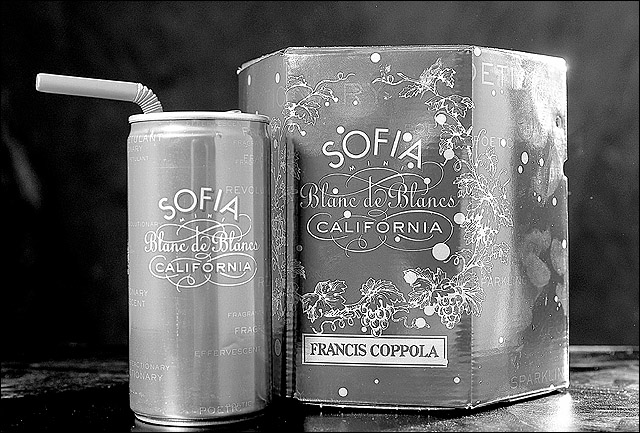
Filmmaker Francis Ford Coppols is going where no competitor has gone before. Coppola, a California vintner by avocation, wants Americans to drink his champagne from cans. Named Sofia after Coppola's daughter, it comes in a demure 6 ounce raspberry-colored can with a straw attached to the side just like Juicy Juice. (George Bridges/KRT)
For them, it’s not just the wine that’s being presented, said Saeed Bennani, Mie N Yu’s worldly beverage manager.
“You’re drinking champagne out of a can with a straw. It’s different, so you’re different,” Bennani explained.
According to Martin, Coppola’s initial idea was to offer individual servings of conventionally bottled Sofia, which sells for about $20. Single servings of champagne and other sparkling wines are big sellers in Europe.
Coppola rejected on aesthetic grounds the scaled-down glass or plastic bottles in which European vintners sell their products, Martin said. But he was drawn to cans by their untapped advantages.
“They’re lighter. They’re less expensive. They cool faster and they’re easier to dispose of,” Martin said.