

EU satellite is first of new GPS system
Paris ? The European Union on Wednesday launched the first satellite in its $4.5 billion Galileo global positioning system, a bid to enhance the world’s growing reliance on satellite navigation and break the U.S. monopoly on space-based networks.
Officials of the European Space Agency said the Galileo system – scheduled to begin operation in 2008 – will double the world’s satellite coverage, now provided by the U.S. military’s Global Positioning System.
With greater accuracy for civilian uses than the American network, it will allow enhanced services such as tracing emergency calls to within a yard of their origin and helping tourists find an ATM in a strange city using a chip inserted into a cellular telephone.
Many Europeans see political significance in the project, too: The world’s only civilian-controlled system will give Europe and its partner nations self-sufficiency from the United States, which has warned it could diminish or cut off GPS satellite coverage to countries considered enemies in times of national emergency.
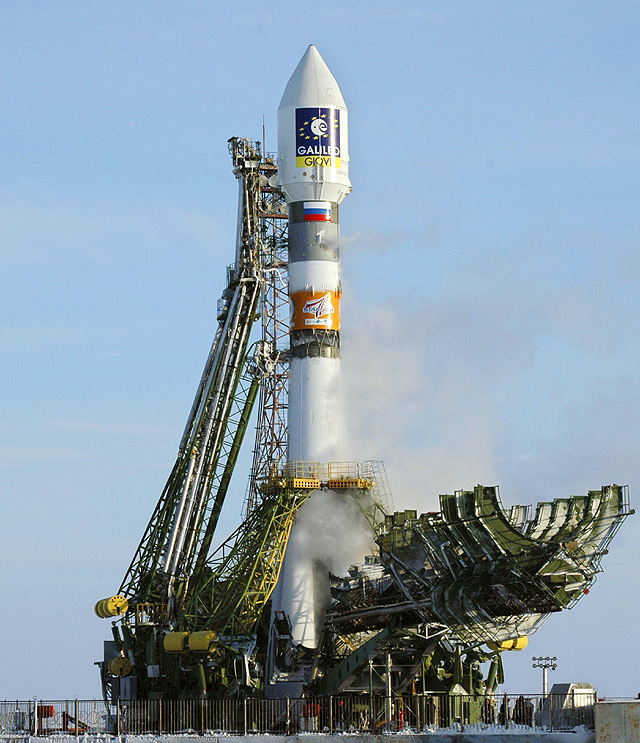
The GIOVE-A, the first in the European Union's Galileo satellite navigation program, is about to blast off from the Baikonur Cosmodrome in Kazakhstan. The satellite was launched Wednesday aboard a Soyuz rocket.
Galileo represents “the independence of the European Union,” French Foreign Minister Philippe Douste-Blazy said Wednesday after the 1,300-pound test satellite soared into orbit from the Baikonur Cosmodrome in Kazakhstan.
Plans call for the system to eventually include necklaces of 30 satellites above the Earth. The project also will give a major boost to the European aerospace industry.
The European Space Agency says it will guarantee operation of Galileo at all times except in case of the “direst emergency.” It does not define what such an emergency would be.