

WTO advances on farm export subsidies
Last-ditch deal keeps talks alive but work remains
Hong Kong ? World Trade Organization negotiators approved an agreement Sunday requiring wealthy nations to end farm export subsidies by 2013, a support system that poor nations say puts them at a competitive disadvantage.
The agreement, which also calls for modest reductions in other trade barriers, brings a binding treaty to further open up global trade one step closer.
All 149 WTO member nations and territories, from tiny Sierra Leone to the 25-nation European Union, endorsed the agreement after six days of hard talks that were accompanied by daily protests and occasional clashes between riot police and demonstrators outside.
But the deal fell far short of the ambitious deal that WTO negotiators had originally hoped to reach in Hong Kong: Agreeing on formulas for cutting farm and industrial tariffs and subsidies.
Toward that end, the accord set April 30 as a new deadline for working out the other cuts, which are required if the WTO is to formulate a new global trade treaty by the end of next year. No decision was made on a location and date for the next ministerial meeting.
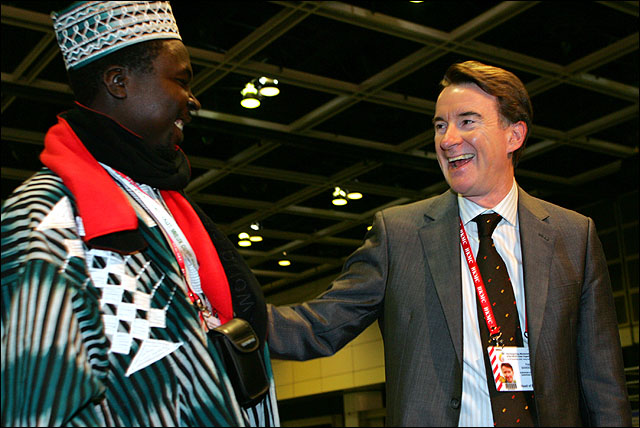
EU trade chief Peter Mandelson, right, chats with Chad delegate Baigong Pahimi prior to the World Trade Organization closing ceremony in Hong Kong. Bringing a binding global trade treaty one step closer, WTO negotiators on Sunday approved a trade agreement that eliminates farm export subsidies by 2013 and makes modest cuts in other trade barriers, while leaving many contentious issues for later.
Hong Kong clears the way for “the down and dirty of negotiations” that ministers face next year, said Susan Schwab, a deputy U.S. trade representative.
“We’ve got a lot of work ahead of us,” she said. “The progress made today really lays the groundwork for negotiations going forward.”
The agreement was “not enough to make it (the meeting) a success, but enough to save it from failure,” said the European Union’s trade chief, Peter Mandelson, whose delegation came under heavy pressure during the gathering to open up Europe’s farming market.
Since the WTO works by consensus, objections from even one member can hold up any deal.
The way was opened to an agreement when delegates managed a last-minute breakthrough on farm subsidies, with wealthy nations agreeing to eliminate their payments to promote exports like cotton and sugar by 2013. Developing nations say the subsidies make it hard for poor farmers to compete.
Poor nations had pushed for the farm subsidies to end by 2010, while the EU held out for 2013. But the accord includes a provision that a substantial part of the subsidies should end by “the first half of the implementation period” to set at a later date.
Although the agreement didn’t include cuts in import tariffs on industrial goods, it seeks to move those negotiations forward by meeting a demand from poor nations that the issue be dealt with in tandem with efforts to give developing countries flexibility in setting market-opening policies. It also links talks on agricultural trade with those in industrial goods.
In a victory for West African cotton-producing nations, rich countries agreed to eliminate all export subsidies on cotton in 2006.
That was a concession by the United States, a major cotton exporter. But U.S. Trade Representative Rob Portman said the proposal would be hard to sell to U.S. lawmakers.
Cotton growers in Burkina Faso, Benin, Chad and Mali say U.S. farm aid drives down prices, making it impossible for small family farms to compete in international markets.
The agreement also calls on wealthy nations to allow, by 2008, duty-free and quota-free trade privileges for at least 97 percent of products exported by the least developed countries, those with per capita incomes of less than $750 a year.
That was considered critical to the overall success of the current round of WTO talks, which began four years ago in Doha, Qatar, with the aim of bringing more liberalization to global trade while addressing the concerns of developing nations.