World AIDS Day marked with education, campaigns
Fatick, Senegal ? Schoolchildren in Senegal pledged to abstain from sex and village women in India cast off a veil of shame about their HIV status as World AIDS Day was marked Thursday around the globe.
“Our teacher told us that AIDS is a very dangerous disease,” said 13-year-old Aissatou Niang, wearing a green Muslim headscarf. “Only abstinence can save us,” she said as her schoolmates giggled nearby.
Such frank talk among African children is key, say anti-AIDS campaigners who emphasize science can help combat the disease.
About 40 million people worldwide are infected with HIV, the virus that causes AIDS. Some 3 million of them are expected to die of AIDS this year. Africa, with only 10 percent of the world’s population, suffers more than half of the world’s HIV infections.
Heavily Muslim Senegal is a relative bright spot on the continent, with only about 1 percent of the population infected. On Thursday, dozens of children packed a schoolhouse in the central town of Fatick to learn more.
“I’ve decided to wait until I’m 19 to have a relationship,” said one of the students, Awa Sarr. “When I go back home I’ll tell my brothers and sisters about AIDS. That’s why we’re here.”
In India, some 70 HIV-infected women stepped out of the shadows during a rally in Golaghat, a town in eastern Assam state, to acknowledge they are living with AIDS and should not be shunned.
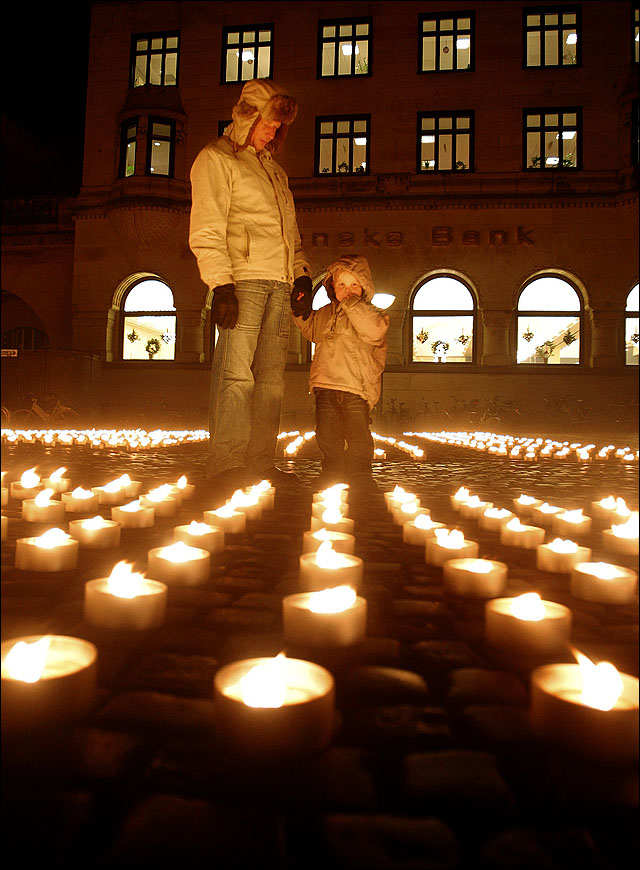
A man and child view 2,000 candles lit for the victims of HIV and AIDS on World Aids Day on Thursday in Copenhagen, Denmark. Organizers are marking the event by encouraging governments and the international community to meet their commitments in fighting the disease, with an emphasis this year on accountability.
An estimated 5.1 million people are living with HIV in India – the most in any country except South Africa. Nigeria, Africa’s most-populous nation, is third.
South African Deputy President Phumzile Mlambo-Ngcuka urged her countrymen Thursday to show their concern about AIDS throughout the year.
But in Swaziland, AIDS events were canceled by royal decree because they clashed with a traditional ceremony. More than 38 percent of adults in the country are infected with HIV.
Only a few dozen joined a procession in Nigeria’s biggest city, Lagos.
“Since I believe I don’t have it, I don’t see why I should march,” said Mufu Adebajo, a 22-year-old craftsman watching from his roadside stand. “Otherwise, people will think I have it.”
Health

ER visits for tick bites on the rise throughout the Midwest
FDA OKs first new sunscreen ingredient in over 25 years
WASHINGTON — Federal health regulators last week signed off on the first new sunscreen ingredient for the U.S. ...
OB-GYN group makes its 1st vaccine recommendations
A prominent OB-GYN group announced vaccine recommendations on Wednesday that differ from what the U.S. ...

How to talk to kids about vaping as fruity flavors make a comeback
Program that helped people with disabilities scrapped again
Margaret Tomlinson has been recovering from a traumatic brain injury for three years. Nearly a year ago, she moved ...