

Coroner: Six passengers were alive when plane crashed
Damaged voice recorder may hinder investigation
Athens, Greece ? Initial autopsies showed that at least six of the 121 people aboard a Cypriot plane were alive but not necessarily conscious when the aircraft crashed while on autopilot, a coroner said Monday, as authorities struggled to explain the actions of the pilot and crew.
The results of the first six autopsies shed some light on the final minutes of Helios Airlines Flight ZU522, which crashed Sunday into a hillside in suburban Athens, killing all 115 passengers and six crew members. But they failed to answer all the questions.
In Larnaca, the Cypriot city where the flight took off, police raided the offices of Helios Airlines, seeking “evidence which could be useful for the investigation into possible criminal acts,” said Cypriot deputy presidential spokesman Marios Karoyian.
Greek aviation officials have said the plane apparently lost pressure suddenly, causing a rapid loss of oxygen on board. In that case, passengers and flight crew would have had only seconds to put on oxygen masks before losing consciousness amid subzero temperatures. Death would be minutes behind.
But two fighter jet pilots who scrambled to intercept the plane saw the co-pilot slumped over, oxygen masks in the plane dangling, and two unidentified people trying to take control of the plane. The pilot was not in his seat when the plane crashed, about 2 1/2 hours after the crew first radioed in air conditioning problems, officials said.
The fire department has said none of the bodies had masks on their faces.
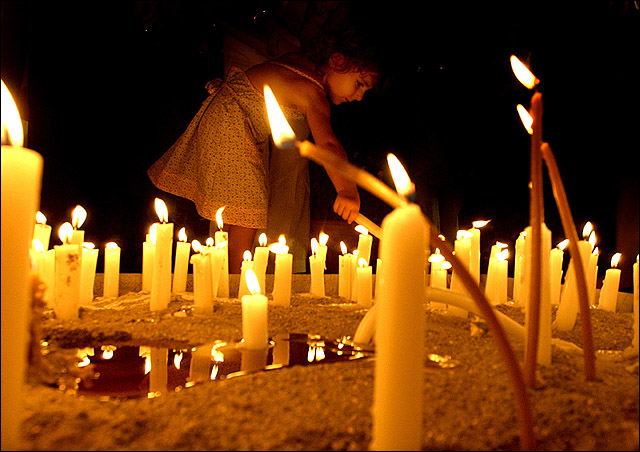
A YOUNG Cypriot girl lights a candle Monday during a prayer for 115 passengers and six crew members who were killed when Helios Airlines Flight ZU522 crashed Sunday.
Athens’ chief coroner, Fillipos Koutsaftis, said he could not determine whether the six people whose bodies were examined were conscious when the Helios Airways Boeing 737-300 plunged 34,000 feet into a mountainous area near the village of Grammatiko, 25 miles north of Athens.
“Our conclusion is they had circulation and were breathing at the time of death,” Koutsaftis said, but stressed: “I cannot rule out that they were unconscious.”
Officials in the coroner’s office said ongoing autopsies on another six bodies were likely to show similar results. They asked not be named because the results had not yet been publicly released.
Greek and Cypriot officials have ruled out terrorism as a cause of the crash.
Investigators, to be joined by U.S. experts, were sending the plane’s data and cockpit voice recorders to France for expert examinations.
But the head of the Greek airline safety committee, Akrivos Tsolakis, said the voice recorder was damaged. “It’s in a bad state and, possibly, it won’t give us the information we need,” he said.
The plane might have run out of fuel after flying on autopilot, air force officials said, asking not to be named in line with Greek practice.
Searchers still were looking for three bodies, including the plane’s German pilot, fire officials said. The body of the Cypriot co-pilot was found in the cockpit.
After the crash, authorities said it appeared to have been caused by a technical failure – resulting in high-altitude decompression. A Cypriot transport official had said Sunday the passengers and crew may have been dead before the plane crashed.
In a related development, police in northern Greece arrested a man who claimed to have received a telephone text message from a passenger. The man – identified as Nektarios-Sotirios Voutas, 32 – told Greek television stations that his cousin on board the plane sent him a cell-phone text message minutes before the crash saying: “Farewell, cousin, here we’re frozen.”
But authorities determined he was lying, and arrested him on charges of dissemination of false information.
A passenger list showed there were 20 children under the age of 16 on board, although the airline initially reported as many as 48 children were passengers.
The airliner’s pilots had reported air conditioning system problems to Cyprus air traffic control about a half-hour after takeoff, and Greek state TV quoted Cyprus’ transport minister as saying the plane had decompression problems in the past.
But a Helios representative said the plane had “no problems and was serviced just last week.”