

Modified hybrids hit up to 250 mpg
Engineers increase fuel efficiency by adding extra batteries
Corte Madera, Calif. ? Politicians and automakers say a car that can both reduce greenhouse gases and free America from its reliance on foreign oil is years or even decades away.
Ron Gremban says such a car is parked in his garage.
It looks like a typical Toyota Prius hybrid, but in the trunk sits an 80-miles-per-gallon secret – a stack of 18 brick-sized batteries that boosts the car’s high mileage with an extra electrical charge so it can burn even less fuel.
Gremban, an electrical engineer and committed environmentalist, spent several months and $3,000 tinkering with his car.
Like all hybrids, his Prius increases fuel efficiency by harnessing small amounts of electricity generated during braking and coasting. The extra batteries let him store extra power by plugging the car into a wall outlet at his home in this San Francisco suburb – all for about a quarter.
He’s part of a small but growing movement. “Plug-in” hybrids aren’t yet cost-efficient, but some of the dozen known experimental models have gotten up to 250 mpg.
They have support not only from environmentalists but also from conservative foreign policy hawks who insist Americans fuel terrorism through their gas guzzling.
And while the technology has existed for three decades, automakers are beginning to take notice, too.
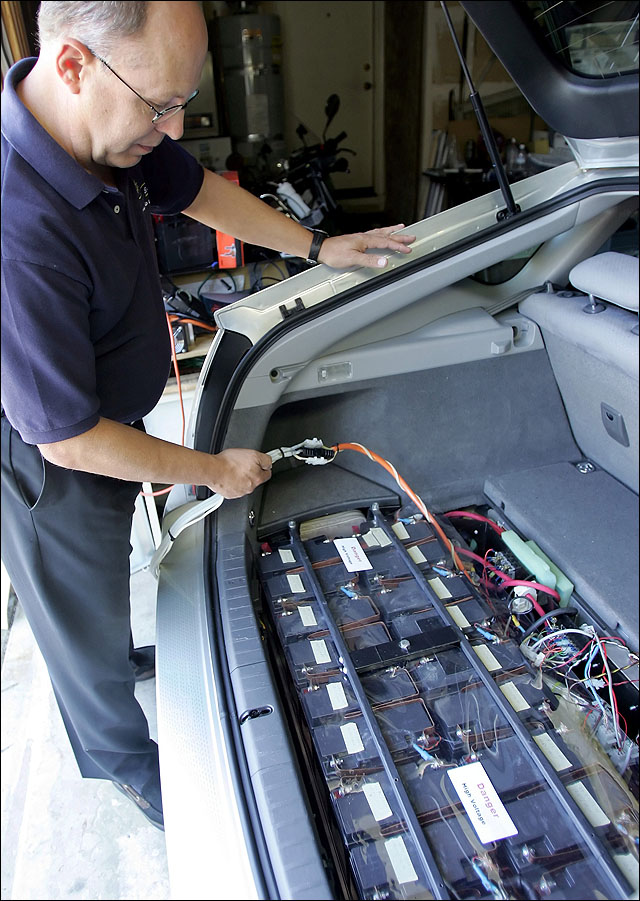
Ron Gremban shows the 18 electric bicycle batteries he added to his converted Toyota Prius at his home in Corte Madera, Calif. Engineers like Gremban have modified their Priuses by installing extra batteries to dramatically increase their efficiency when recharged at a power outlet. Gremban's Prius now gets up to 80 miles per gallon.
So far, DaimlerChrysler AG is the only company that has committed to building its own plug-in hybrids, quietly pledging to make up to 40 vans for U.S. companies. But Toyota Motor Corp. officials who initially frowned on people altering their cars now say they may be able to learn from them.
“They’re like the hot rodders of yesterday who did everything to soup up their cars. It was all about horsepower and bling-bling, lots of chrome and accessories,” said Cindy Knight, a Toyota spokeswoman. “Maybe the hot rodders of tomorrow are the people who want to get in there and see what they can do about increasing fuel economy.”
The extra batteries let Gremban drive for 20 miles with a 50-50 mix of gas and electricity. Even after the car runs out of power from the batteries and switches to the standard hybrid mode, it gets the typical Prius fuel efficiency of around 45 mpg. As long as Gremban doesn’t drive too far in a day, he says, he gets 80 mpg.
Others are modifying hybrids, too.
Monrovia-based Energy CS has converted two Priuses to get up to 230 mpg by using powerful lithium ion batteries. It is forming a new company, EDrive Systems, that will convert hybrids to plug-ins for about $12,000 starting next year, company vice president Greg Hanssen said.
University of California, Davis engineering professor Andy Frank built a plug-in hybrid from the ground up in 1972 and has since built seven others, one of which gets up to 250 mpg. They were converted from nonhybrids, including a Ford Taurus and Chevrolet Suburban.
Frank has spent $150,000 to $250,000 in research costs on each car, but believes automakers could mass-produce them by adding just $6,000 to each vehicle’s price tag.
Instead, Frank said, automakers promise hydrogen-powered vehicles hailed by President Bush and Gov. Arnold Schwarzenegger, even though hydrogen’s backers acknowledge the cars won’t be widely available for years and would require a vast infrastructure of new fueling stations.
“They’d rather work on something that won’t be in their lifetime, and that’s this hydrogen economy stuff,” Frank said. “They pick this kind of target to get the public off their back, essentially.”