

Wal-Mart aspires to be hip, hires trend scouts
Discount giant makes room for stylish clothing, home decor
New York ? Head south on Fifth Avenue, past the look-but-don’t-touch boutiques of Bruno Magli, Salvatore Ferragamo and Henri Bendel, stop at 31st Street and look for a building on the right, between the fast-food restaurant and the souvenir shop.
There, on the sixth floor, sits the only Wal-Mart in Manhattan – not a store, but offices, a laboratory even, where veterans from Nautica, OshKosh B’Gosh and the West Elm furniture catalog work, largely in secret, to help the nation’s largest retailer earn one designation that has long eluded it: Hip.
These retail warriors divine what’s hot by walking the streets of SoHo, sneaking into boutiques in London and snapping photos of teens in Tokyo. They forecast trends in clothing, home decor and furniture in advance of a season, then transmit the details to colleagues in Arkansas who ultimately determine what reaches the shelves of the company’s 3,400 stores.
Given its reputation as a juggernaut, it’s a curious sensation to consider Wal-Mart’s vulnerability. But that is what the two-year-old New York Trend Office is there to address.
With trends in fashion trickling down into everything from toasters to infant clothing, the chain suddenly is worried about missed opportunities. Since its 1962 founding, the company has built its business on the traditional-minded, lower-income shopper who, judging by its merchandise, wants the basics: a sturdy nightgown, a reliable bathing suit, a six-pack of children’s underwear. (Wal-Mart sells one of every two pairs in the United States.)
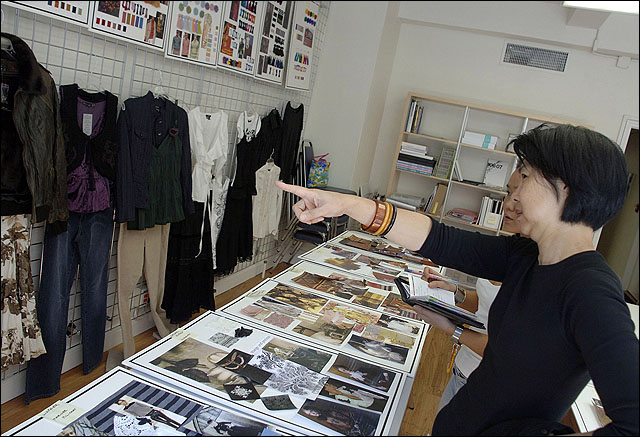
Fran Yoshioka, consultant for women's trends, looks for clothing themes for fall 2006 at Wal-Mart's design office in New York City. One study shows that of the 100 million consumers shopping at Wal-Mart every week, only 34 percent buy apparel.
The discount giant has stuck by that consumer, earning billions of dollars in the process. But now it is rethinking things – placing ads in fashion bible Vogue; having its TV commercials portray a lifestyle, not just a smiley face rolling back prices; even considering hiring a big-name designer. For it has not escaped the attention of Bentonville, Ark., that the rest of the retail world has discovered a different, more lucrative shopper – one who craves style for style’s sake.
Looking ahead
As Wal-Mart upgrades its merchandise to compete with edgier rivals, the New York staff is serving as a scouting party, watching carefully to ensure that a chain known for missing trends now has the right product at the right moment.
But for its globe-trotting exploits to pay off, the Trend Office must change not just what Wal-Mart carries but how the retailer thinks about merchandise, according to those inside and outside the company.
For 43 years, Wal-Mart has been obsessed with individual bargains – the $24 DVD player, the $12.90 twill jacket – regardless of how they fit in with the rest of the store’s merchandise, or even whether they are in style. That singular focus on best sellers has left the chain without the storewide design aesthetic that has turned rival Target into “Tar-zhay,” crammed with bold, contemporary patterns and designs that evoke a lifestyle. And it has left Wal-Mart vulnerable at a time when customers at all levels want fashion.
“We are an item house,” concedes Claire Watts, Wal-Mart’s vice president of product development. “But customer expectations require more than great items.”
What they require, designers say, are risky forays into fashion, the kind that could alienate Wal-Mart’s core customer.
For designer cachet, Target recruited architect Michael Graves and designers Todd Oldham and Isaac Mizrahi to create clothes and home furnishings exclusive to the chain. Hip Swedish retailer H&M snagged Karl Lagerfeld to do the same.
Buying power
The average household income of shoppers at:
¢ Wal-Mart: $44,000
¢ J.C. Penney: $51,000
¢ Target: $55,000
¢ Kohl’s: $62,000
¢ Bed, Bath & Beyond: $64,000
Source: BIGresearch
This movement goes by many names: the democratization of fashion, the dawn of cheap chic. The motivation is simple: A globalized generation of consumers, reared on the endlessly self-improving and consuming message of “Queer Eye” and “What Not to Wear,” is eager for the next trend, even if that skirt or sofa or sneaker lasts only one season.
“This is the trend that keeps on giving,” said Marshal Cohen, chief analyst at market research NPD Group.
NPD has found that a typical appliance consumer would rather buy five or six hip-looking blenders for $19.99 over the next 10 years than a single sturdy one for $89.
“Sure, they know they are getting one that may break down in a few years,” Cohen said, “but they will be able to keep getting the latest.”
Why is Wal-Mart just discovering this?
Running out of room
Until now, the company’s growth relied on a steady schedule of new store openings – about one a day this year. But as it runs out of new places to plop down its mammoth stores, investors are focusing on its lackluster same-store sales, a closely watched figure measuring purchases at stores open for at least a year.
Here, Wal-Mart consistently trails Target, according to Deutsche Bank Securities Inc. Wal-Mart executives blame the sluggish same-store sales on their decision to build new stores close to older ones, which temporarily dampens sales at the older store but ultimately, they say, creates more Wal-Mart shoppers.
Veteran Wal-Mart watcher Bill Dreher, of Deutsche Bank, isn’t buying it.
“Cannibalization is a factor, but not the only or the dominant one in Target’s much stronger performance,” he said.
One culprit, analysts speculate, is Wal-Mart’s shoppers, who consistently seek clothing and home decor outside the chain – namely at J.C. Penney, Kohl’s and Target. One hundred million consumers shop at Wal-Mart every week, but only 34 percent buy apparel there, according to a study by STS Market Research.
Hence the Trend Office in New York, with its 10-person staff – mostly free-lance consultants – that includes Fran Yoshioka, a former trend and design director at Sears; Bryan Norris, formerly a design director for men’s clothing at Nautica; and Lynn Neulander, who has designed home lines for Jonathan Adler and Tracy Porter and apparel for Levi Strauss and Van Heusen.
‘Neutral’ approach
The walls are covered with product samples – a sheer tunic studded with beads from Paris, a silky camisole from London – that will serve as inspiration for the chain’s in-house brands.
Wal-Mart’s store brands are designed with a specific consumer in mind: Puritan for the frugal, traditional man; White Stag for the frugal, traditional woman; and George for the preppy working man or woman.
Designers at work on 2006 lines have shopped the world’s fashion capitals for the right mix of colors, fabrics and cuts. For spring and summer, “color has gotten neutralized and softer,” said Yoshioka, creative director for women’s clothing. “Everyone wants to do bright colors, but neutrals are the right thing to do.”
For fall 2006, “we are going back to the turn of the century, looking at Victorian, Edwardian, Gothic,” she said. “That’s where high-level designers’ heads are.”
Wal-Mart, she said, “will not do a Victorian look. It would not look right. Or Edwardian. Or a Gothic look. So what is there about that inspiration we can pull and add to our basic look?”
The creative director for men’s clothing is experimenting with the chain’s No Boundaries label, which he describes as an “Urban Outfitters-meets-American Eagle-meets-Abercrombie & Fitch sort of look.” Norris has proposed a rugby-style T-shirt with a graphic on the chest and stripes on the shoulder.
Translating inspiration into a product at Wal-Mart isn’t always easy, as the designers are finding out. For fall, Neulander, the creative director for home, had lobbied for sateen bed linens with a Jacquard weave, a trend she had spotted in her research. Wal-Mart toned down the pattern, but she thinks her original idea will happen for spring 2006.
“I feel like we missed it for four to five months,” she said.
When it comes to spotting trends, Bentonville is “uncomfortable. It’s like something over there,” she said, pointing to the distance, “that they are not used to.”
“I don’t want to look like yesterday,” she said, “even for that traditional customer.”
Splurging for stools
The Trend Office itself is classic Wal-Mart, with penny-pinching touches like fake hardwood floors. The cubicles, tables and chairs are standard-issue from Bentonville. But, in a nod toward the office’s fashion ambitions, workers asked to use wall paint a shade brighter than the grayish Wal-Mart white, and to splurge on a set of stools from Design Within Reach.
Quotes from Sam Walton cover the walls.
“We try to live the culture of Wal-Mart, to an extent,” said the head of the Trend Office, Lisa Waltuch, standing in front of a window whose shade, in certain lights, reveals a photo of Sam Walton.
Of course, they also are challenging that culture.
Recently, the New York staff began pushing their counterparts in Bentonville to carry more skirts, given the amount of attention that longish gathered, patterned skirts have been getting in the fashion press.
“Their response was, ‘Oh, we’ve never done well with skirts,'” Waltuch said. “We said, ‘You have to get a couple of them in your lines.’ “
For decades, the retailer has relied on its suppliers to tell the chain what’s fashionable. The problem was that the company had no way of knowing if the vendors were wrong.
“A lot of suppliers got used to selling us large quantities of last year’s look,” said Watts, the vice president of product development.
The Trend Office is branching out into design, too, pitching its own back-to-school collections for fall 2006 that include sleek fluted lamps, bolster pillows, claw-foot coffee tables and retro-inspired alarm clocks.
But as Wal-Mart steps out of its comfort zone, it runs the risk of walking right past its conservative shoppers. A risque line of T-shirts for the teen and ‘tween set carries sexually suggestive messages such as “My boyfriend is out of town,” “Meet me after school,” and a brief but provocative self-description, “Easy.”
In a first, Wal-Mart will have an advertisement in an upcoming issue of Vogue depicting Wal-Mart shoppers discovering style in the store, said Julie Lyle, the chain’s vice president of marketing and advertising.
Back on the sixth floor of the New York Trend Office, above a rack of tunics, camisoles and jackets picked up from boutiques in Paris, London and New York, is a quote from founder Sam Walton, stenciled on a wall painted Wal-Mart blue:
“You can’t just keep doing what works one time. Everything is changing. To succeed, stay out in front of changes.”
Yoshioka looked up at it and smiled.
“They’re trying,” she said. “They’re really trying.”