

King Fahd buried in simple Saudi grave
Riyadh, Saudi Arabia ? The body of King Fahd was shrouded in his brown cloak and lowered into an unmarked desert grave Tuesday as the powerful monarch’s death was marked with the simple rites of this puritanical kingdom.
Hundreds of people, including Muslim princes and potentates from around the world, crowded into Riyadh’s Imam Turki bin Abdullah Mosque to hear the Koranic prayers for the dead chanted over the body of Fahd, who ruled Saudi Arabia nearly a quarter of a century.
In life, the Saudi king ruled over untold riches and the most sacred shrines in Islam. But in death, Fahd was whittled down to the plainest possible profile. He was laid to rest in a dreary stretch of brown dirt and crumbling mud-brick markers, his remains left to languish anonymously among the bones of thousands of other Saudis.
It was a final, egalitarian note after a life of opulence and privilege. But it was also a reminder that, for all of Saudi Arabia’s much-stereotyped materialism, there is a contradictory tendency to weigh spirituality and humility as measurements of dignity.
“Kings the world over have sumptuous funerals that we’ve seen on television,” the news anchor on state-run Saudi television reminded the many viewers who tuned in to the live coverage of the king’s rites. “But the kingdom of Saudi Arabia abides by the Sharia,” or Islamic jurisprudence.
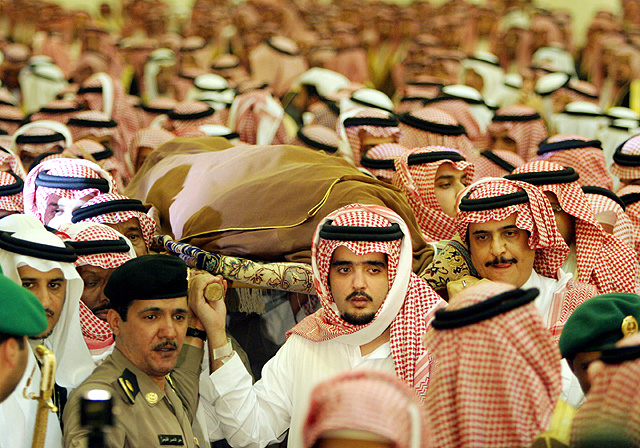
Saudi Prince Abdul Aziz Bin Fahd, center, a son of the late King Fahd, helps carry the shrouded body of his father before performing special prayers at Riyadh's Turk bin Abdullah mosque. King Fahd died Monday at age 84.
While several neighboring Arab countries ground to a stop to mourn a man who had loomed as one of the defining figures in Middle East politics, people in the Saudi capital went about their business with no apparent show of emotion. Shops and cafes were bustling. The stock market closed briefly on Monday, but reopened before the day was over. Government employees stayed at their desks. Flags flapped at full staff.
“Maybe to the outside world we seem cold, but that’s the way we are about things,” said Jamal Khashoggi, a senior adviser to the Saudi foreign ministry.
“We’re very orthodox about things. We want to stick to the pure, simple, prescribed ritual,” he said. “When it comes to death, a person is ascending to the kingdom of God, so we have to be careful. We can’t be innovative about death and have a music march or this or that.”
Non-Muslims were not allowed at the rites; neither were women. Pakistani President Pervez Musharraf, Hosni Mubarak of Egypt, Syrian President Bashar al-Assad, Afghanistan’s Hamid Karzai, Jordan’s King Abdullah II were among the mourners at Tuesday’s ceremony. French President Jaques Chirac paid a condolence call afterward to the royal family.
Vice President Dick Cheney is expected to lead the American delegation at today’s ceremonies. But by then attention will have fallen away from the dead king. Instead, the focus will stay staunchly on the future – Saudis of all backgrounds will come forward to pledge their loyalty to the newly named King Abdullah.