

China, Japan fail to settle dispute
Jakarta, Indonesia ? Leaders of China and Japan met Saturday to try to settle their nations’ worst dispute in three decades, but failed to reach an agreement in the bitter feud over Tokyo’s handling of its World War II atrocities.
Chinese President Hu Jintao told Japanese Prime Minister Junichiro Koizumi that Tokyo had to back up its apologies for wartime atrocities with actions, while Japan played down the tension.
After days of uncertainty over whether the meeting would take place on the sidelines of a conference for Asian and African leaders, Hu and Koizumi sat down to hammer out their differences in a tightly guarded, closed-door session.
“At the moment, Sino-Japanese relations face a difficult situation. Such a difficult situation is not one we want to see,” an unsmiling Hu told reporters in a rare public statement after the 55-minute meeting.
But, he said, “the strong reaction of the Chinese people and the concerns of people from other Asian countries are something that the Japanese side should seriously reflect on.”
It was the first top-level discussion since violent anti-Japanese protests by tens of thousands of people erupted earlier this month in major Chinese cities over Tokyo’s approval of school textbooks that critics claim whitewash wartime atrocities. Chinese also are upset over Japan’s campaign for a permanent seat on the U.N. Security Council.
Japan has asked for an official apology and compensation for the demonstrations, but China has given no indication that it plans to oblige.
If the row cannot be resolved, “it would be detrimental to China and Japan and would affect stability and development in Asia,” Hu warned.
Koizumi agreed the issue could affect regional ties, but struck a more conciliatory note. The two sides are linked by billions of dollars in trade and investment, with China displacing the United States last year as Tokyo’s largest trading partner.
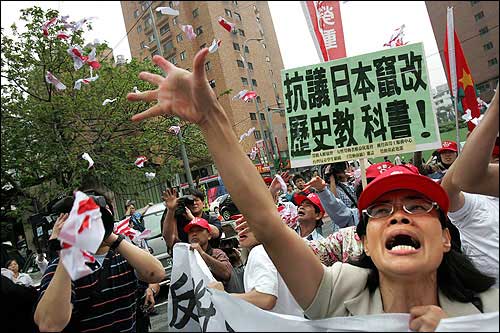
A pro-China labor party supporter throws a shredded Japanese flag during a protest Saturday against Japan's bid for a permanent seat on the U.N. Security Council in front of the Japanese trade office in Taipei, Taiwan. Chinese relations with Japan are also strained by Tokyo's recent handling of its World War II atrocities.
“Japan and China have never needed each other as much as they do today,” Koizumi said in a separate press conference. “We want to promote this relation … instead of agitating hostile feelings.”
He also urged Beijing not to be affected by “temporary confrontations and differences of opinion.”
China, South Korea and other Asian nations have long accused Japan of not apologizing adequately for invading and occupying its neighbors, and Chinese animosities are aggravated by their rivalry with the Japanese to be the region’s dominant power.
At least 12 million Chinese citizens died in Japan’s assault on their nation in the 1930s and 40s. Japan, an ally of Nazi Germany, conquered much of East Asia before its forces surrendered in August 1945. Atrocities include mass sex slavery and germ warfare.