

Trade deficit hits new high
Democrats say Bush's free trade policies not working
Washington ? The U.S. trade deficit reached a record monthly high of $61.04 billion in February as imports of oil and textiles surged while American exports barely budged.
The deficit figure sent tremors through Wall Street with investors worrying that the huge amount of foreigners’ money America needs to finance the deficit could at some point trigger a freefall in the dollar and aggravate U.S. inflation problems.
The February deficit, which was up 4.3 percent from a January trade gap of $58.5 billion, was seized upon by Democratic critics as further evidence that President Bush’s free trade policies are not working. They vowed to oppose Bush’s drive to win passage of the Central American Free Trade Agreement covering six Latin American countries.
“Uncle Sam has been played for Uncle Sucker by incompetent trade negotiators, a failure to enforce trade agreements and by our trading partners who see the U.S. as a patsy,” said Sen. Byron Dorgan, D-N.D., who is leading the effort to defeat CAFTA.
The big jump in textile and clothing imports was expected to spur pressure on the administration to erect barriers to protect domestic manufacturers from a surge in imports from China since global textile quotas expired at the beginning of this year.
Imports of Chinese textiles and clothing are up a sharp 62.4 percent in the first two months of this year, compared with the same period a year ago.
The administration last week began an investigation that could lead to the re-imposition of quotas in certain categories of clothing, an action U.S. manufacturers contend is urgently needed to prevent Chinese goods from wiping out what is left of the U.S. textile and apparel industry.
For the first two months of this year, the overall trade deficit was running at an annual rate of $717.2 billion, a full $100 billion above the record imbalance of $617.1 billion set for all of 2004.
Analysts said the deficit for all of 2005 was likely to set another record of around $675 billion.
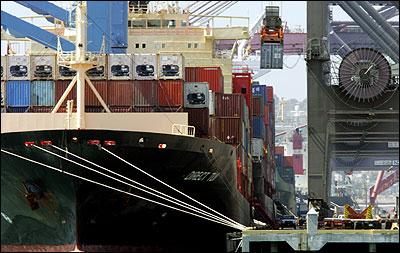
Containers are moved off a ship last month at the Port of Los Angeles. The U.S. trade deficit, exacerbated by surging imports of oil and textiles, soared to an all-time high of 1.04 billion in February.
“We are hemorrhaging red ink in our trade accounts, and the red ink is just spreading wider and deeper,” said Mark Zandi, chief economist at Economy.com.
While the dollar has fallen for three years against the currencies of Europe and Canada, it has not budged at all against the Chinese yuan because of China’s policy of pegging its currency to the dollar. The National Association of Manufacturers said that practice had undervalued the yuan by as much as 40 percent, giving the country a huge competitive advantage over American firms.