

Pope considered resigning, ordered his papers burned
Vatican City ? Five months after he was elected to the Throne of St. Peter, 58-year-old John Paul II took up his pen and began writing thoughts about his death. Still vigorous in the early years of his papacy, he worried about threats to his church and to his native land.
Over the years, as his health declined, awareness of his own mortality grew. The assassination attempt in 1981 weighed heavily on him. “All the more deeply, I now feel that I am totally in the hands of God,” he wrote the year after he was wounded in an entry in his last will and testament.
By 2000, 80 years old and feeling the debilitating effects of Parkinson’s Disease, he wondered if he should resign. He prayed that God would “help me to recognize up to what point I must continue this service.”
The document released by the Vatican on Thursday provides extraordinary insight into the thinking of John Paul, who died Saturday at age 84.
Probably alone in his apartments, he reviewed his testament during the month of Lent, a time of reflection for Catholics. Writing in Polish in longhand, he amended or added to his testament in five years — sometimes with more than one entry, and once with a single line asking for Masses and prayers after his death.
“The times in which we live are unutterably difficult and disturbed,” he wrote in 1980, a time when his native Poland was in turmoil and under a communist yoke. “The path of the church has also become difficult and tense … both for the faithful and for pastors.”
Burn order
It was in those turbulent times that John Paul instructed his faithful personal secretary, Archbishop Stanislaw Dziwisz, to burn his personal notes — an order he never rescinded or referred to again in the testament over the next 25 years.
The contents of those notes will never be known.
Publication of John Paul’s last will came on the eve of his funeral, which promised to be one of the largest Western religious gatherings of modern times. It will be conducted with the pomp of an ancient liturgy and attended by royalty, political power brokers and multitudes of the faithful.

Former Presidents Bill Clinton, from left, and George H.W. Bush and President Bush greet Italian Prime Minister Silvio Berlusconi, Thursday in Rome. The visit came on the eve of today's funeral for Pope John Paul II.
Visitors flood Rome
Throngs of pilgrims — the hardiest of some 4 million who flooded Rome — were rewarded for holding out after police closed off the line Wednesday night waiting to view John Paul’s remains in St. Peter’s Basilica. In the morning, the barriers were lifted for more mourners as the numbers who said a personal farewell approached 2 million since the body went on public view Monday. The basilica’s towering bronze doors were closed late Thursday.
Pilgrims staked out positions with sleeping bags and blankets just outside St. Peter’s Square, getting as close they could to the scene of the funeral — even though they will see little more than the same images on giant television screens as could be seen elsewhere in the city.
Rome groaned under the weight of visitors. Side streets were clogged in a permanent pedestrian rush hour, mostly by kids with backpacks. Tent camps sprang up around the city to take the spillover from hotels. Hawkers jacked up prices of everything from bottled water to papal trinkets.
“You really have to love the pope to be willing to do this,” said Nathanael Valdenaire, a young Frenchman who slept on the pavement in a sleeping bag alongside his sisters.
As dignitaries poured into the city, Rome’s security agencies — bolstered by NATO surveillance aircraft overhead — cranked up their defenses for everything from terrorism to unruly crowds.
| Here are some local events commemorating the life of Pope John Paul II:¢ St. Lawrence Catholic Campus Center, 1631 Crescent Road:Today: Mass for the Holy Father, 7 p.m.¢ St. John the Evangelist Catholic Church, 1234 Ky.:The 8 a.m. and 5:30 p.m. Saturday Masses will be offered in the pope’s memory. |
City locked down
Rome authorities planned to lock down the city. Starting Thursday night, vehicle traffic was banned from the city center. Air space was closed, and anti-aircraft batteries outside the city were on alert. Naval ships patrolled both the Mediterranean coast and the Tiber River near Vatican City, the tiny sovereign city-state encompassed by the Italian capital.
President Bush, along with former presidents Bill Clinton and George H.W. Bush, knelt and prayed at the side of the pope’s bier Wednesday night immediately after arriving from Washington, then paid a courtesy call Thursday on Italian President Carlo Azeglio Ciampi. They planned dinner with Italian Prime Minister Silvio Berlusconi.
The U.S. delegation was to be joined Friday by Prince Charles, who postponed his own wedding by one day to honor the pope; by U.N. Secretary-General Kofi Annan; and by representatives of more than 80 countries. Jewish and Muslim religious leaders will be there, along with Israel’s foreign minister and the head of the Arab League.
His testament
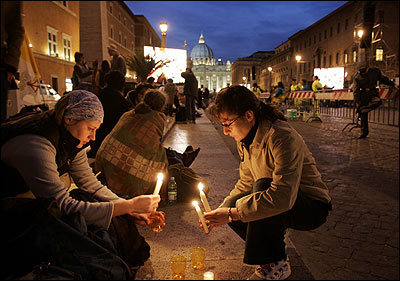
Faithful light candles along the street leading to St. Peter's Basilica, at the Vatican. Police reopened the line to the Basilica on Thursday, giving the faithful a final chance to pay respects to Pope John Paul II, whose funeral is today.
In his testament, John Paul said he left no material property.
It mentioned only two living people: Dziwisz and the retired chief rabbi of Rome, Elio Toaff, who welcomed him to Rome’s synagogue in 1986 in a historic gesture of reconciliation between Roman Catholics and Jews.
In an early entry, he scratched in the margins that he wanted to be buried “in the bare earth, not a tomb.” Accordingly, John Paul will be placed in the grottoes under St. Peter’s Basilica.
In 1982, the pope considered the possibility of a funeral in his native Poland. Three years later, however, he left the site of his burial in the hands of the cardinals.
The same entry worried about the safety of the church and of his own country in the days before the fall of the communist regime.
“In some countries … the church is undergoing a period of such persecution as to be in now way lesser than that of early centuries; indeed, it surpasses them in its degree of cruelty and hatred,” he wrote. “And apart from this, many people disappear innocently, even in this country in which we are living.”
At the end of the March 2000 entry, John Paul remembered his family, his childhood and his early priesthood in Poland.
“As the end of my life approaches I return with my memory to the beginning, to my parents, to my brother, to the sister (I never knew because she died before my birth), to the parish in Wadowice where I was baptized, to that city I love, to my peers, friends from elementary school, high school and the university, up to the time of the occupation when I was a worker, and then in the parish of Niegowic, then St. Florian’s in Krakow, to the pastoral ministry of academics, … to Krakow and to Rome. … to the people who were entrusted to me in a special way by the Lord.
“To all I want to say just one thing: “May God reward you.”‘