

Dinosaur called first stealth hunter
Washington ? The strike would have come out of nowhere: One second the fish was swimming placidly, no danger in sight, a moment later it was lunch.
Scientists have discovered what may have been one of the first stealth hunters, a long-necked swimming dinosaur that could sneak up on prey and attack without warning.
“The long neck would allow it to approach prey without the whole body becoming visible,” Olivier Rieppel of the Field Museum in Chicago, a co-author of the report, said in a telephone interview.
The newly found reptile with fangs lived in a shallow sea in what is now southeast China more than 230 million years ago, the research team, led by Chun Li of the Chinese Academy of Sciences, reports in Thursday’s issue of the journal Science.
Li first found the head of the dinosaur in the fall of 2002, and later uncovered the remainder of the animal. He named it Dinocephalosaurus orientalis, meaning terrible headed lizard from the Orient.
Dinocephalosaurus — with a body about three feet long and a neck adding five and a half feet — is related to Tanystropheus, another long-necked reptile that lived in the area of Europe and the Middle East.
But the researchers said the newly named creature had 25 neck vertebrae, more than twice that of Tanystropheus, and in Dinocephalosaurus they were not as elongated. It had rib-like bones parallel to the vertebrae.
Both are members of a diverse reptile group called the protorosaurs, which have long necks and elongated vertebrae.
Scientists have long wondered at the purpose for the long necks in this group of animals.
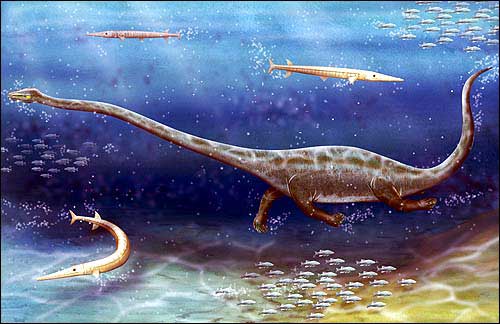
This is An artist's rendering of Dinocephalosaurus orientalis, a long-necked sea reptile that probably preyed on fish and squid in a shallow sea in present-day southeast China more than 230 million years ago. The creature's relatively stiff, 1.7-meter-long neck was almost twice as long as its trunk, which measured less than one meter in length. Every effort has been made to ensure the accuracy of this illustration of Dinocephalosaurus orientalis. It must be noted, however, that the tail and soft tissues, including the muscles, were not preserved with the skeleton. Also illustrated: Saurichthys curionii and schools of semionotid fish.
“This is important research because we have finally explained the functional purpose of this strange, long neck,” said Rieppel, curator of fossil amphibians and reptiles at the Field Museum.
As Dinocephalosaurus approached in murky water, its prey would have been aware only of the relatively small head, not the profile of a predator.
Michael LaBarbera of the University of Chicago, a co-author of the report, said the rib-like bones along the side of the neck might also have played a role in hunting.
According to LaBarbera, contraction of the creature’s neck muscles could have rapidly straightened the neck and splayed the neck ribs outward.
That would have greatly increased the volume of the throat, allowing the animal to lunge forward in the water at prey. Ordinarily, lunging through water creates a pressure wave that a fish can sense, allowing it to flee.
But the researchers said that by suddenly enlarging its throat Dinocephalosaurus could suck in and swallow its own pressure wave, giving it ability to strike without warning.
“It allowed an almost perfect strike at prey, which usually consisted of elusive fish and squid,” Rieppel said.