

WWF report says humans pillaging Earth’s resources
Geneva ? Humanity’s reliance on fossil fuels, the spread of cities, the destruction of natural habitats for farmland and over-exploitation of the oceans are destroying Earth’s ability to sustain life, the environmental group WWF warned in a new report Thursday.
The biggest consumers of nonrenewable natural resources are the United Arab Emirates, the United States, Kuwait, Australia and Sweden, who leave the biggest “ecological footprint,” the World Wildlife Fund said in its regular Living Planet Report.
Humans currently consume 20 percent more natural resources than the Earth can produce, the report said.
“We are spending nature’s capital faster than it can regenerate,” said WWF chief Claude Martin, releasing the 40-page study. “We are running up an ecological debt which we won’t be able to pay off unless governments restore the balance between our consumption of natural resources and the Earth’s ability to renew them.”
But Fred Smith, president of the Washington-based Competitive Enterprise Institute and a former official of the U.S. Environmental Protection Agency during the Nixon and Ford administrations, said he was skeptical. In a telephone interview, Smith said the WWF view was “static” and failed to take into account the benefits many people get from resource use.
Use of fossil fuels such as coal, gas and oil increased by almost 700 percent between 1961 and 2001, the study said.
Burning fossil fuels — in power plants and automobiles, for example — releases carbon dioxide, which experts say contributes to global warming. The planet is unable to keep pace and absorb the emissions, WWF said.
Populations of land, freshwater and marine species fell on average by 40 percent between 1970 and 2000. The report cited urbanization, forest clearance, pollution, overfishing and the introduction by humans of non-native animals, such as cats and rats, which often drive out indigenous species.
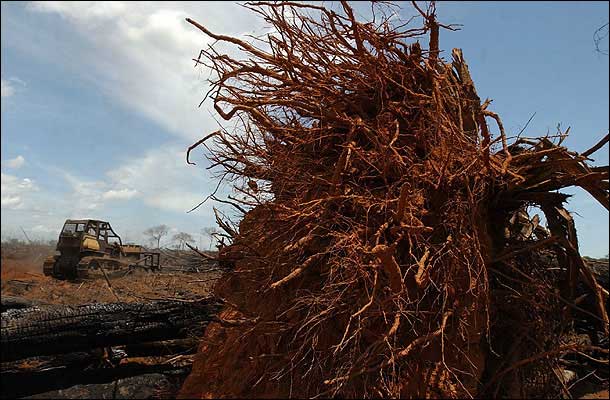
A tractor clears Amazon rainforest to make way for soybean farming near the border with the Xingu Indian Reservation, some 90 miles north of the city of Querencia at the central state of Mato Grosso, Brazil, in this Nov. 28, 2003, file photo. The World Wildlife Fund says its newest report that the destruction of such natural habitats is robbing the Earth's ability to sustain life.
“The question is how the world’s entire population can live with the resources of one planet,” said Jonathan Loh, one of the report’s authors.
The study, WWF’s fifth since 1998, examined the “ecological footprint” of the planet’s entire population.