

Job losses, national debt weigh on voters’ minds
Americans discuss whom they support
For voters across America, the state of the economy determines whether they’ll find a new job, be able to pay their bills and keep their businesses growing.
As Election Day approaches, people are not only concerned about their lives, but the economic prospects for the next generation.
President Bush and Sen. John Kerry have proposed contrasting economic plans: Bush relies heavily on tax cuts, which he says spur job creation. Kerry argues the president’s tax policies favor the rich, and wants tax relief for those earning less than $200,000 a year.
Bush argues the economy is growing steadily; Kerry says the president has lost jobs overall. In a recent AP-Ipsos Public Affairs poll, less than half of likely voters, 47 percent, approved of Bush’s performance on the economy.
Amid debates about tax cuts, the outsourcing of jobs overseas and the national debt, voters at their kitchen tables consider their own pocketbooks today and their economic hopes for tomorrow. Here are some of their reflections:
Single mother
Jackie Cummins, a 33-year-old single mother, was laid off last year from her job as an assembler at Maytag Corp. in Galesburg, Ill., where she earned about $15 an hour. Last month, Maytag ended refrigerator production at the plant and moved jobs to Mexico and Iowa. Cummins, who adopted two children, 3 and 5, shortly before she lost her job, attends a community college and is looking for work. She supports Kerry.
“I think there’s a little bit of hope with every election year, but I think there’s a major amount of fear here. If some kind of major employer doesn’t come back to this local area, I don’t think we’re going to have anything left to stay for. …
“There’s a lot of tension, a lot of angry people. People were really upset that our jobs would move out of the country. … How would you meet your mortgage payments, your automobile payments, insurance? Everybody was just like, ‘Oh, my God, how am I going to make it?’ A lot of houses went up for sale. People were selling house, cars, everything, and you still see it today. …
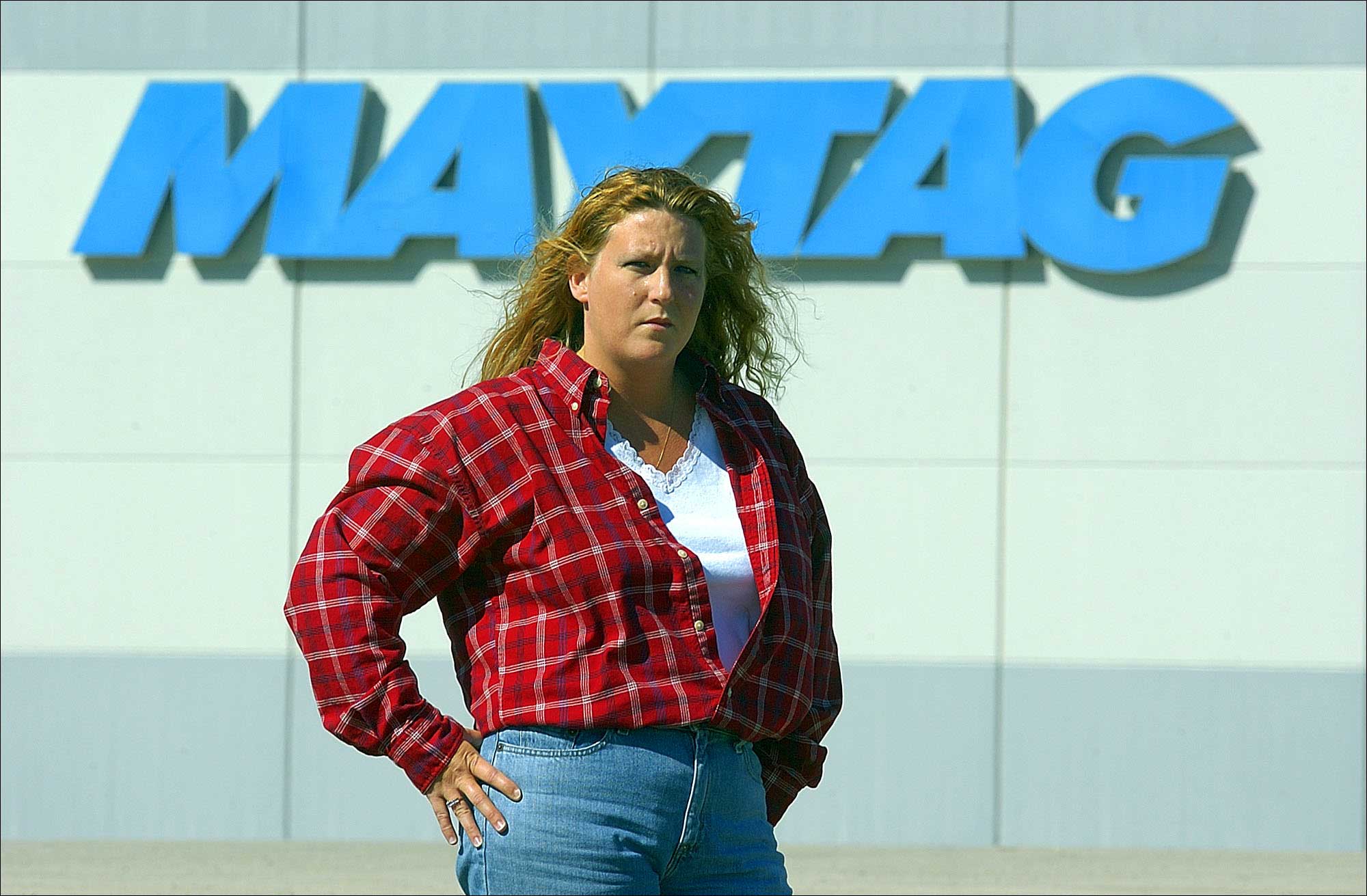
Jackie Cummins was laid off from her job as an assembler at the Maytag Corp. in Galesburg, Ill., in the fall of 2003. She stood Sept. 30 in front of the plant where she worked for 5 an hour. Maytag recently ended refrigerator production at the plant and moved the jobs to Mexico and Iowa. She supports Sen. John Kerry.
“It’s made me a lot more political, a whole lot more interested in what is going on in the world, instead of just my tiny little community. I look at Japan, China. …
“I understand the need to compete in the marketplace, to make a product at a cheap, low, bottom cost. I understand it. But it doesn’t make it any easier to accept that as Americans, we’re losing all of those jobs. I keep hearing it over and over and over again, how we’re changing to a service economy …. I just don’t understand how as Americans we’re not going to produce anything and still be a viable, strong country.
“I try to see where I’m going to be in five years and I can’t answer that. … You know what? I just feel distraught all the time. …
“I would like to have some optimism. … the only thing I do have is fear — of failure. I just see us as a failing economy and I don’t see myself succeeding in any way when times are so tough.”
Clothing store owner
Betty Fedorchak, 58, owns a clothing store, Esoterica, in Minot, N.D., that employs five people. She says she is one of several local merchants whose businesses are prospering. She supports the president.
“We’ve all had a great year. … Usually during elections … things slow down because people are worried as to how things are going, but right now, it’s not that way. It’s very positive. …
“I see new businesses coming in. I see a lot of our youth are tending to stay here, which is a huge switch for us. They were leaving. We see them opening up new businesses. …
“I am better off than I was a few years ago. I see myself going on in this business at least for another good five to 10 years. …
“I personally am not in support of the tax cuts. … To be honest with you, I think (the president is) doing his best. I think the war has put such strains on him that our economy … a lot of people are thinking it’s just not getting the attention that it needs. But there are a lot of people out there working to make it better.
“I think it will be fine. I think our economy will come through this. …
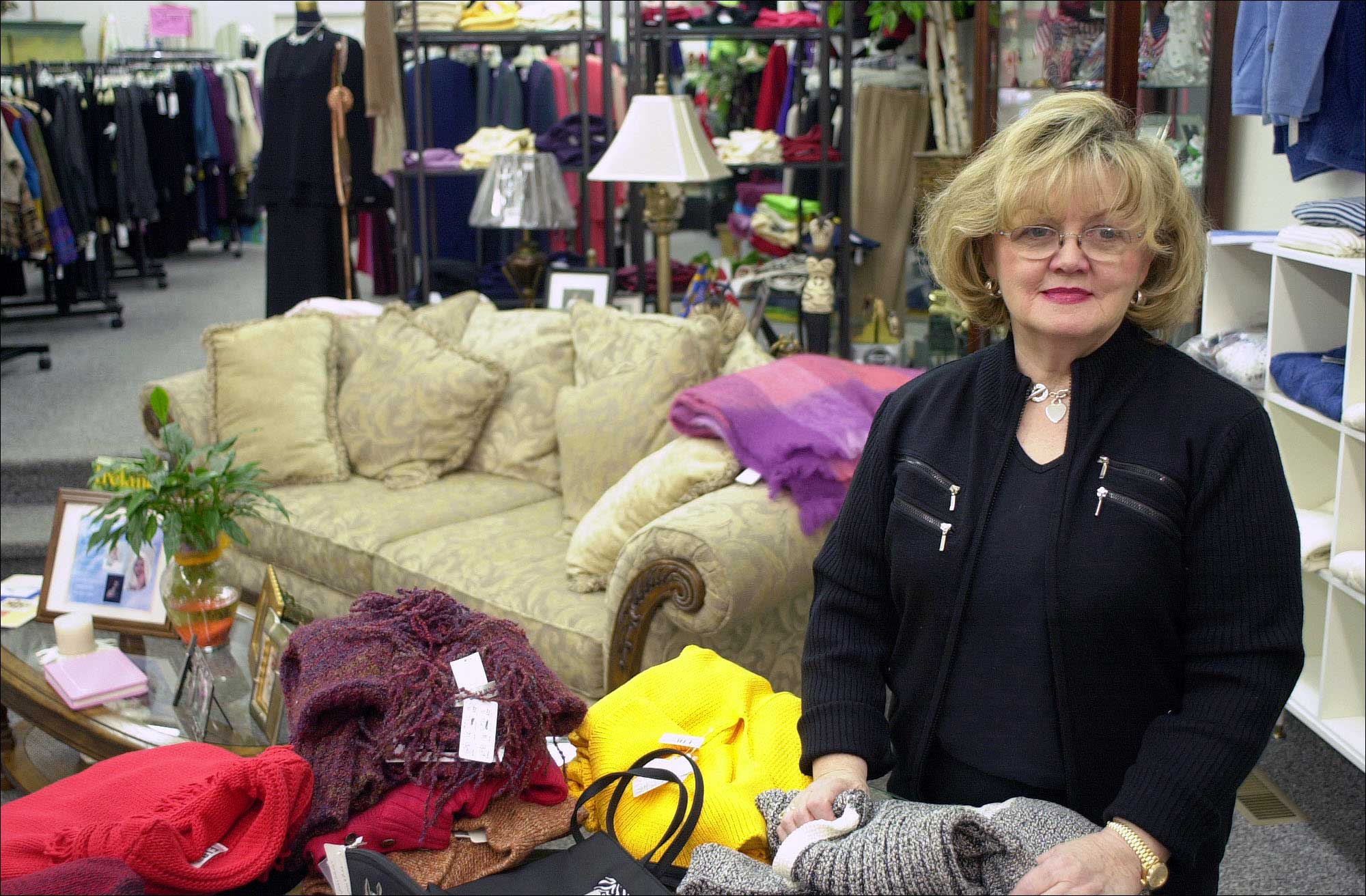
Betty Fedorchak stands in her clothing store, Esoterica, in downtown Minot, N.D. Fedorchak, who was pictured Oct. 11, says she is one of several local merchants whose businesses are prospering. She supports President Bush.
“I want to see Social Security grow stronger. I want to see us to have a reserve. The spending because of this war, I don’t know where the money is going to come from, but I think we need a good nest egg. …
“We have to plan for terrorism much more so than we’ve had ever had to in the past. You know yourself how much that is going to cost. So I don’t need any tax cuts. I think that’s a political move every time there’s an election, but not necessary.
“I worry sometimes that we’re just going to run out of money for the generations to come and I think we should be making our country stronger. So that’s where I want to see the money going, not for myself, for the younger generations.”
Kansas farmer
Tim Peterson, 49, is a fourth-generation farmer near Monument, Kan., about 55 miles from the Colorado line. He has been farming 24 years and grows milo, wheat and sunflowers on 2,800 acres. For the past four years, he has struggled with weather problems, ranging from drought to untimely rains. He is a Kerry supporter.
“To run a farm, it’s a very capital-intensive business. You borrow a lot of money, you handle a lot of money. … The cost of energy and increasing interest rates are making us real nervous right now. …
“When you get nervous, you start hanging on to your pocketbook a little tighter so that then impacts in our local communities. …
“This area was built on people who made do or did without. You kind of go back to that philosophy. You have to sometimes buy equipment in order to take advantage of the technology that’s being offered … but when you talk about your own living, like adding on to your house or buying a new car, yes, we have curtailed that. …
“We’re actually very dependent on government payments. … if it was not for this multi-peril crop insurance … I would not be talking to you as a farmer right now. …
“The policies that increased the federal debt are hurting my operation and our livelihood.
“Social issues are important, but if we’re talking about a survival of a family farm that’s been in operation for four generations, we’re going to try to do those things that will continue to allow us to survive and maybe give a chance to my children to be able to be the fifth generation.”
Company operating officer
Keith Ellenberg is the chief operating officer at Chapura Inc., a software company in Mobile, Ala., with 20 employees. The 43-year-old supports Bush. In eight years, his company has shipped its software in more than 20 million hand-held computers.
“We certainly believe the economy has started to turn. … Is it going to be like it was back in 1999 or 2000? Personally I don’t think it’s ever going to be back to anything like that.
“We’re going to see a much more normal … sane business cycle in how the economy grows and how the economy shrinks. I don’t see us having the big dot-com effect coming down the road again. I think everybody’s learned their lessons from that. …
“Different cities come out of … dark times in different ways. In Mobile, we’re doing that through construction. … We’ve got a $20 million cruise terminal being built. … We’ve got a new 35-story high rise tower being built downtown. That’s going to attract a lot of attention to Mobile. …
“The fact the malls are more crowded … there’s more people out and about shopping says that people certainly feel better about the economy. … You see a lot more people driving new automobiles. …
“We’re certainly better off than we were two years ago. We’re probably back to where were four years ago. … There’s just been so many really unusual things that have happened in the world. We had the dot-com (boom and bust). Then we had 9-11. I feel like the country itself is starting to get over those two events. We still have the war going on and that certainly is a damper. …
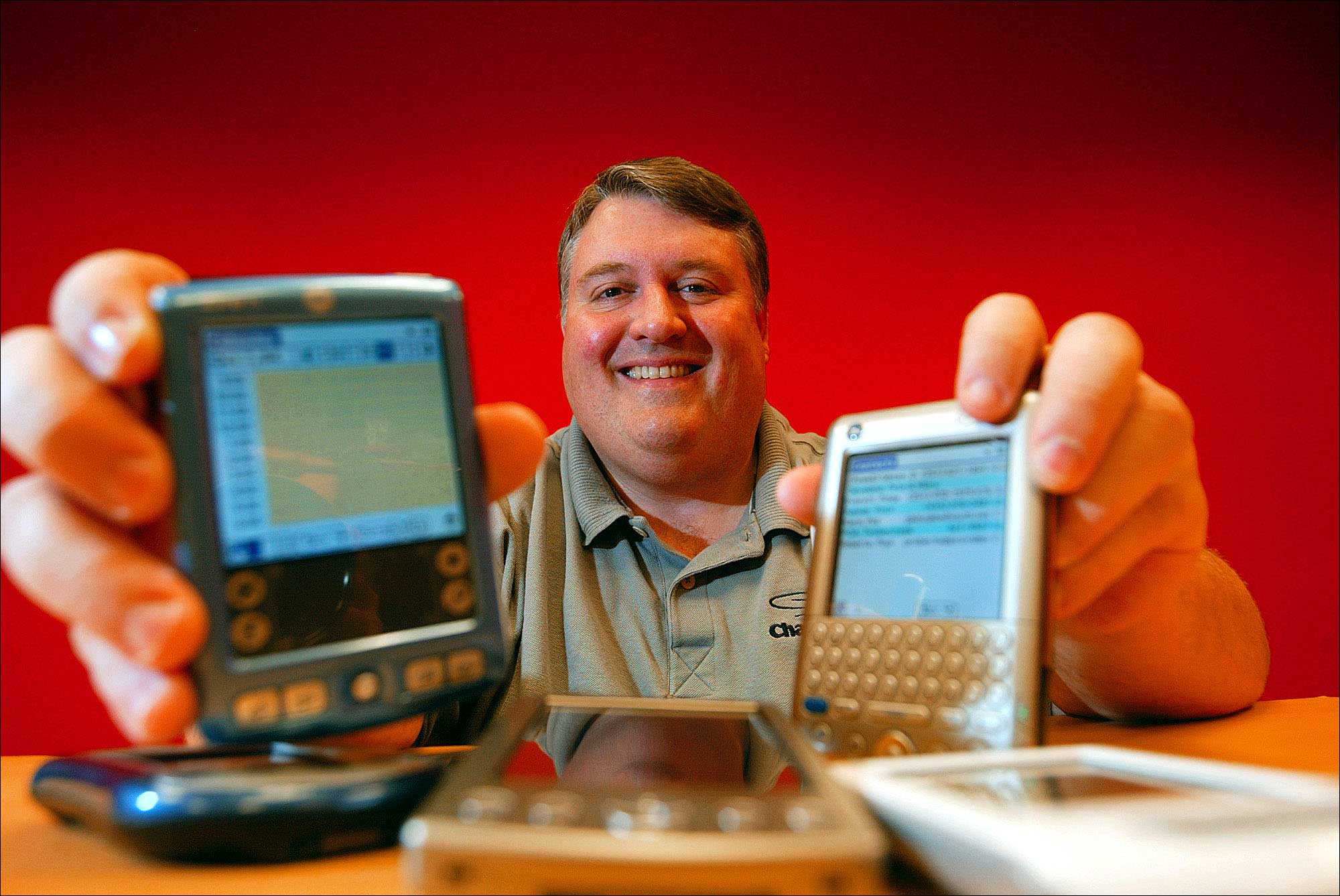
Keith Ellenberg, chief operating officer at Chapura, shows off some personal digital assistants loaded with the company's software. Ellenberg, who supports President Bush, was pictured Oct. 7 at the company in Mobile, Ala.
“To be honest with you, when we’re in an election year, I don’t really listen too much to what anybody (candidate) is saying. …
“I don’t depend on those campaigns to educate me. A lot of it …depends on what you see up and down the street, what you see in the stores, what your employees are telling you. What I see is improving. Absolutely.”
82-year-old retiree
Lucille Wood, 82, worked in bookstores most of her life before retiring three years ago. She lives in Portland, Ore., describes herself as a liberal Democrat and is backing Kerry.
“I think almost everyone knows someone who is having one bad time.
“One of my sons has been unemployed for a year, so I feel it on a personal level. There are people who have lost their houses and had to move in with relatives and got in debt and … they encouraged people to spend their way back to prosperity, so they use bank cards and then they can’t pay for it. …
“The cost of medicine is just outrageous. I take a couple of things and they come to $225 a month. Having worked in a store all my life, I’ve never been wealthy or I’ve never been able to accumulate money. …
“One of the ways I pay for it is that I don’t spend money on other things. Then my dear daughter-in-law who is a pharmacist insisted on getting one of (the prescriptions) for me. … You want to do things for your kids, but my kids are having to do things for me. That’s not how you plan on ending your life. …
“When they say that you can’t go to Canada because we don’t know what they’re putting in their drugs up there … who are they protecting? I would think the drug industry.
“I was even lucky that I worked so long … but I mean there are other women who have been housewives … they are getting three or four or $500 a month, and how in God’s name do they live on it? …
“We’ve lost an awful lot. Just when I think that we can’t lose any more, they find something else and I’m really terribly afraid for this country.”
Nevada rancher
Tim Delong, 61, is a fourth-generation rancher in Imlay, Nev. He has 1,200 cows on 350,000 acres in the north-central part of the state. He backs Bush.
“The biggest things we have against us are government regulation and the weather. …
“George Bush’s tax cuts and the things he’s done for small business have been a big plus for us. …
“We get more money for our cattle than we’ve ever gotten. But everything we buy costs more, too. So basically you’re just trading dollars again. …
“People have got more money to spend and way too much free time. In my opinion, I don’t see how the economy can be that bad when they’re spending money like that. …
“Everything runs on borrowed money. That’s the modern way to do business. Interest rates are cheaper. It’s a good time to borrow money. …
“I’m not too concerned about the deficit. At my age, I just hope Social Security doesn’t go broke. I’ll be able to apply next year. I hope it’s there when I need it. … If I don’t get it, I’ll still survive. People depend on the government too much. That’s a modern deal. It’s getting more so. It’s not the federal government that makes the world go around. It’s the small businesses and others that make the economy work. …
“You’ve got to get the government out of the way. The Republicans do that better than the Democrats.”