

Betting on the blues
Delta towns hope to attract visitors with region's deep musical heritage
Greenwood, Miss. ? In the Mississippi Delta, life is never far from the blues — a challenge and an opportunity for those promoting tourism here.
Already, millions of people visit, drawn by nine casino resorts in Tunica County that pump more than $2 billion a year into the region’s economy.
But a short drive and a world away lies the real Delta — stretching from just beyond the glitzy gambling halls all the way to the magnolia-shaded lanes of Natchez.
Here, amid some of the nation’s richest soil and poorest people, are the sharecroppers’ shacks, cotton fields, small towns and juke joints where the blues were born — music that slaves first sang about the hardships of life.
Now an effort is under way to market this aspect of the Delta to tourists. But just how do you attract visitors to a region famous for poverty and a violent history of racism?
By focusing on it.
“I think it would be a great mistake if people promoting tourism in the Delta ignored the history of the Delta,” said U.S. Rep. Bennie Thompson, D-Miss. “You have to talk about slavery. You have to talk about the night riders.”
Cashing in, lucking out
People come to the Delta for authenticity, said Luther Brown, a member of the state’s newly created blues commission and the Delta Blues Highway Assn. Brown said the “heritage tourists” drawn to the Delta weren’t the same breed as those who spent hours in Tunica’s gambling halls.
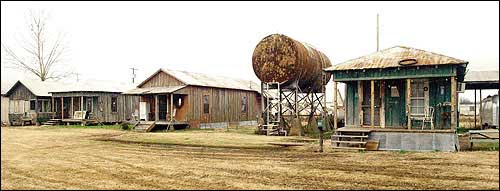
Sharecropper shacks that make up The Shack Up Inn in Clarksdale, Miss., cast a feel for the hardscrabble lives of the farm workers who occupied them years ago. The row of six authentic sharecropper homes sits on the 4,000-acre Hopson Plantation, just four miles south of the crossroads of U.S. highways 49 and 61, where legend has it bluesman Robert Johnson sold his soul to the devil.
So far, however, efforts to attract tourists without the cha-ching of slot machines have had mixed results. While a luxury hotel in Greenwood, The Alluvian, has thrived, an upscale restaurant in Clarksdale run by actor Morgan Freeman has yet to turn a profit.
And while it would seem there’s money to be made from tourists eager to visit landmarks associated with blues legends like Robert Johnson and B.B. King, Sylvester Hoover hasn’t had much luck.
Hoover started his “Trail of Blues Tour” in March. By the end of summer, he had doubts about continuing.
“It’s slow,” said Hoover, who charges $75 for a tour of local blues sites, including Johnson’s grave at a small church cemetery. “I’m not sure if it’s the price or if I’m just not advertising so well.”
In contrast, the Delta’s toniest hotel, The Alluvian — with its etched-glass doors, designer furniture and commissioned artwork — has no trouble attracting guests willing to pay $175 to $295 a night.
| Here are some of the places to see and things to do in the Mississippi Delta.Tunica: Bally’s, Fitzgeralds, Gold Strike, Grand Casino, Harrah’s, Hollywood, Horseshoe, Sam’s Town and Sheraton casinos; www.tunicamiss.org or (888) 4TUNICA.The Alluvian: 318 Howard St., Greenwood; www.thealluvian.com or (866) 600-5201. Rates begin at $175 nightly.Trail of Blues Tour: Three-hour tour, $75; discount for groups of 15 or more; www.deltablueslegendtours.com or (662) 453-3825.Ground Zero: Blues Alley, Clarksdale; www.groundzerobluesclub.com or (662) 621-9009. Open 11 a.m. to 2 p.m. for lunch Monday to Friday; open for dinner with music beginning at 5 p.m. Wednesday through Friday and 6 p.m. Saturdays. Entrees and side orders, $3 to $5; cover charge for music, $5 to $8.Madidi: 164 Delta Ave., Clarksdale; www.madidires.com or (662) 627-7770. Entrees begin at $20. Open for dinner at 6 p.m. (bar opens at 5 p.m.) Tuesday through Saturday.Delta Blues Museum: 1 Blues Alley, Clarksdale; www.deltabluesmuseum.org or (662) 627-6820. Open 10 a.m. to 5 p.m. Monday through Saturday. Admission: $6 adults, $3 ages 6 to 12.Shack Up Inn: 001 Commissary Circle, Clarksdale; www.shackupinn.com or (662) 624-8329. Rates begin at $50 a night.Blues highway: Sample itinerary for driving to blues-related sites along Highway 61 at www.visitmississippi.org/itineraties/themes_highway_61.aspFor more information: See www.visitmississippi.org or call (866) SEE MISS; tourism in Greenwood, (800) 748-9064; tourism in Clarksdale, www.clarksdale.com or (662) 627-7337. |
The Alluvian is owned by Fred Carl, CEO of Viking Range, which manufactures commercial-grade ovens for home use and other luxury kitchen accessories. The Alluvian’s weekend packages offer cooking classes at Viking’s nearby culinary institute as well as a “Midnight Ramble,” a late-night visit to Johnson’s grave in a local churchyard.
There a musician sings and tells Johnson’s life story, including the legend of how the bluesman sold his soul to the devil in exchange for his talent, as well as the tale of his demise — he was poisoned by his lover’s husband.
Fred Hebert, a 68-year-old retiree from Mandeville, La., recently spent his second stay in less than a year at The Alluvian. This time he took a cooking class, featuring Hattiesburg chef Robert St. John preparing a dish of shrimp and grits. On his previous trip, he and his wife visited local pottery and antiques shops.
His sole complaint may be an indication of one small way in which the area could be made more tourist-friendly: “What would help is street signs or signs on the buildings. We spent all kinds of wasted time looking for them,” he said.
A block from The Alluvian, Steve LaVere is renovating buildings that will house a bakery, restaurant, music club and museum dedicated to the history of blues and radio. LaVere, who produced a set of Johnson’s complete recordings in 1990, also is arranging six tours, focusing on civil rights, the Civil War, cotton plantations, the blues, American Indians and local literature.
“There are over 50 authors that were born and raised around Greenwood,” LaVere said. “It’s just amazing.” Local literary greats include playwright Tennessee Williams and Civil War author Shelby Foote.
Reason for optimism
Clarksdale, where Williams’ childhood home is located, is also home to the Delta Blues Museum and the Shack Up Inn, a row of sharecropper shacks on the 4,000-acre Hopson Plantation that have been renovated as motel rooms. Four miles north is the famed crossroads of U.S. highways 49 and 61, where Johnson supposedly made his deal with the devil.
Freeman’s restaurant, Madidi, is here as well, along with Ground Zero, the actor’s blues nightclub. Freeman’s business partner, Bill Luckett, is optimistic about their potential.
A tourist could spend a night at The Alluvian to “get a taste of New York,” he said, then drive to Madidi for dinner, party at Ground Zero and visit the Winterville Indian mounds in neighboring Greenville.
“We’re going to keep massaging this thing so we can get some of those 67,000 buses that show up in Memphis and Tunica every year,” Luckett said. “We need to get those buses to spend an extra day in the Delta.”
Freeman, who was raised in the Delta by his grandmother, said that while tourism would not guarantee local prosperity, it did offer “opportunity for people with an entrepreneurial spirit.”
But can tourism succeed where other development efforts have failed? In the 1980s, then-governors Ray Mabus of Mississippi, Bill Clinton of Arkansas and Buddy Roemer of Louisiana joined forces to improve the regional economy. Roemer, who now said results were minimal, is skeptical about tourism as a cure-all.
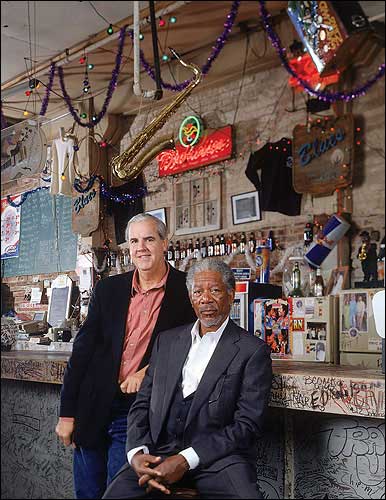
Bill Luckett, left, and Morgan Freeman have opened a blues club, Ground Zero, and an upscale restaurant, Medidi, in Clarksdale, Miss. They are part of an effort to attract tourists to the Delta for more than just casino gambling.
“I do not want to throw cold water on it,” Roemer said. “But who would come? Where would they come? How do we translate tourism into economic dollars for the whole region?”
Clinton also tried to help the region as president, designating the Delta as a federal empowerment zone, which provided tax breaks and grants, and by creating the Delta Regional Authority. But the authority’s budget has decreased since 2001 from $20 million to $2 million, and it was only last spring that a “first-step” meeting was held with local businesses to map out a tourism plan.
‘A reason to stop’
If the tourism boom does come, the town of Rolling Fork — which has a legitimate claim to fame as the birthplace of bluesman Muddy Waters — would like to be part of it. Sometimes tourists stop by Rolling Fork, but not for long.
“These people would eat soul food. These people would stay, but we don’t have any place for them to spend the night,” said Ray Mosby, editor of the local newspaper, the Deer Creek Pilot. The town of 2,486 residents, about 100 miles south of Greenwood, has little more than a hospital, grocery store and one restaurant, Chuck’s Dairy Bar.
Mosby recently persuaded local leaders to form an economic development and tourism organization. In addition to the Muddy Waters connection, Mosby said the area offered the “best public hunting and fishing in Mississippi.”
“Tourism and recreation are the future of the south Delta,” he said. “The future is riding up and down Highway 61 every day. We’ve just got to give them a reason to stop.”