

Makers master method
Hutchinson company produces 75,000 milk containers a day
Hutchinson ? It begins with millions of tiny opaque beads of plastic, about half the size of an aspirin, stored in a silo at Consolidated Container in Hutchinson.
After going through complex modifications, collectively known as extrusion blow molding, those beads end up in Kansans’ refrigerators as gallon-sized containers of fresh, cold milk.
Plant manager Michael Banks says the company uses 4 million pounds of high-density polyethylene resin — the tiny plastic beads — each year.
Inside the production room, the beads are melted down and forced through the blow mold unit, coming out in a steady stream of pliable plastic sleeves called parisons.
A mold clamps around the parisons, trapping the plastic for a split second while air is blown into it, forcing the material to take the mold’s shape.
Everything in the plant depends on timing — from the rate the beads are fed into the production facility to the bagging unit where the jugs are packaged for delivery — and any pause or mishap that throws off the timing can leave the plant workers standing knee-deep in scrapped plastic, which is ground up and recycled through the production line.
As the bottles move through the production line, excess plastic is cut away and the bottles are subjected to extreme heat — up to 1,100 degrees — and cold to shock the molecules into holding the bottles’ form.
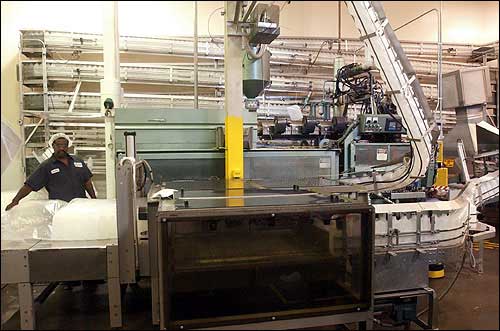
Consolidated Container employee Charles Johnson packages milk jugs before storing them in a truck. From start to finish, the Hutchinson plant can produce five bottles every 6.75 seconds.
Banks said the “12 very dedicated employees” at Consolidated Container work hard to make sure every container holds exactly the right amount of milk and that there are no leaks.
To inspect the bottles, a machine blows air into each container and sensors measure the internal pressure to ensure there are no pinhole leaks. Defective bottles are shuttled off the production line as the rest of the bottles move into the Jackson dairy or to the packaging station.
From start to finish, the plant can produce five bottles every 6.75 seconds, which Banks said allowed his crew to produce nearly 75,000 in a 24-hour period.

Each of the milk containers made at Consolidated Container start as tiny opaque beads of high-density polyethylene resin. The beads are about half the size of an aspirin.
Banks said the Hutchinson location was a “zero warehouse facility,” which means Consolidated must keep up with Jackson’s output and produce what each customer requires every day.
Making milk jugs is not an easy or safe job, Banks said, but the company has installed safety and productivity measures to improve the plant.
“It’s an ever-changing process,” Banks said. “There’s a million different variables that affect the process.”