

Payday firms going public
Wall Street embracing controversial loan companies
Kansas City, Mo. ? For years, the payday loan industry has operated on the fringe, its stores located mostly in working-class neighborhoods, its business practices roundly criticized by consumer groups.
But the industry is positioning itself to become a Wall Street darling.
Already, Kansas City, Kan.-based QC Holdings Inc., which owns 350 stores in 22 states, went public in July, the first payday loan-only company to do so.
So far, the company’s stock has gone up from a low of $12 in August to around $17 now.
“We’ve been very pleased with the results,” said Douglas Nickerson, the company’s chief financial officer, who said that his company was using the new capital to pay off debt and expand.
“What we were trying to communicate to the investors is what we were able to do on our own: with organic-type growth and acquiring. You can make good money, but you have to fund the money. This was an opportunity to do that.”
In a typical payday loan, a customer writes a personal check for the amount, generally $500 or less, to be cashed in two weeks. The lender charges a fee for the money, usually between $10 and $40 per $100 borrowed.
Critics say such fees equal annual percentage interest rates of 300 percent or more and that many customers get trapped, unable to pay back the principal and continually renewing the debt. In some cases, they say, customers end up paying more in interest than the loan itself.
But payday lenders say they’re filling a need and that a majority of customers pay off the loans on time. They also said that commercial banks had their own onerous expenses, such as overdraft charges and service fees.
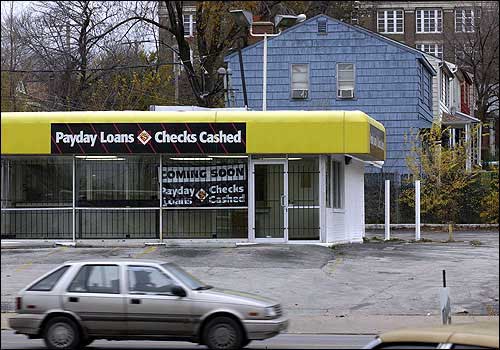
Traffic passes a Quik Cash payday loan store in Kansas City, Mo. The group of 350 stores in 22 states was the first in a trend of payday loan companies to go public.
The two giants in the industry, Spartanburg, S.C.-based Advance America Cash Advance Centers Inc. and Berwyn, Penn.-based Dollar Financial Corp., have registered initial public offerings and are expected to enter the market in the next few months.
A number of companies that offer payday loans along with pawn shops, title loan stores and check cashing services already trade on the stock market, and have done well, giving a potential forecast for the future of payday lenders.
Cash America International Inc. of Fort Worth, Texas, for example, has seen its share price rise from $10 a share in January last year to around $27 now.
“The business has been exploding,” said Mike Loughran, an analyst for The Robins Group of Portland, Ore., who covers Cash America but hasn’t yet picked up QC Holdings.