

Sudan, rebels pledge to end war
Nairobi, Kenya ? The Sudanese government and southern rebel leaders pledged again Friday to end a 21-year civil war — this time making the commitment before the U.N. Security Council holding a special meeting in Africa.
U.N. officials hope the promise to reach an accord by year’s end will also help quell a separate ethnic conflict in Sudan’s western Darfur region, but warned against unwarranted optimism.
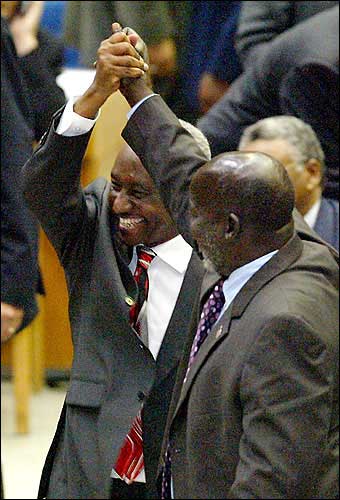
Sudanese Vice President Ali Osman Taha, left, holds hands with Sudan People's Liberation Movement leader John Garang, right, Friday during the U.N. Security Council meeting in Nairobi, Kenya.
“We are very close to peace, but we have been close before,” said John Danforth, who was Washington’s special envoy to Sudan before becoming U.S. ambassador to the United Nations. “Do not let this opportunity slip away,” he told the Sudanese negotiators.
In 48 years of independence, Africa’s biggest country has spent 39 years at war with itself. And both the south and west have long histories of internal conflict even before independence.
International attention has focused on three major rebel groups — one in the south and two in Darfur — but there are more than a dozen militia leaders who constantly shift alliances.
Cementing a full peace will require negotiations with all those militias, which have been responsible for most violations of an informal cease-fire that has largely held for two years in the south.
The southern war has pitted Sudan’s Islamic-dominated government against rebels seeking greater autonomy and a greater share of the country’s wealth for the Christian and animist south. The conflict is blamed for more than 2 million deaths.
Both sides have already agreed on power and wealth sharing and how to integrate their armed forces. All that remains is how to implement the agreements — for example, who will pay the rebel soldiers and whether or not money distributed to the south will be in local or foreign currency.