

Black Pentecostals vote values, but not part of ‘religious right’
Memphis, Tenn. ? Like other evangelical Christians, leaders of the Church of God in Christ want to limit abortion and bar same-sex marriage.
But that doesn’t mean the predominantly black Pentecostal denomination considers itself part of the “religious right” or supporters of the Republican Party.
“I’ve seen the tone of the religious right,” said G.E. Patterson, the church’s presiding bishop. “It seemingly was born out of the fact that African-Americans were making too many gains.”
Patterson’s church, often referred to simply as COGIC, reports having more than 6 million members across the United States and in 57 countries.
While COGIC agrees with white evangelicals that the Bible is the primary source of spiritual authority, its ideas on government social programs and protecting the rights of minorities differ, Patterson said.
“Every law that has anything to do with leveling the playing field for blacks, they are against it,” he said.
Differing views
The church also disagreed with President Bush on the war in Iraq. The church’s top leaders wrote the president before the war started urging him to resist sending in the military.
Bush won the support of 78 percent of white evangelicals, who were stirred in part by issues such as abortion and gay marriage. One COGIC bishop, George McKinney of San Diego, even endorsed Bush for those reasons. But Patterson said those issues alone were not enough to bring COCIC into the Republican camp.
“There’s a lot more to morality than just those two points,” he said.
The church’s national headquarters is in Memphis, where the church was founded in the early 1900s by Charles Harrison Mason, a son of slaves and a former Baptist preacher.
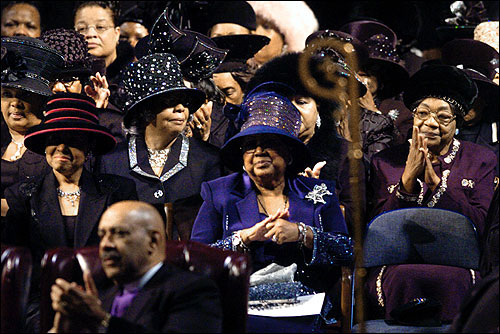
Members of the congregation listen to a sermon during a service at the Church of God in Christ on Sunday in Memphis, Tenn. Leaders of the predominantly black Pentecostal denomination want to limit abortion and bar same-sex marriage like other evangelical Christians but say that doesn't mean they consider themselves part of the religious
Today it’s America’s largest Pentecostal denomination, attracting new members with its foot-stomping, hand-clapping worship services.
“Many black churches that are experiencing numerical decline are often seen as either elitist or very rigid in their worship,” said Quinton Dixie, a professor of religious studies at Indiana University-Purdue University Indianapolis.
“Those that tend to be among the fastest-growing churches are those that lean to a more charismatic worship style.”
The church’s founder preached of a “spiritual baptism” in which believers were suddenly awash in a soul-shaking love for Jesus that left them praising him in a divinely inspired language, known as speaking in tongues.
Civil rights connection
COGIC also has a strong connection to the civil rights struggles of the 1950s and 1960s, which gives it a different perspective from other born-again denominations.
“These are issues that touch them in ways that don’t touch other Pentecostal denominations,” said Edith Blumhofer, a Pentecostal historian at Wheaton College in Wheaton, Ill.
Martin Luther King Jr., who was murdered in Memphis in 1968 while helping lead a sanitation workers’ strike, delivered his last sermon, his famous “Mountain Top” address, at Mason Temple, COGIC’s mother church, the night before he was assassinated.
Pentecostal leaders from COGIC and several large white churches in Memphis met in 1994 to bridge the racial divide. While encouraging at first, the new bonds were strained by the 1996 elections, Patterson said, and the unification movement soon fizzled.
“The demands of politics still remained stronger than the demands of brotherhood,” he said.
Praising Jesus
The church’s primary business is praising Jesus, but the parent church also encourages individual congregations to set up community programs for helping the poor and bringing them to Christ.
“They recognize that part of what it means to live as a Christian witness to the world is to place oneself as an advocate for ‘the least of these,”‘ Dixie said. “Not only do you save souls, but you feed the hungry and clothe the naked.
“There aren’t national programs established by the denominational hierarchy. They allow the local communities to determine what are the needs in their communities.”
Upward of 60,000 church members attended this year’s convocation, which ended Wednesday. Patterson was chosen for a second four-year-term as presiding bishop, the denomination’s top administrator and spiritual leader.