

Summer wildfire forecasts worsen for Western states
Fire managers say residents need to 'get prepared'
YAKIMA, WASH. ? Months ago, national fire managers predicted the 2004 wildfire season would be a bad one in the West. Now, they’re changing their forecast: It’s going to be worse.
With unseasonably warm temperatures in March and April, the potential loss of heavy air tankers for safety reasons and a yearslong drought continuing, Western states and the federal government are facing the possibility of another devastating fire season.
“Things are much worse than they were in February,” said Rick Ochoa, national fire weather program manager for the Bureau of Land Management.
Years of drought have left states across the West vulnerable to extreme fire conditions. The greatest threat lies in the Pacific Northwest, the Northern Rockies of Idaho and Montana, and the Southwest, including Southern California, where conditions are the driest.
The Northwest had escaped the early dire predictions thanks to snow blanketing the Cascades. But it now faces dangerous conditions after a warm spring that melted the snowpack a month earlier than usual.
In Washington, the state Department of Natural Resources already has fought 70 small fires this year, up from the usual 20, and forests are as dry as they typically are in late July or early August.
And snowpack in the Cascades in Oregon has fallen to well below average.
“It really is huge,” said Paul Werth, fire weather program manager for the Northwest Interagency Coordination Center in Portland. “There’s really the potential for a large number of huge fires — long-duration fires.”
Firefighters in the small, heavily forested community of LaPine, Ore., where a 21,000-acre fire burned to the edge of town last year, already are preparing for a long summer. They’ve put out four small fires so far this year, and the conditions aren’t good, Fire Chief Jim Court said.
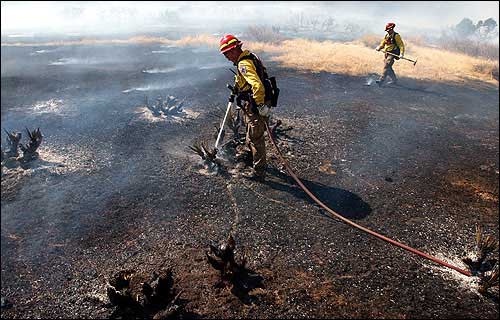
Firefighters douse hot spots of a wildfire in the northern Colorado foothills near LaPorte, Colo., in this April 1, 2004, file photo. National fire managers have revised their earlier, pessimistic 2004 wildfire season prediction, saying they expect even worse conditions.
“Typically, the light fuels — short grasses and brush — will go up easily,” Court said. But the “thousand-hour” fuels, such as 6-to-8-inch logs and dead growth, also ignited, leading the district and state to suspend all burning several weeks ahead of schedule.
“We need to prepare ourselves for an extreme fire season — as bad as last year or worse,” Court said.
Predictions for the Southwest already were bad, and low humidity and hot, dry winds in recent weeks have added to the danger. Early fires already are scorching Southern California, where fire danger usually is highest in the fall when Santa Ana winds blow through. Last year, raging wildfires in Southern California killed more than 20 people.
Wildfires early this month blackened thousands of acres across Southern California and destroyed 28 homes.
The entire state of Arizona and at least the western half of New Mexico are facing above-normal and even critical fire danger, according to Chuck Maxwell, fire meteorologist for the Southwest Coordination Center that serves Arizona, New Mexico and West Texas.
Fire officials across the West are working harder to prepare residents for the worst.
“Be prepared — or get prepared,” said Court, the Oregon fire chief. “We’re already out there telling people to develop a fuel break around their home. Make sure you’re ready in case fire comes to you — not if, but when.”