

Derby should be a doozy
Run for Roses expected to be wet, wild ... and wide-open
Louisville, Ky. ? Here’s all you need to know about the Kentucky Derby this year: If you pick the winner, you’re going to get a price.
“Whoever picks the trifecta is going to be driving a new BMW,” said John Ward, trainer of the 2001 Derby winner, Monarchos. He added: “Whoever picks the superfecta will be able to buy a new home.”
The most wide-open Derby field in anyone’s memory will assemble at the starting gate at 5:04 p.m. today for Derby 130, a field that was reduced from a maximum 20 down to 18 3-year-olds upon the defections Friday of Wimbledon and St Averil.
As a result of the two scratches, track officials decided that the first two stalls in the gate will be left open. Horses to the inside of Imperialism will all move out toward him in post No. 10.
With two horses out, the Derby purse went from $1,214,800, which would have been a record, to $1,154,800, with the winner’s portion reduced from $914,800 to $854,800.
The two scratches also inserted an irony into this Derby, for the maximum-sized field at entry time excluded two more wanting to get in: Eddington and Rock Hard Ten. It’s too late for them now.
Of more concern might be the weather forecast. The possibility of rain adds even more confusion to this race where picking the winner will be difficult because so many horses are seen as capable of winning.
If it rains on Churchill Downs today, “then you can throw it all up in the air,” remarked Bobby Frankel, trainer of Derby hopeful Master David.
So much for those actually trying to pick this illogical race with methods grounded in logic.
Frankel’s reasoning: Horses capable of running only 1 1/8 miles but who like sloppy (wet-on-top) track surfaces are capable sometimes of extending their abilities to 1 1/4 miles on that type of surface.
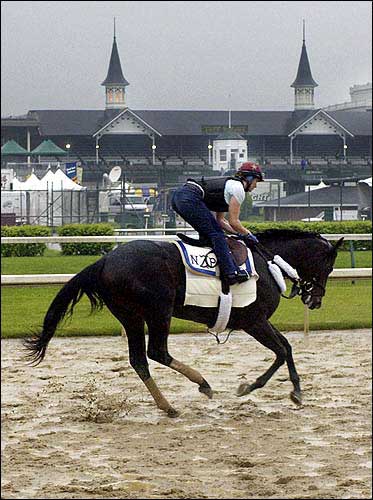
Kentucky Derby favorite The Cliff's Edge, with exercise rider Maxine Correa up, works out along the backstretch at Churchill Downs. The Cliff's Edge slogged across a sloppy track Friday in Louisville, Ky.
A sloppy track could bode well for fast horses like Lion Heart, Limehouse, Read the Footnotes, Quintons Gold Rush and Smarty Jones.
As for a muddy track — a trickier surface than sloppy — that’s another story. A muddy track lacks the secure bottom of a sloppy track. A muddy track can suck a horse to China if the horse isn’t suited to that surface.
Frankel, subscribing to the wide-open characterization of this race, predicts the winning payoff might be “something like $14.” The highest odds of a Derby favorite would have paid exactly that amount, if Harlan’s Holiday, 6-1 in 2002, had won instead of finishing seventh.
So, go figure. Grind those mental gears. Picking this year’s winner is going to be an extraordinarily difficult exercise because the usual guideline — horses’ past performances — won’t be as much help as they sometimes are.
One reason: Twenty-eight Derby preps have been won by 25 different horses, according to the Daily Racing Form. Based on that stunning mark of inconsistency, one horse looks as good as another.
Thus the key to divining this year’s Derby might be more in the pace of the race and in strategy than in the way the Derby preps have brought the contenders to this race.
Limehouse, for one, got a huge boost when the gate change brought by the two scratches moved him from the No. 1 to the No. 3 starting stall. The risk of breaking from the No. 1 hole in the Derby is for the rail horse breaking awkwardly and getting squeezed back. Limehouse now is looking at a straight shot to a good position in the first quarter-mile.
The question is whether he’ll set the pace as he did for the first quarter-mile in the Blue Grass Stakes, forcing Lion Heart to lose valuable ground if racing to his outside as happened at Keeneland. Another scenario would see Limehouse tucking back immediately and letting Lion Heart go to the front.
Lion Heart is the real key to this race. He’s an extremely fast horse who arguably could win this race just as War Emblem did in 2002: on the lead from start to finish. Many fear that if Lion Heart gets an uncontested lead and is allowed to set a moderate pace he’ll be uncatchable at the end.
More likely, the pace will be fast because this Derby has a huge amount of early speed, with all aware of the dilemma facing them if Lion Heart is allowed to race freely on his own up front. In other words, Lion Heart can expect pressure right from the start — unless he’s faster than anyone has realized.
Running from behind
One interesting strategy was revealed on Wednesday during the selection of post positions when the Smarty Jones connections chose to be outside much of the speed. Thus they chose to press, rather than try to set, the pace with this colt who is second choice in the morning line.
There is still more speed lurking in a mix of closers outside of Smarty Jones: Pollard’s Vision, who is blind in his right eye, and Quintons Gold Rush, winner of the Coolmore Lexington Stakes at Keeneland. With Quintons Gold Rush preferring to race close to the front or on the lead, how will he adapt to the far outside post? And what choice will be made for Pollard’s Vision, considering he can see only with his left eye?
A fast and uncontested pace could be the nemesis of any of the front-runners, from Lion Heart to Smarty Jones. It will also benefit late-closers like the morning-line favorite, The Cliff’s Edge, as well as Tapit.
But late-closers run the risk of losing ground if they get hung up on the outside, especially around the final turn into the homestretch. With a fast horse like Lion Heart in position to save important ground (read: shorter distance) from his ideal starting position, those who lose ground are losing key lengths and setting themselves up to lose a race where even inches could count.
As in any large field — and in most runnings of the Derby, it seems — a lot will depend on where fortune determines that a horse will be positioned when it comes time to make that final run. Ferdinand was one such lucky horse when, in 1986, the seas parted for him precisely at the right time in the stretch to make way for him to come through a winner.
Yet Ferdinand had run into trouble at the start and had to drop far back, racing first on the rail, then from farther out on the backstretch and then, after splitting horses in the upper stretch, finding himself back on the inside with a clear track ahead of him.
In order to win the Derby a horse must be at its best at post time on the first Saturday in May. But luck and good fortune always play a role — as pace likewise seems destined to, today.