

China tests larger diplomatic role
Beijing officials offer statements on Taiwan elections, Japan island dispute
Beijing ? Flexing its political muscle over territories it claims as its own, China has gone on the offensive, warning archrival Taiwan about its bitter presidential election, entering Hong Kong’s debate over democracy, and upbraiding Japan over an island dispute.
The barrage of announcements Friday came as China tries to establish itself as a regional power and global diplomatic player able to enforce its will at the far edges of its sovereignty.
“That’s what diplomacy is about,” said Steve Tsang, director of the Asian Studies Center at St. Anthony’s College, Oxford University. “It’s not about facts. It’s not about reality. It’s about how you project the interests of your nation. And that’s what China has successfully done.”
On Friday, Beijing warned that it would not “look on unconcerned” if Taiwan’s political crisis worsens following a disputed election. Beijing, which claims Taiwan as its territory and has threatened in the past to invade, didn’t say what it might do, and it wasn’t clear whether the statement was more than a ritual declaration of the mainland’s rights over the island.
State media didn’t inform China’s public of the March 20 presidential election, but they have reported on the dispute between President Chen Shui-bian and challenger Lien Chan over the outcome and protests by thousands of pro-Lien activists.
Tsang said the statement by the Cabinet’s Taiwan Affairs Office was measured by comparison to past rhetoric.
Taiwan and the mainland have been separated since 1949. Beijing has hundreds of missiles aimed at the island and has threatened war if Taipei takes steps toward making its de facto independence permanent.
Meanwhile, Beijing rejected the arrest of seven Chinese advocates by Japan’s coast guard on a disputed island chain, known to China as the Diaoyu and to Japan as the Senkaku.
“We think that it is illegal and it is a challenge to Chinese territorial sovereignty,” said Foreign Ministry spokesman Kong Quan.
The advocates were returned Friday to the mainland, and Japanese Prime Minister Junichiro Koizumi acknowledged that Tokyo wanted to avoid aggravating relations with Beijing.
China had no immediate comment on Japan’s decision to expel the advocates.
Also Friday, China said it would soon “give interpretations” of Hong Kong constitutional law on choosing the territory’s leader and lawmakers — an issue that has prompted public protests.
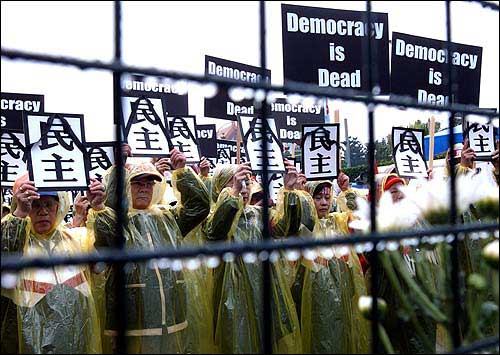
supporters of opposition presidential candidate Lien Chan raise placards with Chinese words Democracy during a sit-in in Taipei, Taiwan. Hundreds of protesters stormed the Central Election Commission headquarters Friday after it certified the results of Taiwan's disputed presidential election -- violence that rival China hinted might provide a reason to take control of the island.