

Cassini ready for close-up of Saturn and its rings
Pasadena, Calif. ? Two decades and $3.3 billion in the making, an international exploration of Saturn begins this week when a spacecraft slips through a gap in the planet’s shimmering rings and arcs into orbit.
After a seven-year, 2.2 billion-mile journey, the Cassini spacecraft will fire its engine Wednesday night to slow down, allowing itself to be captured by Saturn’s gravity. The maneuver will inaugurate a four-year, 76-orbit tour of the giant planet and some of its 31 known moons, including huge Titan.
To scientists, Saturn and its rings are a model of the disk of gas and dust that initially surrounded the sun, and they hope the mission offers important clues about how the planets formed.
Shortly after entering orbit, Cassini will act on its best chance to photograph the rings that have entranced astronomers for centuries.
“We’ll never be that close to the rings as immediately after the insertion,” said Charles Elachi, director of NASA’s Jet Propulsion Laboratory and team leader for Cassini’s radar instrument.
Cassini, laden with a dozen instruments, also carries a probe named Huygens that will be launched into the murky atmosphere of Titan.
The frozen moon intrigues scientists because it may have many of the chemical compounds that existed on Earth before life began.
Named for 17th century Saturn observers Jean Dominique Cassini and Christiaan Huygens, the joint project of NASA, the European Space Agency and the Italian Space Agency dates to proposals made in 1982.
Cassini has already been sending data to Earth, including a wealth of information and sharp images from a close flyby of Saturn’s strange, battered old moon Phoebe.
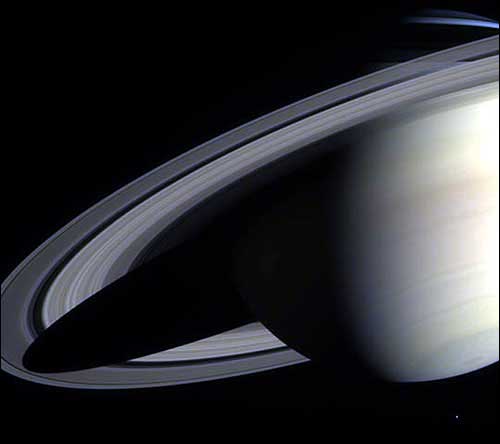
The Cassini-Huygens spacecraft returned this image of Saturn on May 16 when its narrow-angle camera was too close to fit the entire planet in its field of view. NASA's Cassini spacecraft will fire its engine Wednesday to slow down and allow itself to be pulled into Saturn's orbit.
“It’s a great curtain raiser for the Saturn show that’s about to start at the end of the month,” JPL imaging team member Torrence Johnson said.
Saturn will be some 930 million miles from Earth when Cassini arrives. Radio signals will take 84 minutes to travel each way, so the spacecraft will enter orbit on autopilot.