

Pricey Nikon D70 makes amateurs’ shots sparkle
Ventana Wilderness Area, Calif. ? Our overnight backpacking trip was supposed to be bare bones — just enough food for 48 hours, no extra socks, no bulky books. We considered ditching the tent to shed pounds.
But I couldn’t resist one weighty indulgence. I had become addicted to the Nikon D70, a 6.1-megapixel digital camera that costs about $1,300 with an 18-70 mm lens.
The D70 and its $1,000 rival, the 6.3-megapixel Canon EOS 300D Digital Rebel, are the first professional-quality single-lens reflex digital cameras that amateur photographers might consider reasonably priced.
With an SLR, the light from the subject being photographed goes through the lens, hits a mirror and reaches your eye. You can tell exactly what’s in focus, and you get better clarity through the viewfinder than with popular point-and-shoots, which cost $300 or less. And you can switch to zoom or wide-angle lenses.
Photojournalists spend $4,000 or more for digital SLRs, but manufacturers hope the D70 and EOS will bring such equipment to the masses. The D70, which handles many other Nikon lenses, debuted in January and instantly become the rage among “prosumers” — amateurs so discriminating they spend like pros.
The D70 transformed me from an uninspired amateur into an enthusiastic shutterbug. It’s downright difficult to take a bad shot with the D70, which has a manual override but which I kept in automatic mode.
The D70 uses a rechargeable lithium-ion battery that gets up to 2,000 photos per charge and can last several days, depending on flash use. The D70 also can use disposable CR2 batteries.
My favorite features were portrait mode, which focuses sharply on your subject and beautifully blurs the background, and “burst,” which lets you take up to 144 pictures at three pictures per second (without flash). Burst, combined with an ultra-short shutter time lag, captures facial expressions and body motions that sluggish point-and-shoots miss.
High-speed functions — including a power on-off switch with virtually zero delay — catch athletes’ moves and gone-in-a-blink expressions of babies.
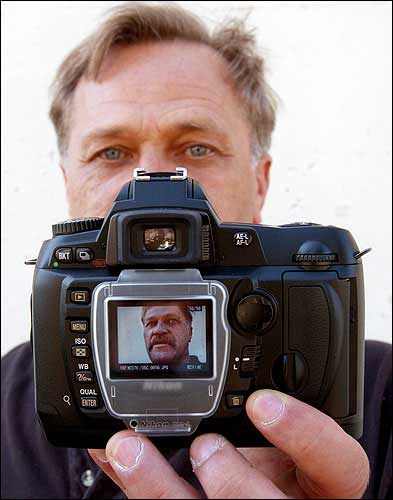
Tom Tworek, digital tech salesman at a Keeble and Shuchat Photography store, looks at the new Nikon D70. He recently showed off the camera at his store in Palo Alto, Calif.
But the D70 isn’t for everyone.
Although anyone can turn it on and take beautiful photos, the uninitiated might get lost in advanced features and pull-down menus. The camera has three scroll wheels and 12 buttons, not including the shutter button.
If you enjoy using the back-panel display on point-and-shoots, the SLR’s viewfinder seem small and awkward. The D70 lets you magnify, crop and edit from the back panel, but you can’t see the photo until after you shoot it.
Downloading 256 MB of high-resolution JPEG images with the built-in USB 1.1 connection takes a long time — at least 5 minutes before photos are copied to your hard drive. Better to remove the CompactFlash card (not included) and use a separate card reader if you have one.
Although in many ways the D70 is worth its price, $1,300 gives me pause: Would I take it on a whale-watching trip, where it could get wet? Or to a South American jungle trek, where it could get stolen or dropped?
The D70’s biggest challenges, compared to point-and-shoots, are bulk and weight.