

Army desertion case is four decades in making
Washington ? The Army’s desertion case against Charles R. Jenkins seems to hinge on four notes he left behind that cold morning on Jan. 5, 1965, when he disappeared while on patrol in a wooded no man’s land.
“I am going to North Korea,” he wrote in one of the notes, this one to his mother.
The Army says Jenkins deserted inside the Demilitarized Zone separating North and South Korea. Doubters have wondered if the sergeant, just a few weeks shy of his 25th birthday, was kidnapped.
Some clues — but no clear answers — to this strange case rooted in the Cold War are found in dozens of pages of Army records on Jenkins. The material was released at the request of The Associated Press after the Pentagon disclosed in January 1996 that he and three other former U.S. soldiers were still alive inside North Korea.
Largely ignored for years, the case has risen to the level of a diplomatic crisis today.
The government in Tokyo is trying to reunite Jenkins, 64, with his Japanese wife, who is now free after being kidnapped by North Korea 26 years ago. Washington has threatened to arrest Jenkins if he comes to Japan.
Among the documents is an intelligence message to the Army’s top general saying Jenkins “apparently defected.” This message was shared with the CIA three days after Jenkins’ disappearance.
It also says a search of Army counterintelligence records yielded no evidence that Jenkins might be a communist agent.
The same document says Jenkins left behind four notes “indicating that he did not intend to return.” One of the notes was addressed to his mother, Pattie, allegedly saying, “I am going to North Korea.”
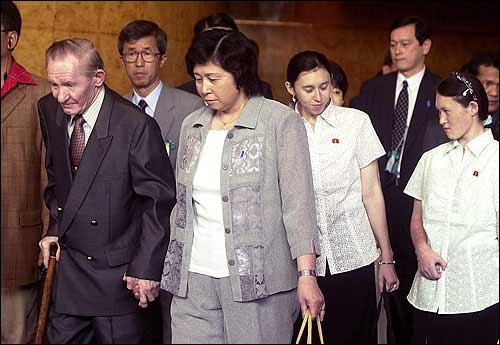
Accused U.S. Army deserter Charles Jenkins, left, his Japanese wife, Hitomi Soga, center, and their daughters, Mika, third from right, and Belinda, right, walk together in a lobby at the Intercontinental Midplaza Hotel before their departure. Jenkins and his family traveled Sunday to Japan for his medical treatment.
On the basis of that statement, and little else that is apparent from the available personnel records, the Army concluded within weeks of his disappearance that Jenkins was a deserter and in violation of Article 85 of the Uniform Code of Military Justice.
If convicted of desertion, Jenkins could face life in prison. Desertion is punishable by death only in time of war. The last time a soldier was put to death for desertion was in 1945.
Jenkins had a spotless record after joining the Army in 1955 at age 15, lying about his age. In November 1961, shortly after completing his first tour of duty in Korea, Jenkins was given a Good Conduct Award for “exemplary behavior, efficiency and fidelity.” He had a three-year tour in Europe before returning to South Korea for a second tour there.
The Pentagon has said little about Jenkins over the years.
In 1996, however, Pentagon official In Sung Lee told Congress that a North Korean defector had said he met Jenkins in a coffee shop in Pyongyang and that Jenkins had told him he was “ready to return to America.”
For years after that, Pentagon officials repeatedly asked North Korea for permission to talk to Jenkins and the three other known former American soldiers living in the communist country. The North Korean government has refused.
| Tokyo (AP) — American Charles Jenkins, accused of deserting the U.S. Army to defect to North Korea, said Saturday he was prepared to travel for his family’s sake to Japan, where U.S. officials await to detain him.The American ambassador in Tokyo, however, indicated Washington wouldn’t seek his immediate custody, but would allow doctors to treat Jenkins, 64, who had been living for decades in North Korea.Ambassador Howard Baker said there were no “immediate” plans for U.S. officials to seek out Jenkins when he arrives today to be taken immediately to a Tokyo hospital, accompanied by his Japanese wife and their two children.Jenkins is reportedly suffering abdominal problems after surgery in North Korea and may undergo another operation in Japan. |